August 05, 2025
Last Updated: August 05, 2025
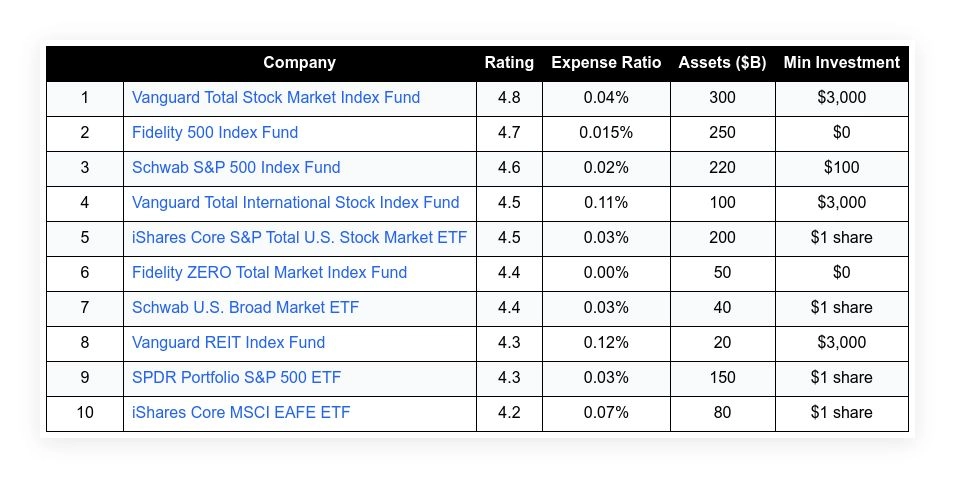
This article presents a ranked list of index funds that investors might consider for their retirement goals. The list is created to help guide readers who want stable, long-term investment options. Background data and market performance have informed this ranking. Each fund has been reviewed with a focus on delivering steady returns, low costs, and ease of access for everyday investors. The selection criteria include:
- Expense Ratio
- Assets Under Management
- Minimum Investment Requirement
- Historical Performance
- Investor Accessibility
Each criteria provides key insight into the fund’s long-term stability and overall suitability for retirement portfolios.
Picking the funds is only half the problem — how you draw them down once you retire matters just as much, and the old rule of thumb is under real pressure. See why the 4% rule is showing its age, and what smarter withdrawal strategies look like for 2026.
15 Best Index Funds for Retirement
Vanguard Total Stock Market Index Fund
Vanguard Total Stock Market Index Fund offers broad market exposure. The fund covers nearly the entire U.S. stock market. Investors experience low operating costs and consistent performance. It has been favored among those building a long-term retirement portfolio. The fund benefits from diversified holdings and a proven track record. Its performance highlights stability in both bull and bear markets. The ratings reflect positive reviews from many users. The returns have been steady, making it appealing for risk-conscious investors. Its low expense ratio and impressive asset base add to its overall strength. The fund is designed to grow capital over time with modest initiation costs and prudent investment strategy.
Expense Ratio: 0.04%
Asset Growth: Strong
Performance: Consistent
Accessibility: High
Management: Time-tested
| Summary of Online Reviews |
|---|
| Users describe the fund as dependable and cost-efficient for long-term growth. |
Fidelity 500 Index Fund

Fidelity 500 Index Fund tracks a major market index and delivers exposure to leading U.S. companies. It has been noted for its low fees and solid market performance. The fund attracts investors looking for simplicity and steady returns. Its availability with no minimum investment requirement allows flexibility for new and seasoned investors alike. The fund has demonstrated reliable performance over multiple market cycles. Its diverse portfolio includes large-cap companies that help manage market fluctuations. Fidelity has a history of transparency and investor-friendly practices. The ease of investment makes it a popular option among retirement savers seeking both growth and stability.
Expense Ratio: 0.015%
Asset Growth: High
Performance: Steady
Accessibility: Excellent
Management: Investor-focused
| Summary of Online Reviews |
|---|
| Investors highlight the fund as accessible with consistent returns over time. |
Schwab S&P 500 Index Fund
Schwab S&P 500 Index Fund is a favored option among investors seeking exposure to large-cap U.S. companies. Its design offers balanced risk and steady returns. The fund is known for its low operating costs and minimal barriers to investment entry. Reviews describe it as a reliable choice for retirement planning. Its straightforward structure makes it accessible for both beginners and experienced investors. The fund benefits from the reputation of a trusted financial institution. It has maintained stable performance, even in volatile markets. By focusing on core market sectors, the fund supports capital growth and income generation.
Expense Ratio: 0.02%
Asset Growth: Reliable
Performance: Stable
Accessibility: High
Management: Efficient
| Summary of Online Reviews |
|---|
| Users call the fund dependable and appreciate its low costs structure. |
Vanguard Total International Stock Index Fund
Vanguard Total International Stock Index Fund offers exposure to global markets outside the United States. The fund provides investors with a well-diversified portfolio. It targets both developed and emerging markets to protect against regional downturns. This fund is appreciated for its modest fees and clear investment approach. Data shows it has successfully balanced risk while capturing international growth. The structured diversification gives investors a chance to benefit from varied economic trends. It has become a reliable tool for those building retirement portfolios. The fund highlights extensive global reach and efficient cost management. Its clarity in investment strategy benefits long-term asset growth.
Expense Ratio: 0.11%
Asset Growth: Solid
Performance: Steady
Accessibility: Good
Management: Global-focused
| Summary of Online Reviews |
|---|
| Investors remark on its broad reach and cost efficiency in global markets. |
iShares Core S&P Total U.S. Stock Market ETF
This ETF offers a broad exposure to the overall U.S. stock market. It is designed for investors seeking simplicity and liquidity. The fund has demonstrated steady performance with minimal fees. Many investors value its high liquidity and transparent structure. The tradeable nature of the ETF makes it flexible for retirement strategies. It has grown in assets while keeping operational costs low. The index tracking has shown consistency. Its wide market coverage supports long-term capital gains. Users appreciate the clarity in its cost structure and efficient management.
Expense Ratio: 0.03%
Asset Growth: High
Performance: Consistent
Accessibility: Very High
Management: Transparent
| Summary of Online Reviews |
|---|
| Clients praise its liquidity and note its transparent fee structure. |
Fidelity ZERO Total Market Index Fund

Fidelity ZERO Total Market Index Fund is designed with no expense fees. It offers exposure to the full U.S. stock market while eliminating typical investment costs. This makes the fund attractive for cost-sensitive retirement plans. Its structure is clear and favors a buy-and-hold strategy. The fund attracts both new and experienced investors who value a zero-fee approach. Its performance remains competitive with other low-cost funds. The investment style focuses on steady market returns and low entry barriers. Data indicates it has grown its asset base efficiently. Its simplicity and cost efficiency set it apart in a competitive market.
Expense Ratio: 0.00%
Asset Growth: Moderate
Performance: Competitive
Accessibility: Excellent
Management: Cost-focused
| Summary of Online Reviews |
|---|
| Investors call the fund extremely cost-effective with satisfactory market returns. |
Schwab U.S. Broad Market ETF
Schwab U.S. Broad Market ETF offers a straightforward path to investing in a wide range of U.S. companies. The ETF format makes it easy to trade. It has a low fee structure and appealing cost benefits. Investors praise the fund for its simple approach towards long-term growth. It displays steady performance and contains a broad market mix. The flexibility of purchasing single shares suits investors with varying capital sizes. Its performance in different market conditions has been steady. The fund is structured to support both growth and income generation over time.
Expense Ratio: 0.03%
Asset Growth: Steady
Performance: Reliable
Accessibility: High
Management: Simplified
| Summary of Online Reviews |
|---|
| The ETF is described as user-friendly and cost-effective by many investors. |
Vanguard REIT Index Fund
Vanguard REIT Index Fund provides exposure to real estate investment trusts. The fund offers diversification into property markets without directly owning property. It is known for its competitive fee structure and steady performance in the real estate segment. Many investors include this fund for income generation and a hedge against inflation. The fund has maintained attractive performance, backed by a wide mix of REITs. Its focus on long-term value has gained the attention of retirement savers. It is designed to capture income as well as asset appreciation. The fund remains a popular choice for those seeking balance in their retirement portfolios.
Expense Ratio: 0.12%
Asset Growth: Modest
Performance: Steady
Accessibility: Good
Management: Market-sensitive
| Summary of Online Reviews |
|---|
| Reviews mention the fund as stable with a focus on regular income. |
SPDR Portfolio S&P 500 ETF
SPDR Portfolio S&P 500 ETF offers an efficient way to track a well-known market index. The fund is structured to provide steady exposure to top U.S. companies. It benefits from low fee investment strategies and easy tradability. Investors value the fund for its simplicity and competitive fee structure. Its asset base has grown over time thanks to consistent market tracking. The ETF is set up to serve retirement investors seeking a balance between growth and stability. Its low minimum investment by share purchase increases its accessibility. The consistent performance and focus on core companies make it a reliable investment option.
Expense Ratio: 0.03%
Asset Growth: Strong
Performance: Steady
Accessibility: High
Management: Index-focused
| Summary of Online Reviews |
|---|
| Investors note the ETF is efficient and commonly appreciated for its straightforward access to the S&P 500. |
iShares Core MSCI EAFE ETF
iShares Core MSCI EAFE ETF provides exposure to developed markets outside the United States. The ETF is designed to offer steady international diversification. It strikes a balance between performance and cost control. The fund has been noted for its clear investment approach and efficient tracking. Investors find the ETF useful for smoothing out portfolio volatility that can arise from domestic market changes. Its allocation across major markets helps in mitigating risk while accessing growth overseas. The ease of trading and competitive expense ratio make it suitable for retirement planning. Its performance record supports its long-term viability.
Expense Ratio: 0.07%
Asset Growth: Moderate
Performance: Steady
Accessibility: Good
Management: International-focused
| Summary of Online Reviews |
|---|
| Users mention the ETF as balanced and value its international reach and clarity. |
Vanguard Total Bond Market Index Fund
Every fund above holds stocks, which is exactly what you want early on. Closer to retirement, bonds are what keep a bad year from derailing your timeline. Vanguard Total Bond Market Index Fund covers a broad cross-section of U.S. investment-grade bonds in a single low-cost holding, which makes it a common default for the fixed-income slice of a retirement portfolio.
Fidelity U.S. Bond Index Fund

Fidelity U.S. Bond Index Fund gives exposure to both government and corporate bonds, with a low expense ratio and no minimum that would keep smaller accounts out. If your brokerage is already Fidelity, this is usually the simplest way to add bond exposure without moving money between providers.
Schwab U.S. Aggregate Bond ETF
Schwab U.S. Aggregate Bond ETF bundles U.S. government and corporate bonds into an ETF wrapper at one of the lowest expense ratios available. The ETF structure means you can buy it in any brokerage account, not just a Schwab one, which makes it the most portable of the three bond options here.
Vanguard FTSE All-World ex-US Index Fund
Vanguard FTSE All-World ex-US Index Fund covers developed and emerging markets outside the United States. U.S. and international markets do not move in lockstep, so holding both smooths returns over a multi-decade retirement horizon rather than betting the whole portfolio on one economy.
Fidelity Extended Market Index Fund

Fidelity Extended Market Index Fund holds mid- and small-cap U.S. companies, the part of the market that S and P 500 funds leave out. Pairing it with a 500 index fund gets you close to total-market coverage, and smaller companies have historically carried more growth potential in exchange for more volatility.
Final Thoughts
The rankings reveal a variety of choices for retirement planning — and for an even broader comparison, see our guide to the top 15 low-cost index funds for retirement. Investors may choose based on expense ratios, asset sizes, and ease of access. Each fund offers stable performance with low costs and a clear investment approach. The evaluations highlight that a broad market exposure is vital. The selection appeals to those seeking straightforward options with steady growth. Readers should review the criteria and decide which fund meets their goals. The funds listed are well-regarded for balancing growth and risk in long-term portfolios.

How to Choose the Best Index Funds for Retirement (2026)
Picking the best index funds for retirement is less about chasing last year’s winners and more about owning broad, low-cost exposure to the market and leaving it alone for decades. An index fund simply tracks a basket of securities, such as the largest U.S. companies or the entire stock market, so your returns mirror the market rather than depending on a manager’s stock picks. Because there is no expensive active management, the fees are typically very low, and over a long retirement horizon those savings compound into a meaningful difference.
Compare expense ratios first
The single most controllable factor in long-term returns is cost. A fund’s expense ratio is the annual percentage you pay to own it, and lower is almost always better when two funds track the same index. Providers like Vanguard, Fidelity, and Schwab are known for rock-bottom expense ratios on their core index funds. Even a fraction of a percent saved each year can add up to a large sum across a multi-decade career, which is exactly why disciplined investors who built a sizable portfolio using index funds tend to favor the cheapest options.
Match the fund to your time horizon
The further you are from retirement, the more comfortable you can usually be with stock-heavy funds. A core S&P 500 fund or a total-stock-market fund gives you wide diversification in a single holding, and many investors believe broad U.S. equity exposure is hard to beat over the long run, as we explain in our look at why investing in S&P 500 index funds rewards patience. As you near retirement, adding a total-bond-market index fund can cushion volatility. Target-date index funds automate this glide path for you, shifting from stocks to bonds as your retirement year approaches.
Which Account Should Hold These Funds?
Picking the funds is only half the decision — where you hold them determines how much of the return you keep. Index funds are tax-efficient enough to sit comfortably in a taxable account, but the highest-growth holdings generally belong somewhere the gains escape tax entirely. Brokerage account vs Roth IRA covers that split, including why the Roth limit is use-it-or-lose-it each year while brokerage capacity is unlimited.
If you are choosing between a workplace plan and an IRA for these funds, IRA vs 401(k) compares the contribution limits, fund menus, and costs.
Key Takeaways
- The best index funds for retirement are broadly diversified and carry very low expense ratios.
- Core building blocks include an S&P 500 or total-stock-market fund, a total-bond-market fund, and optionally an international fund.
- Hold your funds inside a tax-advantaged account such as a 401(k) or IRA to keep more of your gains.
- Consistency matters more than timing: automatic contributions and decades of compounding do the heavy lifting.
Where you hold these funds matters as much as which ones you choose. Opening the right account first can make your contributions far more tax-efficient, so consider learning how to open a Roth IRA before you invest. If you want a deeper list of specific low-fee options, our companion guide to low-cost index funds for retirement goes further, and it is wise to also plan ahead to protect your retirement savings from inflation.
Frequently Asked Questions
What are the best index funds for retirement?
For most people, a low-cost S&P 500 index fund or a total-stock-market index fund forms the core, paired with a total-bond-market fund as retirement nears. The “best” choice is the one with broad diversification and the lowest expense ratio available in your account, since funds tracking the same index produce very similar returns.
How many index funds do I need for retirement?
You can build a complete retirement portfolio with as few as one to three funds: a total-stock-market or S&P 500 fund, a total-bond-market fund, and optionally an international stock fund. A single target-date index fund can even do all of this in one holding, automatically adjusting over time.
Are index funds safe for retirement?
Index funds carry market risk, so their value rises and falls, but broad diversification spreads that risk across hundreds or thousands of companies rather than a few stocks. Over long periods, diversified index funds have historically been a reliable core for retirement savers. For unbiased basics, review the guidance at Investor.gov from the SEC, or the index fund overview on Investopedia.
Related Reading
For a famously simple way to put index funds to work in retirement, see the Warren Buffett 90/10 rule.
Related Reading: New to the market? Learn how to get good investment returns as a beginner.
Related Reading: Need a great checking and savings home base? See the best banks for millennials.
Related Reading: New to investing? Start by understanding the types of investment accounts and which to open first.
Related Reading: Hold your index funds in the right account. Compare the 3 types of IRAs to maximize tax-advantaged growth.
Related Reading: Choosing what to hold in your account? See the best Roth IRA investments to buy and what to skip.
Related Reading: Compare the top high-return investments for retirement.
Related Reading: Let your savings snowball with the best compound interest investments for retirement.
Related Reading: Build a low-cost core with the best ETFs for retirement.
Related Reading
Once you have chosen your funds, decide how to draw them down. A flexible retirement withdrawal strategy can help your savings last longer than the rigid 4% rule.
Related Reading: Want your portfolio to pay you monthly? Learn how to make $5,000 a month in dividend income.
Related Reading: Want tax-free growth too? Explore the best Roth IRA investments for long-term wealth.
Related Reading: Prefer single stocks to funds? Understand the risks behind a name like NVIDIA stock before you buy.
Related Reading: Tune out the hype and stay diversified — Templeton explains why believing this time it’s different is so costly.