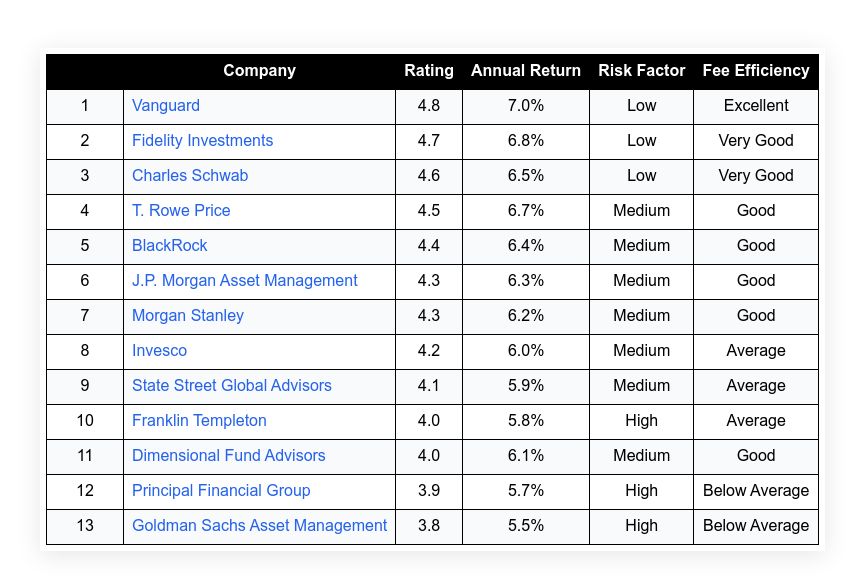
This article presents a ranked list of 13 investment options that have delivered strong returns for retirement portfolios. The review is based on data and performance metrics known to benefit long-term investors. The list is aimed at investors seeking options with attractive historical growth, competitive costs, and manageable risk levels. The evaluation considers several factors that are key to a successful retirement plan. The criteria used in deciding the ranking include:
- Historical Return Performance
- Risk Levels
- Fee Structure Efficiency
- Management Quality
- Market Reputation
Top 13 High-Return Investments For Retirement
Vanguard
Vanguard is a well-known investment management firm that has built its reputation on low-cost index funds and strong historical returns. The company offers a range of retirement investment options and emphasizes lower fees that contribute to enhanced net returns over time. Its funds often appeal to investors who favor long-term growth and simplicity. Vanguard’s disciplined approach and extensive product line make it a preferred choice for retirement planning. The firm continually supports customer portfolios with steady, data-supported decisions that benefit retirement savings.
Historical Return: 7.0%
Risk Level: Low
Fee Structure: Low Cost
Management Quality: High
Customer Reputation: Excellent
| Summary of Online Reviews |
|---|
| Users state it is cost-effective and reliable for steady growth. |
Fidelity Investments

Fidelity Investments is recognized for its robust retirement planning tools and diversified investment options. Its emphasis on active management and innovative research delivers consistent returns. The firm offers guidance backed by data and provides tools aimed at helping investors manage risk while benefiting from competitive performance. Fidelity supports a broad client base with a wide range of funds and advisory services designed to enhance the retirement portfolio over time.
Historical Return: 6.8%
Risk Level: Low
Fee Structure: Competitive
Management Quality: High
Customer Reputation: Very Good
| Summary of Online Reviews |
|---|
| Clients mention it has wide-ranging resources and solid guidance. |
Charles Schwab

Charles Schwab is favored among retirement investors for its emphasis on transparent fee structures and resourceful planning tools. The firm has a strong track record of offering accessible investment options that suit a variety of goals. Schwab provides thorough market research which supports strong growth for retirement funds. Its low-cost funds are frequently highlighted as a primary reason for its steady performance.
Historical Return: 6.5%
Risk Level: Low
Fee Structure: Transparent
Management Quality: High
Customer Reputation: Very Good
| Summary of Online Reviews |
|---|
| Customers find it user-friendly with reliable support. |
T. Rowe Price

T. Rowe Price has earned respect for its balanced investment strategies that merge growth with prudent risk management. The firm offers diversified mutual funds that have shown steady historical growth. Its research-driven approach backs the performance of its retirement investment products. Many investors appreciate the clarity in risk assessment and detailed performance updates provided by the firm.
Historical Return: 6.7%
Risk Level: Medium
Fee Structure: Reasonable
Management Quality: High
Customer Reputation: Good
| Summary of Online Reviews |
|---|
| Reviewers note its steady performance and calculated risk approach. |
BlackRock
BlackRock provides a wide selection of funds with a focus on sustainable investment practices and long-term growth. The firm leverages extensive market data to support investment decisions. Investors find comfort in its diversified funds and extensive risk analytics. This approach often results in investments that are well-suited for retirement growth while managing exposure.
Historical Return: 6.4%
Risk Level: Medium
Fee Structure: Balanced
Management Quality: High
Customer Reputation: Good
| Summary of Online Reviews |
|---|
| Feedback highlights its analytical rigor and consistent service. |
J.P. Morgan Asset Management
J.P. Morgan Asset Management combines extensive financial expertise with modern portfolio strategies. The firm is known for its analytical approach and focus on creating balanced portfolios. Its retirement offerings emphasize mitigating risk while taking advantage of market trends. The systematic data review supports decisions that have helped many investors achieve reliable returns.
Historical Return: 6.3%
Risk Level: Medium
Fee Structure: Competitive
Management Quality: Very Good
Customer Reputation: Good
| Summary of Online Reviews |
|---|
| Investors remark its service as data-driven and efficient. |
Morgan Stanley
Morgan Stanley offers services that equip retirement investors with well-calibrated investment options. The company uses market research and client feedback to maintain a strong performance record. Its balanced portfolio options are geared toward balancing growth with risk control. Many investors favor the firm for its clear planning processes and data-supported strategies.
Historical Return: 6.2%
Risk Level: Medium
Fee Structure: Transparent
Management Quality: High
Customer Reputation: Good
| Summary of Online Reviews |
|---|
| Reviews mention its approach as clear and reliable in planning. |
Invesco

Invesco is noted for offering a wide range of funds suitable for long-term investment growth. The company remains dedicated to data-backed research and a market-focused strategy. Its investment offerings often support diverse retirement plans, and its fee structure is designed to maximize net returns for investors. Invesco’s services are structured for customers who favor a balanced approach between risk and reward.
Historical Return: 6.0%
Risk Level: Medium
Fee Structure: Moderate
Management Quality: Good
Customer Reputation: Average
| Summary of Online Reviews |
|---|
| Clients report it is consistent and fair in performance. |
State Street Global Advisors
State Street Global Advisors provides investment solutions known for their balanced risk and steady performance. The firm focuses on tailored products that suit large portfolios and retirement needs. Its systematic research and deep market insight help support investors with clear strategies for long-term growth. Many reviews indicate the company manages to keep risk in check without sacrificing return potential.
Historical Return: 5.9%
Risk Level: Medium
Fee Structure: Stable
Management Quality: Good
Customer Reputation: Average
| Summary of Online Reviews |
|---|
| Users feel it is steady in performance with controlled risk. |
Franklin Templeton
Franklin Templeton is known for its active fund management and tailored retirement funds. The firm presents a mix of growth strategies that sometimes carry higher risk. Its funds are suited for investors who do not mind a higher risk factor in exchange for the possibility of increased gains. The detailed market analysis supports the products, and many investors appreciate the clarity of its investment approach.
Historical Return: 5.8%
Risk Level: High
Fee Structure: Standard
Management Quality: Good
Customer Reputation: Average
| Summary of Online Reviews |
|---|
| Investors describe it as strategically aggressive with clear market insights. |
Dimensional Fund Advisors
Dimensional Fund Advisors offers investment options designed for long-term retirement growth. The firm uses academic research to guide its fund management. Its focus on evidence-based strategies appeals to investors who seek measured risk paired with competitive returns. The clear performance metrics and low fee levels add to its attractiveness as an option for retirement plans.
Historical Return: 6.1%
Risk Level: Medium
Fee Structure: Low Cost
Management Quality: High
Customer Reputation: Good
| Summary of Online Reviews |
|---|
| Feedback highlights its approach as evidence-based and transparent. |
Principal Financial Group
Principal Financial Group provides a variety of retirement investment products aimed at long-term portfolio growth. The firm offers solutions that balance risk with moderate return expectations. It is noted for its practical advisory approach and its efforts to tailor strategies to individual needs. Many investors appreciate the clear cost structures and steady performance figures presented over time.
Historical Return: 5.7%
Risk Level: High
Fee Structure: Standard
Management Quality: Good
Customer Reputation: Fair
| Summary of Online Reviews |
|---|
| Users report its service as steady with clear investment explanations. |
Goldman Sachs Asset Management
Goldman Sachs Asset Management delivers investment services that target long-term growth through targeted market strategies. The firm focuses on providing structured investment products backed by deep market reviews. Its retirement funds are built with a focus on controlled risk and the potential for moderate returns. Many investors value the data-supported methods that back its recommendations and overall approach.
Historical Return: 5.5%
Risk Level: High
Fee Structure: Premium
Management Quality: High
Customer Reputation: Fair
| Summary of Online Reviews |
|---|
| Clients mention the service as data-focused with clear market insights. |
Final Thoughts
The ranking reflects a careful look at investment solutions that have consistently produced notable returns over time. Investors seeking to strengthen their retirement portfolios can compare risk, fee structures, and historical performance across options. Each firm has its own strengths; some prioritize low costs and steady growth, while others offer robust research and active management. This guide helps in identifying an option suitable for varying comfort levels with market fluctuations. Careful evaluation against clear criteria may lead investors to a choice that fits their retirement goals and financial vision.
Related Reading: Add real-estate income to your plan with the best REIT ETFs for retirement.
Related Reading: Prefer dividend income to capital gains? See the best Vanguard dividend ETFs to fund your retirement.

How to Choose High-Return Investments for Retirement
Chasing the highest possible return is rarely the right goal on its own. Investors who build lasting retirement wealth focus on the combination of return, risk, cost, and time horizon. A fund that posts spectacular gains in one year but swings wildly can be far harder to live with than a diversified portfolio that compounds steadily for decades. When you weigh high-return investments for retirement, judge each option against your age, your tolerance for volatility, and how soon you will need to draw the money.
Match risk to your time horizon
Generally, the more years you have before retirement, the more short-term volatility you can absorb in exchange for higher expected growth. A worker in their thirties can lean more heavily into stock-based funds, while someone within a few years of retiring usually shifts toward a more balanced mix. Reviewing your allocation as you age helps keep risk aligned with your timeline. For a deeper look at the trade-offs, see our guide to low-cost index funds for retirement.
Keep costs and taxes low
Fees quietly erode returns year after year, so favoring low-expense funds is one of the most reliable ways to keep more of your gains. Tax-advantaged accounts such as a 401(k) or IRA also let your money compound without an annual tax drag. Exchange-traded funds are often more tax-efficient than comparable mutual funds; our roundups of the best ETFs for retirement and REIT ETFs for retirement explain how these fit a long-term plan.
Balancing Growth and Income
A strong retirement portfolio usually blends growth assets with income-producing holdings. Growth investments aim to increase in value over time, while income investments pay regular distributions you can reinvest or spend. As you approach retirement, the income side typically grows in importance so your portfolio can support withdrawals without forcing you to sell during a downturn.
Reinvest for compounding
Reinvesting dividends and interest is one of the most powerful drivers of long-term growth, because each payout buys more shares that then generate their own returns. Investments built around steady payouts pair well with this approach — see our look at compound interest investments for retirement and Vanguard dividend ETFs for examples. For authoritative, unbiased background on building a plan, the U.S. Securities and Exchange Commission’s Investor.gov retirement toolkit is a useful starting point.
Key Takeaways
High returns matter, but only in context. Diversify across several of the firms and fund types in the ranking above rather than betting on a single option, keep your fees and taxes low, and revisit your allocation as your retirement date nears. Over long periods the broad U.S. stock market has historically delivered solid average annual growth, but past performance never guarantees future results, so size each position to a level of risk you can hold through good markets and bad. For a primer on the fundamentals, Investopedia’s overview of retirement planning is a helpful reference.
Frequently Asked Questions
What are the best high-return investments for retirement?
For most people, broadly diversified, low-cost stock funds — index funds and ETFs from firms like the ones ranked above — offer the best balance of long-term growth and manageable risk. Adding dividend funds, REIT ETFs, and bonds helps smooth returns as you get closer to retirement.
How much risk should I take for higher returns?
Take only as much risk as your time horizon and temperament allow. Younger investors can generally hold more stock-heavy, higher-growth investments because they have time to recover from downturns, while those near retirement usually dial back risk to protect the savings they will soon need.
Are high-return investments safe for retirement savings?
Higher expected returns almost always come with higher volatility, so no high-return investment is fully safe. You can manage the risk by diversifying across asset types, keeping costs low, holding for the long term, and maintaining a cash cushion so you are never forced to sell investments at a bad time.
Related Reading: Prefer to protect capital while you earn? See the top defensive ETFs for retirement.
Related Reading: Prefer broad, low-cost exposure? See the top total market ETFs for retirement.
Related Reading: Prefer a hands-on approach? See our guide to trading stocks in retirement.
Related Reading: Complement your portfolio with these steady income streams in retirement.
Related Reading: Want a lower-volatility complement to growth holdings? See how gold works as an inflation hedge.

How to Choose High-Return Investments for Retirement
High-return investments for retirement can accelerate your savings, but higher potential returns almost always come with higher risk. The goal is not to chase the single biggest number, but to capture strong long-term growth while keeping enough stability that a market downturn near retirement does not derail your plan. That means understanding your time horizon, diversifying across asset types, and matching the aggressiveness of your portfolio to how many years you have before you will need the money.
Weigh return against risk
Every investment sits somewhere on a spectrum of risk and reward. Growth-oriented stock funds and sector plays offer the highest long-run potential but swing the most in value, while dividend funds and real estate income sit a notch lower, and bonds or CDs anchor the conservative end. Building your core with broad, low-cost holdings such as the best ETFs for retirement and proven index funds for retirement captures market growth efficiently, while REIT ETFs and dividend ETFs add income alongside appreciation.
Diversify and protect your timeline
No single asset should carry your whole retirement. Spreading money across stocks, real estate, and income investments smooths out the ride, and reinvesting earnings into compound interest investments for retirement lets time do much of the work. As you approach your target date, gradually shifting toward steadier long-term investments for retirement and taking steps to protect your savings from inflation helps lock in gains while preserving growth.
Key Takeaways
- High-return investments for retirement boost growth potential but carry more risk, so match them to your time horizon.
- Diversify across stock funds, REITs, and dividend payers rather than concentrating in one high-flyer.
- Reinvesting earnings harnesses compounding, the biggest driver of long-term wealth.
- Shift toward steadier assets and inflation protection as retirement approaches.
Frequently Asked Questions
What investment has the highest return for retirement?
Historically, broad stock market funds have produced the highest long-term returns among common retirement investments, outpacing bonds and cash over multi-decade periods. The trade-off is greater short-term volatility. Most savers capture that growth through low-cost index funds or ETFs rather than betting on individual stocks, which spreads risk while still aiming for strong returns.
How much risk should I take in retirement?
Your risk level should reflect your time horizon, income needs, and comfort with volatility. Younger savers can generally hold more in growth assets, while those near or in retirement often shift toward income and stability to protect against a poorly timed downturn. For the fundamentals of balancing risk and reward, see the SEC’s investing basics.
Are high-return investments safe for retirement?
No investment offering high returns is truly safe; higher potential reward inherently means more risk. The practical approach is to combine higher-return assets with steadier ones so your overall portfolio can grow without exposing you to catastrophic loss. Investopedia explains this balance in its overview of the risk-return tradeoff.