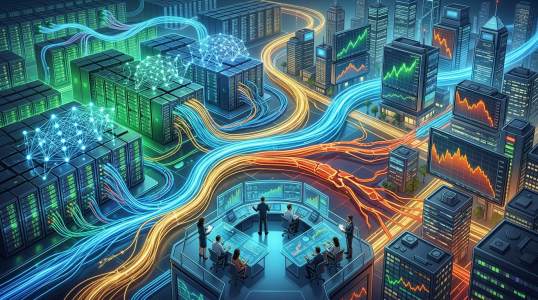
A sharp overnight market reversal showed how quickly investors can move from fear to relief. Technology shares initially fell as a Democratic electoral sweep appeared more likely. Within hours, however, the market recovered. The rebound suggests investors may fear uncertainty more than regulation itself. Yet a harder question remains: Can the artificial intelligence trade withstand strong political opposition to new data centers?
Table of Contents
ToggleAn Overnight Reversal in Technology Stocks
The first market reaction was severe. As the blue wave became apparent, investors sold technology shares and other risk-sensitive assets.
The Nasdaq was down about 2.5% around midnight. That is a large move for a major index, especially during overnight trading. It reflected an immediate effort to price in a new political outlook.
Then the direction changed. During the early morning hours, buyers returned, and technology shares recovered much of the decline. Several AI-related companies were positioned to open higher.
“The market loves clarity.”
That sentence helps explain the reversal. Markets do not always rise because investors approve of a policy. They can rise because investors believe they understand what comes next.
As CEO of LifeGoal Wealth Advisors, a Certified Investment Management Analyst, and a Certified Financial Planner, I study these shifts through the lens of expectations. Prices often move before a policy has taken effect. Investors trade their estimate of future earnings, costs, and risks.
The overnight decline showed the first layer of concern. The recovery revealed a second layer of analysis.
View this post on Instagram
Why a Blue Wave Matters for AI
A blue wave refers to broad Democratic electoral gains. For the AI sector, that result can create concerns about regulation, energy use, land development, and local control.
Artificial intelligence depends on physical infrastructure. Large models require data centers filled with advanced computing equipment. Those sites also need electricity, cooling systems, network connections, and enough land for construction.
Democratic candidates had campaigned against some forms of data center development. The opposition reflected concerns about power demand, water use, noise, land use, and the effect on nearby communities.
That political resistance is not a minor issue for AI companies. A model may exist as software, but training and operating it require major physical capacity. If data centers face longer approvals, higher costs, or construction limits, the economics of AI could change.
Elon Musk’s reported decision to direct $150 million into a Republican campaign effort in Texas illustrated the stakes. The spending was tied to opposition against policies that could restrict data center growth. Such a large political commitment suggests industry leaders view infrastructure policy as a major business risk.
The immediate concerns can be grouped into four areas:
- Permitting delays could slow the construction of new data centers.
- Higher energy requirements could attract more regulatory review.
- Local resistance could limit suitable sites near power and network systems.
- New rules could increase costs for technology companies and their partners.
These risks help explain why the Nasdaq sold off as the election result became clearer. Investors initially assumed that stronger Democratic control could mean a harder operating environment for AI infrastructure.
Why Investors Bought the Decline
The recovery may look illogical at first. If the election result created greater risk for AI, why would AI-related stocks rebound only hours later?
The answer is that uncertainty and bad news are not the same thing. Investors can adjust to stricter rules if those rules are clear, stable, and applied in a predictable way.
Large technology companies have spent decades operating under changing tax policies, privacy laws, labor rules, and environmental standards. They often respond by changing where they invest, how they structure projects, and which partners they use.
Investors appear to be betting that the largest AI companies can do the same here. Once management teams know the new requirements, they can revise their plans.
A company might move a proposed facility to another region. It could negotiate a different energy agreement, invest in more efficient cooling, or redesign a project to meet local standards. It may also spend more on legal work and public outreach.
None of those responses are free. They can raise costs and delay revenue. Still, the market may view them as manageable for companies with strong cash flow and access to capital.
This leads to an important distinction. Regulation can reduce expected profits without destroying an investment case. If investors had feared a less predictable outcome, a clearer policy path may still support higher prices.
Not Every AI Company Faces the Same Risk
The phrase “AI trade” can make the sector sound like one unified investment. It is not. Different companies have different exposure to data center restrictions.
SpaceX, CoreWeave, and Oracle were among the names identified as exceptions to the broader morning strength. Each business has its own financial structure, customer base, capital needs, and relationship with physical infrastructure.
Some companies directly own or operate large computing sites. Others rent capacity from outside providers. Chip designers may benefit from AI demand without managing every local construction issue. Software businesses can face indirect effects if computing costs rise.
Investors should therefore avoid treating every AI-linked stock the same. A policy that hurts one business may have a limited effect on another.
Useful questions include:
- Does the company own data centers or rely on outside providers?
- How much new capacity does its growth plan require?
- Can it pass higher computing costs to customers?
- Does it have enough cash to absorb delays and added expenses?
- How dependent is it on one state, power market, or permit process?
These questions matter because large firms may adapt more easily than smaller competitors. A company with deep resources can hire specialists, secure power years in advance, and develop sites in several regions.
A smaller business may have fewer choices. One delayed project or expensive energy contract could place more pressure on its finances.
The Market’s Bet on Corporate Adaptation
The rebound reflects a familiar market belief: Large companies will adapt once they know the rules.
History offers support for that view. Major businesses frequently revise operations after elections and regulatory changes. They build new compliance systems, alter spending plans, and shift investment to more favorable areas.
However, past adaptation does not guarantee the same result for AI. The sector’s demand for electricity and computing capacity may create constraints that paperwork alone cannot solve.
Data center construction depends on power generation, transmission lines, skilled workers, specialized chips, cooling equipment, and local approval. If several of those resources are limited at once, adjusting may take years rather than months.
Political resistance may also differ from standard business regulation. Community concerns can be emotional and immediate. Residents may worry about utility bills, water supplies, noise, or changes to nearby land.
Those concerns can place elected officials under pressure. Even a company willing to spend more may struggle if voters outright oppose a project.
The Central Risk Facing the AI Trade
My main question is not whether large technology companies can follow new rules. Most can. The bigger issue is whether public opposition will limit how much infrastructure can be built.
“Can the AI trade sustain itself against the visceral Democratic opposition to data center development?”
AI valuations often assume strong future growth. That growth requires more customers, more computing capacity, and continued investment. If infrastructure expansion slows, earnings may miss high expectations.
This does not mean the AI trade must collapse. It means investors should examine the gap between expected demand and available capacity.
Higher computing costs could even help some established businesses. If new competitors cannot secure enough capacity, large firms with existing data centers may gain an advantage. Scarcity can protect incumbents while hurting smaller entrants.
At the same time, higher costs could reduce the number of profitable AI services. Companies may discover that some tools cost more to operate than customers are willing to pay.
The political debate may therefore affect both sides of the market. It could restrict supply while also testing whether AI demand can support higher prices.
How Investors Should Read Sharp Reversals
Overnight trading can produce dramatic moves because fewer shares are changing hands. Prices may react sharply to headlines, election projections, or early policy assumptions.
A 2.5% Nasdaq decline matters, but timing does. Thin trading can magnify both selling and buying. Investors should avoid assuming that the first move offers a final verdict.
The reversal also shows why political news should not be viewed through a simple party-based framework. A result that appears negative for one sector may already be priced in. Investors may also decide that the affected companies can adapt.
Rather than chasing each move, I prefer to watch what the price action says about expectations. In this case, the market first priced in political danger. It then priced in clarity and corporate flexibility.
Both reactions can be reasonable. The initial decline recognized a real policy risk. The recovery recognized that strong businesses often find ways to operate under new limits.
The overnight rebound should not be read as proof that data center concerns have disappeared. It shows that investors currently believe the largest technology companies can respond. Permit decisions, energy policy, construction costs, and corporate earnings will test that belief.
The key lesson is simple: Markets can accept difficult rules more easily than unclear ones. Still, clarity does not remove the economic cost of those rules. Investors should track whether AI companies can build enough capacity, control expenses, and earn adequate returns on their spending.
The AI trade may remain strong, but its next stage will depend on more than software and chips. Power, land, public approval, and political policy will help determine which companies succeed.
Frequently Asked Questions
Q: Why did the Nasdaq recover after falling 2.5%?
Investors initially reacted to the risk of stricter data center policies. They later appeared to decide that clear rules would allow large technology companies to adjust their plans.
Q: How could data center restrictions affect AI stocks?
Restrictions may delay construction, raise energy and compliance costs, or limit computing capacity. The effect will vary based on each company’s resources and infrastructure needs.
Q: Does the rebound mean political risk has passed?
No. The rebound reflects investor expectations, not a final policy outcome. Future permits, energy rules, local opposition, and company earnings will show whether those expectations were justified.
Image Credit: Rafael Minguet Delgado; Pexels