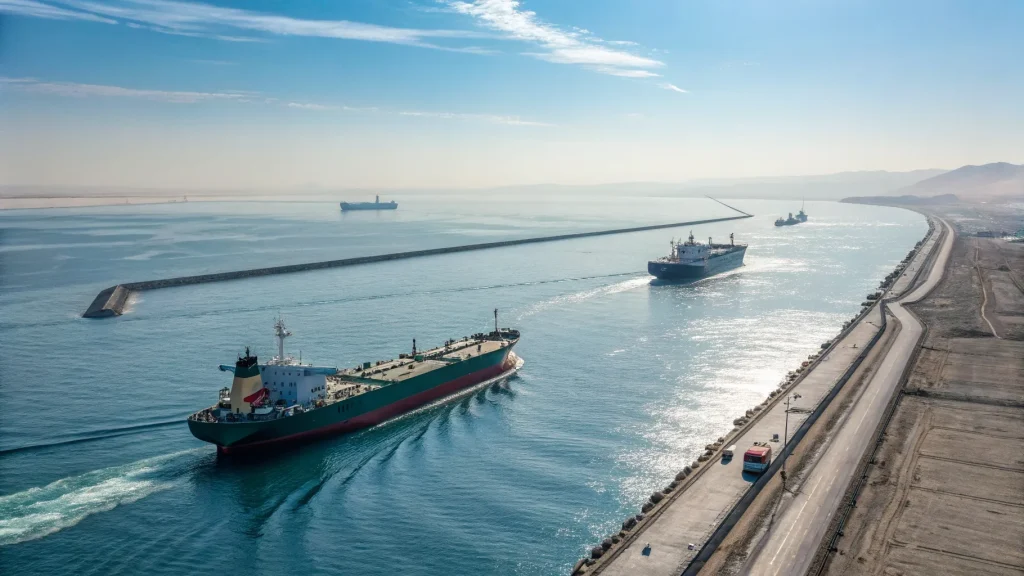
Oil prices jumped as a U.S. naval blockade at the Strait of Hormuz threatened to choke off tanker traffic and risked pulling China into a high-stakes standoff with Washington. The move, centered on the narrow corridor off Iran’s coast, raised alarms across energy markets on Monday as shippers weighed reroutes and importers braced for higher costs.
“The U.S. naval blockade of the Strait of Hormuz threatens to halt more tanker traffic, sending oil surging and risks drawing China into a widening confrontation with Washington.”
The flashpoint affects a waterway that handles a large share of the world’s seaborne crude. Traders and governments rushed to assess how long the disruption could last and what it might mean for inflation, supply chains, and regional security.
Table of Contents
ToggleWhy the Strait Matters
The Strait of Hormuz is only about 21 miles wide at its tightest point, yet it is one of the world’s most important energy lanes. Industry and government estimates have long put its share of global oil flows at around one-fifth. Liquefied natural gas shipments from Qatar also depend on the route.
Any slowdown here hits far and wide. Refiners in Asia buy much of their crude from the Gulf. Europe relies on both crude and products that cross the Strait before heading west. If tankers idle, inventories shrink, and prices rise.
Past flare-ups show the stakes. The “Tanker War” of the late 1980s drew U.S. escorts into the Gulf. In 2019, tit-for-tat tanker incidents rattled shipping insurance and briefly lifted prices. Each episode revealed how fast risk premiums can escalate.
Market Shock and Shipping Choices
Prices climbed on the blockade headlines, with traders paying up for near-term barrels and freight. Insurers reviewed war-risk surcharges for voyages touching the Gulf. Some operators paused sailings to gauge the threat level and naval guidance.
Shippers face hard math. Rerouting around Africa adds time and fuel, tightening effective supply even if output stays the same. Buyers with flexible supply contracts may pivot to West Africa or the U.S. Gulf Coast, but that cannot replace Middle East volumes overnight.
- Near-term impact: higher spot prices and freight rates.
- Medium-term risk: refinery run cuts if feedstock lags.
- Knock-on effects: pricier gasoline, diesel, and jet fuel.
China’s Stake and Strategic Dilemmas
China, the world’s largest crude importer, buys significant volumes from Saudi Arabia, Iraq, the UAE, and Iran-linked streams—flows that often pass Hormuz. Any prolonged disruption would raise costs for Chinese refiners and could strain domestic fuel markets.
Beijing has a few tools. It holds large strategic stockpiles that can cushion short-term shocks. It can also adjust buying patterns toward Russia or West Africa. But those shifts carry trade-offs on price and logistics. The bigger question is political. A blockade near Iran could test China’s ties with Gulf suppliers and its careful positioning between Washington and Tehran.
Diplomatic friction is a real possibility. China has maintained a limited naval presence for anti-piracy missions in nearby waters and has acted as a regional go-between, including efforts to ease Saudi-Iran tensions. A prolonged U.S. military posture could pressure Beijing to respond—at least rhetorically—to protect energy security while avoiding direct confrontation.
Regional Reactions and Security Calculus
Gulf producers will seek to keep exports moving, but options are narrow. Existing pipelines that bypass Hormuz offer only partial relief. Kuwait, Qatar, and much of Saudi crude still depend on the strait. Any miscalculation at sea could widen the crisis, raising the risk of insurance cancellations and crew safety issues.
European and Asian allies are likely to push for coordinated maritime advisories and emergency stock releases if supply tightens. Central banks will watch inflation closely. A sustained price spike could complicate plans to ease monetary policy this year.
What to Watch Next
Three signals will set the tone. First, clarity on the scope and duration of the U.S. action. Second, whether tanker convoys resume under naval escorts. Third, signs that major importers are tapping strategic reserves to cap prices.
If flows restart quickly, the price jump may fade. If not, expect more aggressive rerouting, wider time spreads in oil markets, and fresh talks among producers and consumers to stabilize supply. Energy-intensive sectors—aviation, trucking, and petrochemicals—would feel the pinch first.
The bottom line: a blockade at Hormuz is a blunt shock to a tight system. It raises costs, stirs big-power friction, and tests the crisis playbook built after earlier Gulf scares. The next few days will show whether this is a short jolt or the start of a deeper squeeze. For now, governments, shippers, and consumers should plan for volatility and keep an eye on stockpile moves, insurance shifts, and any sign of de-escalation at sea.