Wyoming, with its rugged, rural image as the Cowboy State, may be best known to outsiders for Yellowstone and Grand Teton national parks. And while its Office of Tourism reports upwards of 8.5 million visitors each year, the state isn’t just a picturesque place to pitch a tent or eagerly watch thermal geysers. It’s becoming one of the hottest spots in the U.S. to form a business. Whether it’s first-time founders, remote entrepreneurs, or retirees looking to start a business in retirement for flexible income, the formation data speaks for itself.
At first glance, this may seem surprising for a state where antelope nearly outnumber people. Long distinguished as the least-populated state, although the tenth-largest by area, Wyoming is home to just over 65,000 residents in its capital, Cheyenne. Yet despite its fewer large cities, limited worker and customer base, and modest population growth (about 0.2% from 2024-25), Wyoming keeps winning quietly in business formation.
Its secret? The state knows how to lasso new businesses from inside and out.
Table of Contents
ToggleRecord-Breaking Business Formations
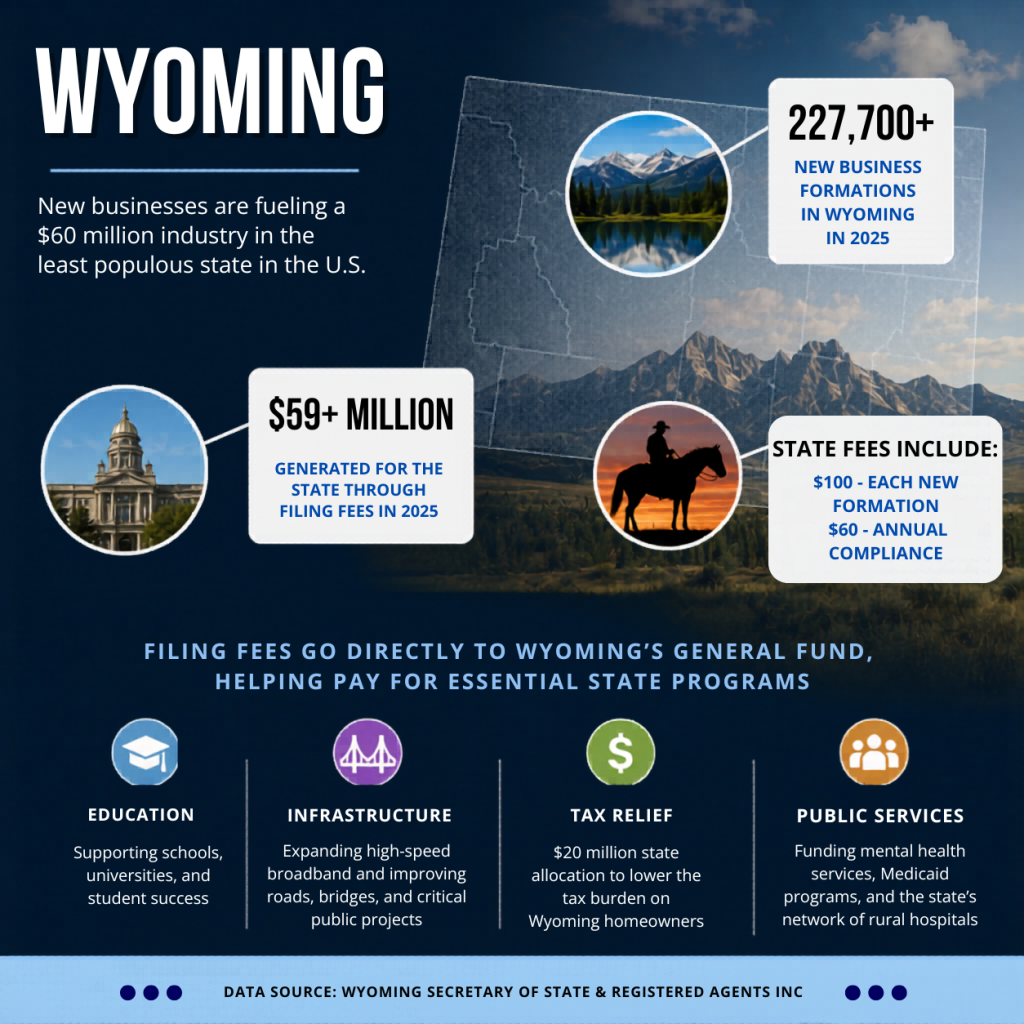
In 2025, Wyoming experienced its highest-ever growth in new business formations (227,723). According to the April Business Formation Report from Registered Agents Inc., the largest U.S. service of its kind assisting hundreds of thousands of aspiring entrepreneurs each year, that’s a massive 35% jump from 2024, outpacing the next-closest state, Montana, by 10%. The report, which tracks monthly formation filings across all 50 states, has followed Wyoming’s rise. So far, the trajectory has been consistently upward.
As a snapshot in context with other states, Wyoming remains impressive. Florida, California, Texas, Delaware and New York lead in total monthly filings, but Wyoming comes in seventh with 21,405 new business formations in March 2026. One driver behind this strong growth may be the state’s ranking as America’s “Most Business-Friendly Tax Climate” for the past three years, according to the Tax Foundation. The Wyoming Business Council says that the state welcomes founders through “a pro-business attitude and wide-open spaces full of adventure.”
Beyond The Typical Founder
The idea of a Wyoming entrepreneur typically conjures a picture of someone whose business is tied to the land or the local economy. This could be a boutique hotel owner or a small operator in Wyoming’s oil and gas fields. This image, while accurate, only tells part of the story.
A significant portion of Wyoming’s new wave of business owners are individuals and teams who have never set foot in the state. Remote workers, digital entrepreneurs, and independent professionals across the country are choosing Wyoming as their business’s legal home for the same reasons: no state income tax, strong asset protections, and a formation process that doesn’t require owning or leasing a local office.
Retirement-age entrepreneurs represent a segment of business activity, too. From consultation to business coaching, retirees are finding the same appeal in Wyoming’s business environment as younger remote founders. A 2020 report by the Kauffman Foundation tracking entrepreneurship trends found that 25% of new business owners were aged 55-64.
International entrepreneurs are another growing presence. Wyoming’s registered agent model allows non-U.S. residents to form and operate LLCs within the state, with the agent handling state correspondence. This makes Wyoming one of the most accessible and cost-effective options for founders based everywhere. It’s also generating meaningful revenue for the state, too. In 2025, new business formation activity contributed more than $23 million to Wyoming’s general fund. This fund supports everything from higher education and public safety to healthcare, tax relief, and economic development across the state.
Why Wyoming?
Once known as the Equality State for being the first to grant women the right to vote and hold office, Wyoming now offers a level playing field for entrepreneurs. The key factors:
- Low Tax Burden. Wyoming earns the status of “Most Business-Friendly Tax Climate” with no corporate or personal state income tax and no franchise taxes, making it painless to launch a new business.
- Simple & Cost-Effective Setup. LLC formation costs about $100, online processing often takes 1-2 business days, and annual report fees start at just $60. This stands in contrast to states with higher initial filing fees, such as Massachusetts, and those with higher ongoing compliance costs, such as California.
- Registered Agent Friendly Framework. Wyoming’s registered agent infrastructure is purpose-built for the kind of remote, flexible business ownership the state is becoming known for. Founders don’t need a physical location in Wyoming to get started, only a registered agent to handle legal correspondence.
- Light Regulations & Flexibility. In Wyoming, less paperwork means fewer compliance headaches. This is driven by lower reporting requirements than many states, a more flexible management structure (member-managed or manager-managed), and no requirement to actually live in Wyoming to start a business.
- Strong Privacy & Asset Protection. Many remote businesses choose to file in Wyoming due to laws that protect personal assets from business liabilities and because it’s one of the few states where LLC owners do not have to list their names and addresses on the public record if they hire a registered agent.
Growth from Inside and Out
In Wyoming, it’s easy to see the state’s fastest-growing industries. Of course, energy still dominates the economy, but alongside traditional oil, gas, and coal, there is a boom in wind and other renewable projects. Growing sectors also span manufacturing (e.g., industrial machinery, electrical equipment), construction (e.g., commercial development, civic infrastructure), agriculture (e.g., tech-enabled ranching and farming), small business (comprising 99% of businesses in Wyoming and employing over 65% of its workforce), and its Old Faithful: tourism and outdoor recreation.
Wyoming is also seeking to become a crypto- and blockchain-friendly state, with thousands of crypto-related businesses registered in light of state policies that actively support digital assets and fintech. Beyond technology, the state is increasingly a magnet for new business formations, especially LLCs, with a surge in registrations that has pushed it past incorporation-dominant Delaware on a per-capita basis.
Unlike states like California or Texas, whose growing populations are themselves drivers of business growth, Wyoming can’t rely on population density alone. Instead, the state has had to earn its formation numbers through policy.
A System That Makes Business Work
With a growing share of Wyoming’s businesses founded by out-of-state founders, a natural question arises: how are these entrepreneurs making their operations work remotely? Part of the answer lies in the infrastructure Wyoming has built around online resources and its registered agent system.
A registered agent is a person or company with a physical Wyoming address that handles legal correspondence on behalf of businesses, often providing compliance and formation filing services. Wyoming doesn’t simply tolerate the registered agent model. The state has codified it into law and explicitly defined the role and responsibility of registered agents. This gives founders a reliable, legally grounded point-of-contact without requiring them to maintain any physical presence of their own.
The registered agent system is only one piece of the puzzle, though. A simple annual reporting process, free of burdensome fees or intrusive disclosure requirements, helps Wyoming retain the new businesses it attracts. Wyoming’s Secretary of State’s online filing system also makes it easy for entrepreneurs who prefer to build without a filing service’s help. For founders who need to move fast and avoid unnecessary friction, this is another reason why Wyoming keeps coming out on top.
Building on a Winning Formula
Wyoming Governor Mark Gordon recently affirmed his commitment to “foster an environment where individuals who create and build businesses can flourish.” The formation data tracked by Registered Agents Inc backs him up.
Wyoming’s business activity isn’t the product of a booming population or a coastal tech ecosystem. Instead, it’s driven by deliberate policy choices that remove barriers and make remote ownership accessible, paired with thoughtful investment in the state’s quality of life.