When it comes to personal finance, debt is considered something to be avoided at all costs. We’re told to live within our means, pay cash, and stay as far away from credit as possible. For most of us, that advice makes sense. Experian reports that Americans carried $17.57 trillion in total debt in Q3 2024, an increase of 2.4% from the same period last year. Taking into account credit cards, auto loans, mortgages, and student loans, that comes out to $105,056 per consumer.
Having that much debt has real consequences. Anxiety and depression are closely linked to financial stress. Monthly payments crowd out savings, childcare, and essentials. Additionally, mismanaged debt can damage credit, making future borrowing more expensive.
But entrepreneurship plays by different rules — and freelancers who think like business owners understand this instinctively.
For business owners, debt, often referred to as leverage, is not automatically a liability. It’s a tool. When used properly, it accelerates growth. But it can also cripple a company when used poorly. What’s different is not the debt itself, but how and why it’s used.
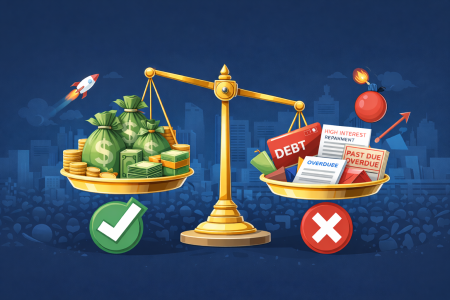
Success isn’t necessarily determined by money; it’s determined by return on capital. Knowing the difference between “Good Debt” and “Bad Debt” is the difference between scaling a company to the moon and watching it sink under the weight of high-interest debt.
Table of Contents
ToggleDefining the Divide: Return vs. Consumption
In the end, what differentiates good debt from bad debt for an entrepreneur is its destination.
- Good debt is debt used to acquire assets or resources that are expected to return more than their cost (interest and fees). In other words, it’s an investment in future cash flow.
- Bad debt consists of borrowed capital used to fund consumption, cover recurring losses, or purchase depreciating assets that will not generate revenue. As a result, existing cash flows are depleted.
When Leverage Makes Sense: The “Good Debt” Scenarios
It makes sense to use leverage when the spread between your interest rate and your profit rate is high. As such, the following are five areas where entrepreneurs should consider taking on debt.
1. Funding revenue-generating assets.
A good example of good debt is a piece of equipment that increases production by 50% and triples profit over the loan payment.
Consider the case of a landscaping company taking out a loan to purchase a commercial-grade zero-turn mower. As a result, the crew can visit three times as many houses with the mower in a day, reducing the time spent on a job from three hours to one. It costs $400/month to repay the loan, but it generates $4,000/month in additional revenue.
2. Bridging inventory gaps (working capital).
Inventory often limits the growth of product-based businesses. With only $20,000 in the bank and a $100,000 purchase order from a major retailer, it’s impossible to fulfill the order.
You can, however, lower your Cost of Goods Sold (COGS) if you use a line of credit strategically, such as to buy inventory at a bulk discount. By increasing margins, the debt pays for itself.
3. Strategic expansion and real estate.
Buying the building you operate out of is often considered good debt. Instead of paying rent (a pure expense), you build equity in an asset that appreciates over time. Additionally, using debt to open a second location, provided the first location is profitable, is a classic way to grow.
4. Acquiring talent (the human asset).
Often, the best “asset” you can buy is a person. Funding the first six months of salaries of high-level sales executives or CTOs can be a brilliant move if it results in a 10x increase in development speed or revenue. This is “human capital” leverage.
5. Tax advantages.
Tax deductions are available for interest paid on business loans in many jurisdictions. As a result, the Effective Cost of Debt is reduced. When your interest rate is 8% but your tax deduction brings your real cost down to 6%, while your business is growing at 15%, the math of the debt is overwhelmingly in your favor.
The Red Flags: When Debt Becomes “Bad”
In addition to amplifying gains, leverage also amplifies losses. When debt is used to fix a broken business model, it becomes “bad.”
Funding operational deficits.
Using debt to cover a lack of profitability only delays the inevitable while making the eventual crash much harder. Borrowing to pay rent or payroll when your business is losing money is a “death spiral.”
Unless the loss is deliberate, such as a venture-backed tech startup burning cash to acquire users, debt to cover a lack of profitability only delays the inevitable.
Lifestyle creep and non-essentials.
Have you seen other founders take on debt for a luxury car “for the brand?” Instead of co-working spaces, how about an expensive office in a trendy district? This is lifestyle creep, and it’s an example of bad debt.
In addition to being depreciating assets, they don’t provide a measurable return on investment (ROI).
High-interest “predatory” lending.
In some cases, a merchant cash advance (MCA) or short-term fintech loan can have an effective APR between 40% and 150%. Regardless of how good your business is, it’s impossible to out-earn a 100% interest rate. Almost always, this type of debt chokes a business’s cash flow.
The Metrics of Leverage: How to Measure Risk
Entrepreneurs must consider two key metrics before taking on debt:
Debt Service Coverage Ratio (DSCR)
This shows whether or not a business or property can pay its debts. It’s calculated as Net Operating Income (NOI) ÷ Total Debt Service.
- DSCR < 1.0: Not enough cash to cover debt (high risk).
- DSCR = 1.0: Just enough to pay off debt, no cushion.
- DSCR > 1.0: More income than needed since lenders prefer 1.25x or higher.
To put it simply, lenders use DSCR to evaluate loan risks. The higher the DSCR, the stronger the cash flow, which can lead to better loan terms and loan approval.
Weighted Average Cost of Capital (WACC)
When your cost of debt exceeds your Return on Assets (ROA), you’re essentially working for the bank. Why? There isn’t enough income from your assets to cover your borrowing costs.
That means:
- You’re destroying value
- Capital is being used inefficiently
- Ongoing risk of financial trouble
A better benchmark is ROA vs. WACC. In an environment where ROA is below WACC, the business is not earning enough to satisfy shareholders or lenders. If you want to fix this, you can raise ROA or lower borrowing costs.
Conclusion: Respect the Hammer
Debt can be a tool for acceleration, not creation. The more debt you have, the faster your business will fail. In a successful business, though, debt can help it thrive.
Rather than viewing debt as an emotion, the successful entrepreneur views it through the lens of a calculator. You may want to ask yourself: “Will this dollar of debt bring me more than one dollar in profit?” If you can answer “yes,” then leverage becomes a competitive advantage.
For more strategies on growing your business and personal wealth, learn how to build a passive income business, improve your financial literacy, and explore smarter investment decisions.
FAQs
Is it always better to bootstrap than to take on debt?
Not necessarily. While bootstrapping is safer, it’s often slower. In “winner-take-all” markets where speed to market is everything, avoiding debt may result in you losing market share to a competitor who is willing to use leverage.
What is an “SBA Loan,” and is it considered good debt?
SBA loans offer lower interest rates and longer repayment terms because they are government-backed. Because of their low cost, they are generally considered “good debt” because they make it easier to achieve a positive spread.
Should I use a personal credit card to fund my business?
Generally, this is a high-risk move. A personal credit card has high interest rates and lacks the same legal protections as a business credit card. In addition, if your business is sued, “piercing the corporate veil” can expose your personal assets (such as your home) to liability.
When does “Good Debt” turn into “Bad Debt”?
Market changes can turn good debt into bad debt. If a recession hits and you borrow for a second location, that “good” expansion debt can become “bad” if the location can’t support its own payments. Be sure to maintain a cash reserve to cover your debt payments during a storm.
How do I know if I’m ready for leverage?
When you have a repeatable process, you are ready to leverage it. Every $1 you spend on marketing brings in $3 in profit, or every $1 spent on a new machine brings in $2 in efficiency. Instead of “finding” a business model, use leverage to “fuel” one you already have.
Image Credit: Albert Costill/ChatGPT