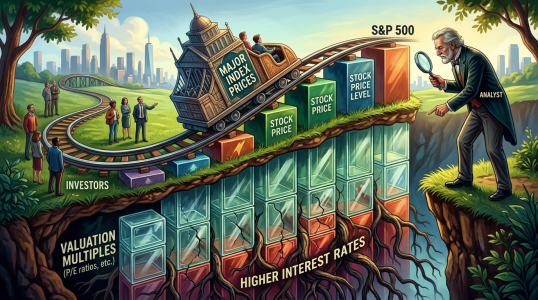
Technology stocks are under heavy pressure, but that does not mean the entire stock market is collapsing. I see a different process taking place beneath the major indexes. Money is moving out of crowded technology positions and into health care, consumer staples, energy, and dividend-paying companies. The main lesson is simple: a falling tech portfolio is not always evidence of a broad market crash.
Table of Contents
ToggleFive Record-Breaking Deals Tested Investor Demand
Artificial intelligence has attracted huge amounts of capital. Companies are spending heavily on computing capacity, data centers, chips, energy, and related infrastructure.
This year included five record-setting AI-related financing events. They covered several major parts of the capital markets:
- The largest initial public offering.
- The largest equity raise by a public company.
- The largest equity raise by a private company.
- The largest equity raise by a foreign company.
- The largest bond deal.
Together, these records show how aggressively businesses and investors have funded the AI buildout. Equity investors supplied capital to both public and private companies. Bond investors also provided financing through the debt market.
That level of activity matters because investment demand is not unlimited. Even a popular theme can absorb too much money too quickly. New stock offerings, private fundraising, and bond issuance all compete for capital.
The central question is whether these five events became the final test of investors’ appetite for technology. They may have marked the point at which the market began to say, “enough.”
“The market is saying enough and puking tech stocks. But the market isn’t crashing.”
The language is blunt, but the distinction is important. Investors can sell technology shares aggressively while continuing to buy other sectors. That is weakness in one part of the market, not automatic proof of a system-wide decline.
View this post on Instagram
A Rotation Is Different From a Crash
A crash usually involves widespread selling across most asset classes and sectors. Fear rises sharply, liquidity can become strained, and investors often move toward cash or very defensive assets.
A rotation works differently. Capital remains invested, but it changes location. Investors sell areas that appear expensive, crowded, or overowned. They then shift money into sectors offering lower valuations, steadier earnings, better income, or stronger near-term prospects.
Recent performance points to that kind of movement. Over the past month, several groups delivered positive returns while technology struggled:
- Health care rose about 8%.
- Consumer staples gained about 8%.
- Dividend growth stocks increased about 7%.
- Energy advanced about 12%.
Those gains do not fit the usual picture of a market-wide crash. If investors were abandoning stocks as a group, it would be unusual to see several large sectors rising by those amounts at the same time.
Instead, the data suggest that investors are changing what they want to own. Some are reducing exposure to high-growth companies. Others are seeking dependable cash flow, dividends, defensive demand, or assets linked to energy production.
The index can remain stable even while former market leaders fall sharply. This happens because broad indexes include companies from many industries. Strength in energy, health care, or staples can offset part of the decline in technology.
The Dot-Com Era Offers a Useful History Lesson
Many investors remember the dot-com period as a single dramatic crash. That description leaves out an important part of the story.
The technology bubble did not simply end with every stock falling at the same rate. The market also experienced a major rotation. Technology and internet shares lost leadership, while other areas held up better or attracted new capital.
That history does not mean the current market will repeat the same path. AI businesses have different revenue models, balance sheets, and customers than many internet companies from the late 1990s. Several leading technology firms are highly profitable and generate substantial cash.
Still, the earlier period offers a useful warning about concentration. A strong investment theme can become so popular that investors treat it as the market itself. Once leadership changes, a portfolio built almost entirely around that theme can fall much more than a broad benchmark.
Market leadership also changes faster than many people expect. Investors often assume recent winners will keep winning. Prices can then reflect very optimistic expectations. A company may report growing sales and profits, yet its stock can still decline if results fail to match those high expectations.
This is why a good business and a good investment are not always the same thing at every price. Valuation, position size, investor expectations, and the supply of new securities all affect returns.
Your Portfolio May Not Represent the Market
One of the most common investing mistakes is confusing personal portfolio performance with overall market performance.
If a portfolio holds mostly technology stocks, a decline in that sector can feel like a crash. The investor may see losses across nearly every account position. Yet health care, energy, staples, and dividend strategies may be rising at the same time.
Concentration can develop without a deliberate decision. Technology stocks may appreciate faster than other holdings, increasing their portfolio weight. Investors may also own several funds that hold many of the same large technology companies.
For example, someone might own a broad growth fund, a technology fund, an AI fund, and individual semiconductor stocks. The account may look diversified because it contains several securities. In practice, each position may depend on the same small set of market forces.
As a financial advisor, I believe investors should examine their exposure by company, sector, investment style, and source of risk. Counting funds is not enough.
A practical portfolio review should address several questions:
- How much of the portfolio is invested in technology and AI-related companies?
- Do different funds own many of the same stocks?
- Would a technology selloff affect several holdings at once?
- Are defensive sectors, dividend growers, and other industries represented?
- Does the current mix still match the investor’s time horizon and risk tolerance?
These questions don’t argue for abandoning technology. They help measure whether one idea has gained too much control over the portfolio.
What Sector Strength Says About the Market
Each leading sector can offer clues about investor priorities.
Health care often attracts buyers because demand for many medical services does not depend entirely on economic growth. Consumer staples can serve a similar role. People continue buying food, household goods, and personal care products during weak and strong economic periods.
Dividend growth companies appeal to investors seeking cash distributions and financial discipline. A record of rising dividends may signal durable earnings, although no dividend is guaranteed.
Energy stocks respond to a different set of forces. Commodity prices, production levels, supply constraints, and global demand can influence their returns. Their recent 12% gain shows that capital has found opportunities outside the technology trade.
These sectors carry their own risks. Defensive stocks can become expensive. Energy prices can reverse quickly. Dividend-paying companies can cut payments. Rotation does not make the new leaders safe or ensure that recent gains will continue.
The better conclusion is narrower: market participation remains active outside technology. That evidence challenges the claim that stocks as a whole are crashing.
How Investors Can Respond
A sharp decline can tempt investors to make emotional decisions. Some may sell every technology holding after prices have already fallen. Others may buy more without checking whether their existing exposure is already excessive.
A more measured response starts with the investment plan. Long-term goals, cash needs, tax effects, and risk tolerance should guide any adjustment.
Rebalancing may help restore a portfolio to its intended targets. This can mean trimming positions that became too large and adding to underrepresented areas. It does not require predicting the exact day that technology will recover or another sector will peak.
Investors should also separate company analysis from broad themes. AI may create valuable products and support long-term growth. That does not mean every AI-related security offers an attractive return at any price.
The same principle applies to recent sector winners. Buying energy or health care only because they rose last month can replace one form of performance chasing with another.
I would focus on risk control rather than short-term forecasts. A diversified portfolio should withstand leadership changes without forcing an investor to abandon the plan.
Technology’s decline deserves attention, especially after record amounts of AI financing. Yet the stronger message comes from the sectors still advancing. Health care, staples, dividend growers, and energy show that money is moving rather than disappearing.
The stock market may not be crashing at all. A technology-heavy portfolio may simply be experiencing the painful side of a rotation. Investors should review concentration, overlapping holdings, and risk before reacting. Understanding what is happening under the surface can lead to better decisions than following the loudest headline.
Frequently Asked Questions
Q: How can stocks rotate without the whole market falling?
Investors can sell one sector and reinvest the proceeds elsewhere. Gains in health care, energy, staples, or dividend stocks may offset losses in technology within a broad index.
Q: Does this mean investors should sell all technology stocks?
No. The right decision depends on valuation, portfolio weight, goals, taxes, and risk tolerance. The concern is excessive concentration, not technology ownership itself.
Q: How can I tell if my portfolio is too dependent on tech?
Review each fund’s underlying holdings and add up repeated exposure to the same companies. Also measure the total share invested in technology, growth stocks, semiconductors, and AI-related businesses.
Image Credit: Tima Miroshnichenko; Pexels