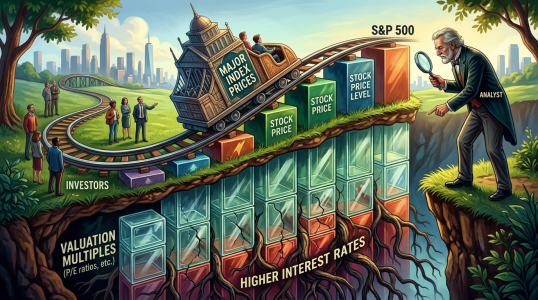
Many television commentators warn that higher interest rates could cause a future stock market crash. I see the issue differently. Much of the pressure is already evident, but it shows up more in valuation multiples than in major index prices.
I am Taylor Sohns, CEO of LifeGoal Wealth Advisors, a Certified Investment Management Analyst and Certified Financial Planner. My firm manages more than $500 million. From my perspective, investors should examine earnings and valuations before reacting to dramatic market predictions.
Table of Contents
ToggleThe Market’s Hidden Adjustment
The S&P 500 rose about 15% during the one-year period under review. At first glance, that gain might suggest higher rates had little effect on stocks.
Yet share prices tell only part of the story. S&P 500 companies’ earnings rose about 30% during the same period.
That difference matters. If profits grow much faster than stock prices, investors are paying less for each dollar of corporate earnings. The index can rise while its valuation falls.
“You can’t see it in the share price. The S&P is up 15% over the past year. But over the same period, earnings of the S&P companies are up 30%.”
This market adjustment may go unnoticed. Higher rates have not necessarily produced the broad price collapse that many commentators predicted. Instead, they have reduced how much investors will pay for company profits.
View this post on Instagram
Understanding the Price-to-Earnings Multiple
The price-to-earnings ratio, often called the P/E ratio, compares a stock’s price with the company’s earnings. For an index, it compares the collective market value with its member companies’ profits.
A higher P/E ratio means investors are paying more for each dollar of earnings. A lower ratio means investors pay less.
Consider a simple example. Suppose a business earns $5 per share and its stock trades at $100. Its P/E ratio is 20.
If earnings rise to $6.50 while the share price climbs to $115, both figures have improved. However, the P/E ratio falls to roughly 17.7. The stock gained value, but its valuation became cheaper relative to earnings.
The same principle can apply to the S&P 500. An index gain does not prove that valuations expanded. Profits may have grown even faster, pushing the market multiple lower.
- Stock prices reflect what investors pay today.
- Earnings show how much profit companies generate.
- The P/E ratio connects the two.
- Faster earnings growth can reduce valuations even as prices rise.
A JPMorgan chart cited in my market review showed a sharp decline in the price-to-earnings valuation. The contraction was nearly 20% over the period reflected in the data.
The exact change can vary depending on the dates chosen and the earnings measure. Analysts may use reported earnings, projected earnings, or different index levels. Still, the central point remains: valuation pressure has already been meaningful.
Why Interest Rates Affect Valuations
Interest rates influence the value investors assign to future profits. When rates are low, bonds and cash often offer limited returns. Investors may then accept higher stock valuations in search of stronger growth.
Higher rates change that comparison. Treasury securities, money market funds, and other interest-bearing assets may offer more attractive yields. Stocks must compete with those alternatives for investor capital.
Rates also affect the present value of future earnings. A dollar expected several years from now is worth less when the discount rate rises. This pressure can be stronger for companies whose expected profits sit far in the future.
Businesses may also face higher borrowing costs. New debt becomes more expensive, while adjustable-rate obligations may require larger payments. That can reduce cash available for hiring, expansion, dividends, or share repurchases.
These forces do not guarantee an immediate market decline. They often reduce valuation multiples first. Strong earnings can offset that pressure and keep index prices rising.
That appears to be the key lesson from the cited figures. Corporate profit growth helped support the S&P 500, even as higher rates put downward pressure on what investors paid for those profits.
Price Declines Are Not the Only Form of Pain
Financial news often treats a market crash as the main measure of damage. That view is too narrow.
A market can adjust through lower prices. It can also adjust through time, earnings growth, inflation, or lower valuation multiples. These paths may occur separately or together.
In this case, the index price remained positive over the measured year. Yet investors did not reward earnings growth with an equal rise in prices. Companies produced much higher profits, while the market’s gain was more modest.
That gap represents a form of repricing. If interest rates had remained lower, investors might have assigned a higher multiple to the same earnings. No one can know that alternate outcome with certainty, but the valuation change shows clear restraint.
This distinction also explains why headlines can confuse investors. One commentator may say the market is strong because the index rose. Another may say financial conditions tightened because valuations fell. Both statements can be true.
What Investors Should Watch
Investors should avoid making decisions from an index price alone. A fuller review includes profits, interest rates, valuations, and the quality of corporate earnings.
- Compare price growth with earnings growth. This reveals whether market gains are supported by improving profits or rising valuations.
- Review current valuations against history. A lower multiple may reduce some risk, but it doesn’t automatically make stocks cheap.
- Track the direction of rates. Rising, stable, and falling rates can produce different pressures across industries.
- Examine earnings expectations. Stock prices often reflect projected profits, not just past results.
- Keep a suitable time horizon. Short-term forecasts should not replace a financial plan built around personal goals.
It is also wise to separate broad market analysis from individual investment advice. A decline in the S&P 500 valuation does not affect every company equally.
Highly valued growth companies may react more sharply to higher rates. Banks, insurers, utilities, and dividend-paying businesses may respond differently. Company debt, profit margins, and pricing strength also shape the result.
A lower P/E ratio does not remove market risk. Earnings could weaken, rates could remain elevated, or economic conditions could deteriorate. If profits fall, an index can become more expensive without its price increasing.
Likewise, a high valuation does not ensure an immediate decline. Markets can remain expensive for long periods, especially when profits are growing and investor confidence is strong.
Why Dramatic Forecasts Can Mislead
Television discussions often favor simple predictions. Claims that rates will “crash the market” attract attention, but they may overlook adjustments already visible in financial data.
I call these loud commentators “squawkers” because volume shouldn’t be confused with useful analysis. Investors need context, not just a forecast.
The better question is not whether higher rates matter. They do. The better question is how their effects have appeared and what the market has already priced in.
Valuation contraction offers one answer. Investors have become less willing to pay the same multiple for earnings, even while strong profit growth supported share prices.
This does not prove that another decline cannot occur. Markets respond to inflation, employment, economic growth, policy decisions, and unexpected events. It shows why warnings focused only on future price losses can be incomplete.
My practical view is simple: study both the numerator and denominator. Price is only one side of valuation. Earnings are the other.
Higher interest rates have already affected stocks by lowering valuation multiples. The S&P 500’s rise can coexist with that pressure because corporate earnings grew faster than prices. Investors should focus on data, maintain a long-term plan, and take dramatic predictions with a grain of salt.
Frequently Asked Questions
Q: Can the S&P 500 rise while becoming less expensive?
Yes. If company earnings grow faster than index prices, the P/E ratio can decline. That makes the index cheaper relative to its profits, even after a positive return.
Q: Why do higher interest rates often reduce stock multiples?
Higher rates give investors more competitive returns from bonds and cash. They also reduce the present value of future corporate profits and may increase borrowing costs for businesses.
Q: Does a lower market valuation mean stocks cannot fall?
No. Lower valuations may provide a better starting point, but prices can still decline. Earnings weakness, persistent inflation, economic stress, or further rate increases could create added pressure.
Image Credit: