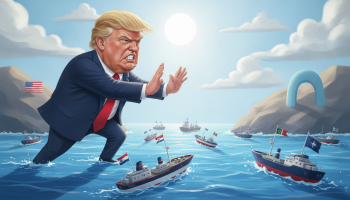
Donald Trump’s frustration with allies flared over maritime security in the Strait of Hormuz, as he complained that NATO members declined U.S. requests for help during Washington’s campaign against Iran. The dispute, centered on a key global shipping route off Iran’s coast, exposed long-running tensions over burden sharing, strategy, and risk.
Trump frequently vented about NATO members’ refusal to heed U.S. calls for help clearing the Strait of Hormuz during its campaign against Iran.
At issue was how the alliance, and U.S. partners in Europe, should respond to security threats tied to Iran and regional tensions in the Gulf. The episode highlighted competing goals: Washington sought visible support, while European governments weighed legal, political, and economic costs.
Table of Contents
ToggleWhy the Strait Matters
The Strait of Hormuz is one of the world’s most important energy chokepoints. Tankers carrying crude and refined products pass through its narrow waters each day. Any disruption can rattle markets and spike shipping insurance costs.
U.S. officials argue that keeping the waterway open protects the global economy, not just American interests. That view often underpinned calls for allies to contribute ships, aircraft, or surveillance.
- Roughly a fifth of global crude exports move through the Strait.
- Even brief incidents can raise oil prices and maritime premiums.
A Clash Over Burden Sharing
Trump’s complaints fit a familiar pattern. He has long pressed NATO members to spend more on defense and join U.S.-led missions. The Hormuz dispute became another test of that pressure campaign.
Supporters of his stance said allies benefit from secure shipping and should help police the corridor. They argued that European navies have the capability to escort vessels and deter threats.
But several European governments were reluctant. Officials feared being pulled into a direct confrontation with Iran, especially as they tried to preserve diplomatic channels and manage fallout from the nuclear deal’s collapse.
NATO, But Not NATO
There was also a practical hurdle. NATO as an alliance has no standing mission in the Gulf. Any deployment would be a national choice, not a NATO operation. That distinction let some governments keep their distance while still offering limited help elsewhere.
European diplomats often favor coalition structures under clear legal mandates. In the Gulf, the mandate question was murky. Was the goal deterrence, escort, or interdiction? The absence of a shared framework complicated buy-in.
Europe’s Calculus on Iran
European leaders faced a balancing act. They sought to counter threats at sea without closing the door to talks with Tehran. They also had domestic constraints, with parliaments wary of open-ended missions.
Critics of Trump’s approach said public pressure and sharp rhetoric made alignment harder. Quiet coordination, they argued, might have delivered more flags in the water. Backers countered that only public pressure forces action.
Security and Market Impacts
Uncertainty in Hormuz tends to ripple through energy markets. Shippers react quickly to risk signals. Insurers adjust premiums. The longer allies argue over roles, the more jittery traders get.
Maritime experts warn that mixed signals can invite testing by hostile actors. Clear rules of engagement and visible patrols lower the odds of miscalculation.
What It Means for the Alliance
The Hormuz dispute was not only about ships and sailors. It was a stress test for alliance politics. It raised a basic question: when U.S. pressure meets European caution, who yields?
For Washington, the episode fed a narrative that allies free-ride. For Europe, it reinforced the need for independent assessments of risk, law, and strategy. For NATO, it showed the limits of an alliance built for the North Atlantic operating far from home waters.
The immediate tension has cooled, but the core issues remain. Energy routes are still vulnerable. Iran remains unpredictable. Allied navies are stretched. The next flashpoint could come with less warning and higher stakes.
The takeaway is stark. Shared interests at sea require shared plans on paper, not just speeches. Clear mandates, defined objectives, and predictable roles would make the next call for help less contentious—and faster to answer.
Watch for signals of tighter European coordination on maritime security, and for any future U.S. push to formalize coalition patrols. If allies can align mission goals before a crisis hits, the inevitable arguments might shrink—and the tankers will keep moving.