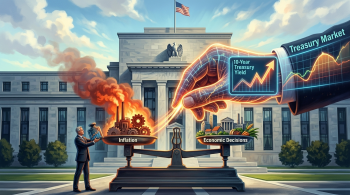
The Federal Reserve faces a difficult interest-rate decision. Inflation remains a concern, but pressure from the Treasury market may now carry greater weight. I had expected no increase. Yet a 10-year Treasury yield above 5% could force the Fed to act, even if another hike does little to address the sources of inflation.
Table of Contents
ToggleThe 10-Year Treasury Yield Changes the Debate
The 10-year Treasury yield has moved above 5%, reaching its highest level since 2007. That is a major milestone for bond traders. It affects borrowing costs across the economy.
Investors set long-term Treasury yields through buying and selling. Those yields reflect expected inflation, economic growth, government borrowing, and future Fed policy.
The Federal Reserve controls a short-term policy rate. It does not directly set the 10-year yield. Still, its decisions and public statements influence how bond investors view inflation risk.
If the Fed does not raise rates, investors could interpret the decision as a weak response to inflation. They may then demand higher yields before lending money to the federal government for a decade.
That creates a serious risk. A decision intended to avoid tighter financial conditions could produce the opposite result. Long-term rates might rise because investors lose confidence in the Fed’s inflation commitment.
“If the Fed does not hike, long-term Treasury interest rates could explode higher because that would signal the Fed is not all that serious about inflation.”
This does not mean yields will surge after a pause. Markets can move for many reasons. However, the risk is large enough that policymakers must account for it.
View this post on Instagram
Why I Initially Expected No Increase
I had been in the no-hike camp. Public expectations around the Fed’s leadership had leaned toward lower rates, not another increase.
A rate cut would reduce short-term borrowing costs and may support parts of the economy. That possibility shaped market expectations before the latest rise in Treasury yields.
Another rate increase also carries costs. It can make business loans, credit cards, and other forms of borrowing more expensive. It may also weaken hiring and investment.
Those concerns normally support patience. The Fed can leave rates unchanged while it studies inflation, employment, consumer spending, and financial conditions.
The bond market has complicated that choice. A 10-year yield above 5% suggests investors need more compensation for holding long-term government debt.
That move may reflect inflation worries. It could also reflect heavy Treasury borrowing, stronger economic growth, or uncertainty about future policy. The Fed cannot control each of those forces.
Even so, policymakers cannot ignore the message. A pause may be read as permission for inflation expectations to drift higher.
Mortgage Rates Show the Household Impact
Mortgage rates are already near 7%. They are not set directly by the federal funds rate, but they often move with longer-term bond yields.
Lenders price mortgages using several inputs. Those include Treasury yields, credit risk, operating costs, and the risk that a borrower refinances early.
When the 10-year yield rises, mortgage rates often follow. A further increase from 7% to 7.5% would reduce affordability for many buyers.
The difference may look small, but it can add a meaningful amount to a monthly payment. It can also reduce the price a buyer can afford without increasing a housing budget.
Higher mortgage rates affect more than new buyers. They can discourage current owners from moving because many already have lower-rate loans.
This “lock-in” effect limits the supply of homes for sale. It can keep prices elevated even as demand weakens.
The main channels of pressure now include:
- Higher monthly payments for new homebuyers.
- Reduced incentives for existing owners to sell.
- More expensive loans for businesses and consumers.
- Lower values for older bonds carrying smaller yields.
These effects explain why control of long-term rates matters. If yields rise too quickly, financial conditions can tighten without another official Fed increase.
A Rate Hike Cannot Fix Every Source of Inflation
I do not believe another rate increase would do much to solve supply-driven inflation. Monetary policy can reduce demand, but it cannot produce oil or clear a blocked shipping route.
The Strait of Hormuz is especially important because a large share of global oil shipments passes through it. Disruption in that area can raise energy prices and shipping costs.
A Fed rate hike cannot reopen the strait or increase the physical supply of crude oil. It cannot repair a damaged pipeline, resolve a conflict, or speed a delayed tanker.
“A rate hike is not going to open the Strait of Hormuz and let oil flow through.”
This distinction matters because inflation can come from different sources. Demand-driven inflation may respond to higher interest rates. Supply-driven inflation is harder for the Fed to address.
Higher rates can still reduce demand elsewhere in the economy. Consumers may spend less, companies may delay expansion, and hiring may slow.
That could offset some pressure from energy prices. However, it does so by weakening other activity rather than correcting the original supply problem.
The Fed therefore faces an imperfect choice. It can raise rates to defend its inflation credibility, even though the move may not lower the price of oil.
Credibility May Matter More Than the Immediate Effect
Central banking depends partly on expectations. If households and businesses expect inflation to remain high, they may change their behavior.
Workers may seek larger wage increases. Companies may raise prices sooner. Investors may demand higher yields to protect future purchasing power.
Those responses can make inflation harder to control. The Fed tries to prevent short-term price shocks from becoming lasting expectations.
That is why an increase may serve as a signal rather than a direct cure. It would tell markets that policymakers remain willing to tighten financial conditions.
The signal could help limit a disorderly rise in long-term yields. Yet success is not assured. Investors could still focus on energy prices, federal borrowing, or stronger growth.
A hike also risks reinforcing concerns about persistent inflation. Bond investors might conclude that the Fed sees a worse problem than markets had assumed.
The result will depend on both the decision and the explanation. Clear guidance will be as important as the rate change itself.
What Investors Should Watch
The headline decision will attract attention, but investors should examine the Fed’s reasoning. Small changes in language can alter expectations for later meetings.
I will be watching whether policymakers describe inflation as broad-based or tied mainly to energy. That distinction may show how long they expect pressure to last.
The Fed’s view of the Treasury market will also matter. Officials may discuss tighter financial conditions even if they avoid targeting a specific long-term yield.
Investors should also monitor the 10-year Treasury yield after the announcement. A hike followed by lower yields could suggest that markets welcome the inflation response.
A hike followed by higher yields would send a different message. It could indicate that inflation fears, government debt supply, or growth expectations remain dominant.
Mortgage rates, inflation expectations, oil prices, and the dollar can provide added clues. No single measure will explain the full market reaction.
For long-term investors, one Fed meeting should not dictate an entire financial plan. Rapid changes based on headlines can create avoidable mistakes.
Bond investors should review maturity risk. Longer-term bonds usually move more sharply when yields change. Borrowers should test budgets against higher financing costs.
Homebuyers should focus on monthly affordability rather than trying to predict the perfect mortgage rate. Refinancing may remain an option if rates decline later, but it is never guaranteed.
The Fed may now be more likely to raise rates because doing nothing has become more expensive. A hike would not solve an oil supply shock. It could, however, protect confidence in the central bank’s inflation response.
The broader lesson is practical. Watch the bond market, not only the Fed’s policy rate. Long-term Treasury yields can shape mortgages and economic activity before policymakers announce their next move.
Frequently Asked Questions
Q: Why does the 10-year Treasury yield matter to consumers?
It influences many long-term borrowing costs. Mortgage rates often move with it, while business loans and other forms of credit may also become more expensive.
Q: Would another Fed rate increase lower oil prices?
Not directly. Higher rates can reduce demand, but they cannot increase oil production or restore shipping through a disrupted trade route.
Q: What should investors examine after the Fed decision?
Watch the 10-year Treasury yield, mortgage rates, inflation expectations, oil prices, and the Fed’s policy language. Together, they show how markets interpret the decision.