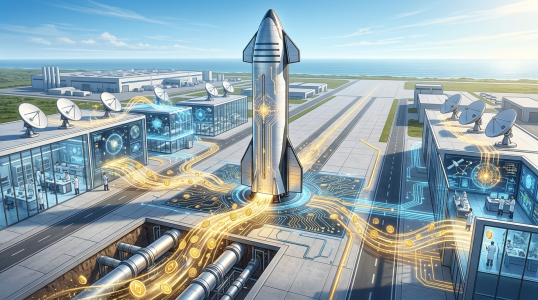
SpaceX is spending heavily to rebrand as an artificial intelligence company, signaling a broader role for AI across rockets, satellites, and communications.
The shift could alter how investors value the private space company. It may also deepen its ties with Elon Musk’s other businesses, which span AI, social media, electric vehicles, and brain technology.
SpaceX is spending “gobs of money” to refashion itself as an AI company.
That description suggests a strategic shift rather than a routine software upgrade. AI could influence spacecraft operations, satellite management, manufacturing, and services built on Starlink’s global network.
Table of Contents
ToggleWhy SpaceX Wants More AI
SpaceX already depends on automation. Its rockets use software to guide flight, return boosters, and perform landings with limited human control.
Starlink creates a different challenge. The satellite internet system requires SpaceX to manage a large fleet in low Earth orbit while routing traffic among users, ground stations, and satellites.
AI systems could help the company predict equipment failures, allocate network capacity, and respond to changing demand. They may also assist with collision avoidance and production planning.
Several possible uses stand out:
- Automating satellite and spacecraft operations
- Improving Starlink traffic management
- Finding manufacturing defects earlier
- Training robots for factories or missions
- Supporting data services linked to orbital infrastructure
SpaceX has not publicly detailed every expense behind the reported push. That limits any firm judgment about how much funding supports internal systems, computing infrastructure, or partnerships.
Musk’s Companies Draw Closer
The strategy fits Musk’s habit of sharing ideas, workers, data, and technical expertise among companies. Tesla has invested heavily in AI for driver assistance and humanoid robots. His xAI venture develops models and computing systems.
SpaceX could provide connectivity and physical infrastructure, while xAI supplies models and training expertise. Such cooperation may lower development costs, but it also creates questions about pricing and governance between related companies.
Investors will want clear answers about which business pays for computing equipment, receives intellectual property, and benefits from shared staff. Those details matter because SpaceX remains privately held and carries major launch obligations.
High Costs Meet Uncertain Returns
Building advanced AI systems requires expensive chips, data centers, electricity, networking equipment, and skilled employees. Space operations add strict safety demands because an error can destroy hardware or disrupt service.
The spending may produce useful efficiencies. Better maintenance forecasts could reduce downtime, while smarter network controls could improve Starlink service without adding as much physical capacity.
Yet the “AI company” label can also work as financial positioning. Technology companies tied to AI have attracted high valuations, giving businesses a reason to stress their computing plans. SpaceX must show that the term reflects measurable products, not fashionable packaging.
Regulators and Rivals Will Watch
AI-driven spacecraft raise questions about accountability, cybersecurity, and human oversight. Regulators may seek proof that automated systems remain safe during launches and orbital maneuvers.
Competitors will also watch whether SpaceX combines launch access, satellite connectivity, and AI services into one commercial package. Its control over rockets and Starlink could give it an advantage that software-only rivals cannot easily copy.
The key test will be execution. SpaceX must explain where the money is going, what AI products will generate revenue, and how safety controls will keep pace. If it succeeds, the company may sell more than trips to orbit and internet access. If it does not, “gobs of money” could become an unusually expensive rebranding exercise.