Let me be straight with you. I used to hate Facebook.
I barely posted anything. Occasionally, I’d post a random update, but I never took it seriously. As far as social media platforms go, Facebook ranked last. I found it to be outdated, noisy, and nowhere near as exciting as YouTube.
Then something happened that completely changed my opinion. You can earn money by posting on Facebook. I’m not just talking about viral videos. Facebook pays for almost everything: images, videos, Reels, stories.
My first payout? $137. Sure, nothing glamorous. And, definitely not exactly wealth-changing.
But that tiny deposit turned into something I still don’t understand. Since I started posting content on Facebook, I’ve made almost $200,000. In fact, as of December 3rd, 2025, around 1 p.m., right after lunch, I had already made $2,400.
If you want to make money on Facebook in 2026, let’s talk about how the Facebook Monetization Program works, how to enter, and what to avoid.
Step 1: Understand What Facebook Actually Pays For
There’s a misconception that Facebook works like YouTube, where views are equivalent to money and videos are equivalent to views. Nope.
In reality, Facebook pays for four types of content:
- Text posts
- Images
- Reels
- Stories
The shocker? Even after 10+ years on YouTube, videos are not my biggest earner on Facebook.
Images make me almost 90% of my revenue.
The second most popular post type is text. A distant third is Reels.
The reason this matters is that creating an image post is much faster than recording and editing a video. You can easily spend two hours or more editing a 60-second reel from start to finish. Alternatively, you can earn significantly more with an image post that takes only 10 minutes.
But here’s the catch: Just because an image works for me doesn’t mean it will work for you.
Through Reels, I’ve helped many Facebook creators make a lot of money. Someone who recently joined my course made their first $1,000 month almost entirely from Reels.
To put it simply, there is no “best” format. You should choose a format that engages your audience.
Step 2: Make Sure You’re Eligible
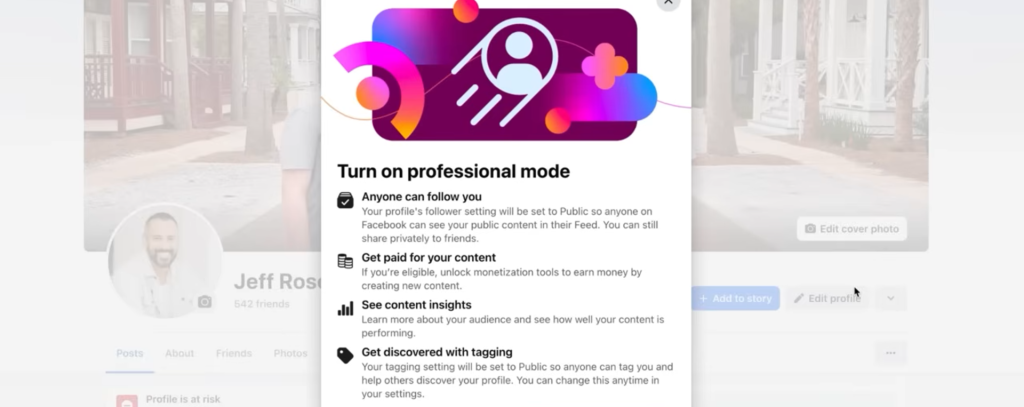
There’s a possibility that you already have access to the monetization program — you just haven’t activated it yet.
For instance, if you’re using your personal profile, switch to Professional Mode in your settings.
But if you have a business page, you’re already in Professional Mode. However, you won’t receive an invite immediately if your page is brand new.
In addition, Facebook has updated its policy as follows:
- You must post original content
- For a minimum of 30 days
Because of this, people ask me all the time: “I’ve been posting for three days—why haven’t I been invited yet?”
The answer is simple. Rather than quick bursts of activity, Facebook wants consistency. Make sure you stick with it for the full 30 days.
Step 3: How to Actually Get Invited Into the Program
There’s a lot of misinformation online coming from outdated policies from older programs, such as:
- Ads on Reels
- Performance Bonuses
- Breakthrough Bonuses
In the past, these used to require 10,000+ followers or specific watch times. Now, that’s not the case.
It’s not uncommon to see people get invited with fewer than 7,000 followers.
The common thread? They posted a lot, and people engaged with the content on Facebook.
I’m not talking about one or two posts a day. It’s more like 15 posts per day.
Quality, however, still matters. You won’t be invited to Facebook if you spam low-effort posts with no engagement. Essentially, your page is your audition. Whenever a stranger visits:
- Are they interested in following you?
- Do they want to leave a comment?
- Is your post something they would like to share?
If not, rethink your strategy.
For the love of Zuckerberg, stop copying viral memes, pasting them into ChatGPT, creating 50 versions, and uploading them. It looks cheap. Scratch. It is cheap. And it won’t work.
What makes a successful page mix? It often has a combination of:
- Text posts
- Images
- Reels
- Personal insight
- Some personality and opinion
You don’t have to show your face. However, you must show who you are.
Step 4: What NOT to Do (If You Don’t Want to Get Banned)
Once you’re in, there are a few mistakes that will get you kicked out of the program faster than you can say “boosted post.”
Don’t share false or misleading content.
There’s no comparison between Facebook and X (Twitter). If you want to go viral, you can’t simply post anything.
You can be flagged, suspended, or removed for sharing misinformation, whether intentional or unintentional.
How do I know?
I’ve had posts flagged, and it wasn’t pleasant. My mistake was figuring out what I did wrong by carefully reading the monetization policies.
Watch out for copyrighted audio.
Even a faint bit of copyrighted music in your reel can result in it being flagged or demonetized.
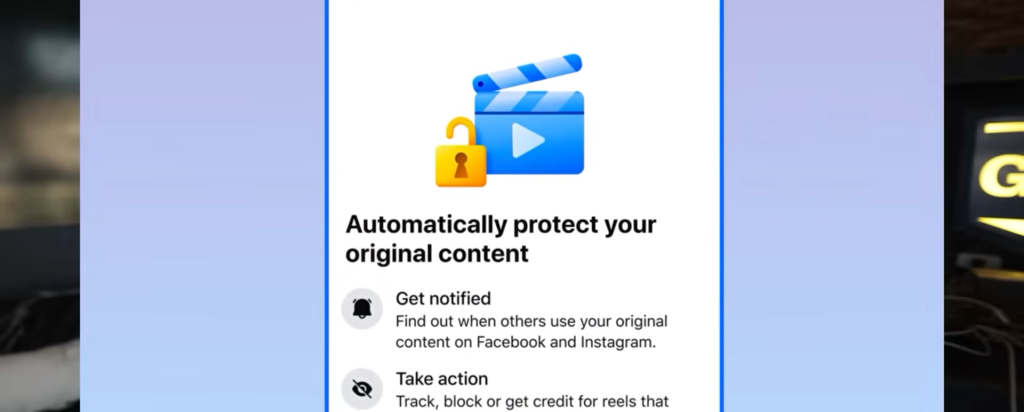
The big one: Do not steal content.
In an effort to combat content theft, Facebook is aggressively clamping down.
Included are:
- Uploading someone’s reel after downloading it.
- Taking someone else’s caption and pasting it.
- Using someone else’s photo as your own.
- Uploading viral content without transforming it.
One time, I found a page that used all my pictures, captions, and everything. The only reason I found it? Their post was shown to me by the algorithm.
Creators will catch you. More importantly, they can report you.
If you steal content, you will be permanently banned, not temporarily banned. And that’s definitely not worth the risk.
Why Facebook Is the Platform I’m Most Excited About for 2026
I barely used Facebook in 2023 and early 2024. As soon as I realized the earning potential and the fact that I could get started for free, I was all in.
With nearly $200,000 earned through this program, I’m more convinced than ever that Facebook is the biggest opportunity for creators in 2026.
What I’m seeing from creators is:
- $4,000 a month
- $10,000 a month
- Even $50,000+ months
…all from a free platform they ignored.
To learn how I went from $137 to nearly $200k, check out my course Get Paid to Post.
No worries if you’re not ready for a course. As long as I’m learning, I’ll keep dropping everything I know to help you earn more, build engagement, and grow your audience.
Facebook is changing the game. And we’re just getting started.
FAQs
How many followers do I need to get invited to the Monetization Program?
There is no official requirement to follow. I’ve seen people get invited with fewer than 7,000 followers. It’s more important to post consistently and engage with your followers than to have a large number of followers.
What type of content pays the most on Facebook?
It varies from creator to creator. Nearly 90% of my revenue comes from image posts. Others make most of their money from Reels. See what works for your audience by testing different formats.
How often should I post to get invited?
The most successful pages share 5–15 times per day, according to what I’ve seen. However, quality is equally important as quantity. Don’t spam people — create content they’ll want to read.
What will get me banned from the monetization program?
Major violations include:
- Posting copyrighted or stolen content
- Sharing misinformation
- Using copyrighted music in videos
- Reposting without adding original value
Once banned, it can be permanent.
Do I need to spend money on ads or tools to make money on Facebook?
Nope. With Facebook monetization, you can start for free. You don’t need ads, fancy equipment, or editing software.
Image Credit: Photo by Tima Miroshnichenko: Pexels