An unusual shipping strategy in the Strait of Hormuz is shaping oil markets. Older tankers may carry crude through the riskiest waters, then transfer it to modern vessels outside the danger zone. This approach can protect valuable ships and keep oil moving, but it also creates major safety, legal, and environmental concerns.
I am Taylor Sohns, CEO of LifeGoal Wealth Advisors, a Certified Investment Management Analyst and Certified Financial Planner. My focus here is simple: explain how activity far from Wall Street can affect oil prices, inflation, and investment markets.
Table of Contents
ToggleWhy the Strait of Hormuz Matters
The Strait of Hormuz is a narrow shipping route between Iran and Oman. It links the Persian Gulf with the Gulf of Oman and the Arabian Sea.
It is one of the world’s most important energy shipping routes. Large volumes of crude oil, petroleum products, and liquefied natural gas pass through it.
That makes the strait a strategic choke point. A tanker has few practical alternatives once oil is loaded at major Persian Gulf terminals. Some producers can use pipelines, but those systems cannot replace every barrel moved by sea.
Any threat to vessels in this area can quickly affect prices. Traders may react to drone attacks, missile threats, ship seizures, military action, or warnings from governments.
The first price response often reflects fear rather than an actual loss of supply. If tankers continue moving and exports remain steady, that fear premium can fade.
View this post on Instagram
The Logic Behind the “Pirate Tanker” Strategy
The ships at the center of this activity are sometimes described as “pirate tankers.” That phrase is colorful, but it should not be taken as a precise legal label.
These vessels are better understood as older or less transparent ships that accept risks larger operators may reject. Some may operate with limited public tracking, unclear ownership, or weaker insurance.
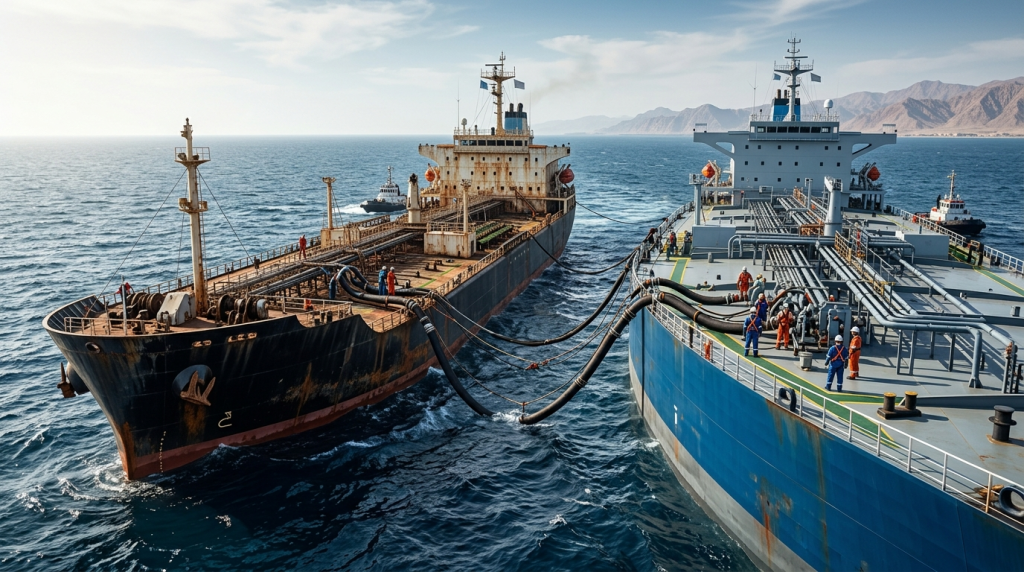
The reported strategy works like a relay:
- An older tanker loads or receives oil near the Persian Gulf.
- The vessel travels through the Strait of Hormuz.
- It meets a newer tanker in safer waters.
- The oil is transferred from ship to ship.
- The modern tanker carries the cargo to its final market.
- The older ship returns and repeats the route.
This setup is similar to using a shuttle through the most dangerous part of a journey. The most valuable tanker and its crew avoid repeated exposure to the highest-risk waters.
For oil companies, the calculation can be harsh but practical. A modern tanker may be worth tens of millions of dollars. Its cargo can also be high-value.
Sending that vessel through waters threatened by drones or missiles creates a large financial risk. Insurance costs may rise sharply, or coverage may become difficult to obtain.
Instead of exposing expensive modern tankers to the entire route, operators may use older ships as taxis through the choke point.
The strategy does not remove danger. It shifts danger from one vessel to another. It may also shift risk to crews, coastal communities, and the marine environment.
Why AIS Tracking Is Important
Commercial ships commonly use the Automatic Identification System (AIS). It broadcasts details such as a vessel’s identity, location, speed, and direction.
AIS helps ships avoid collisions. It also lets authorities, insurers, analysts, and shipping companies track maritime traffic.
Some vessels may turn off AIS or transmit incomplete information. A ship that “goes dark” becomes harder to track through standard public systems.
That does not make a vessel fully invisible. Governments can use satellites, radar, aircraft, patrol ships, port records, and visual observation. Private companies also study satellite images and radio signals.
Still, reduced AIS visibility makes routine monitoring more difficult. It can hide routes, meeting points, and ship-to-ship transfers from many observers.
There can be valid reasons for limiting a public signal in a conflict area. A visible location may help hostile forces identify a target. Yet disabling safety equipment can raise collision risks and trigger regulatory concerns.
How Continued Shipping Can Lower Oil Prices
Oil prices respond to both current supply and expected supply. Markets do not wait for a physical shortage before moving.
If traders expect the Strait of Hormuz to close, prices may rise because future deliveries appear uncertain. Refineries and buyers may compete for available barrels.
If exports continue despite the risk, the expected shortage may not materialize. Prices can then fall as traders remove part of the risk premium.
The central relationship is straightforward:
- Higher disruption risk can push oil prices upward.
- Steady tanker traffic can ease supply fears.
- Ship-to-ship transfers may support continued exports.
- Lower fear can pull prices back below recent peaks.
Oil returning to prewar flow levels would send an important signal. It would suggest that shipping networks are adapting faster than many traders expected.
A price below $90 per barrel can reflect that adjustment. However, one price level does not prove the risk has ended. Oil also responds to global demand, production decisions, inventories, currency moves, and refinery activity.
This means the tanker strategy may be one reason for lower prices, not the only reason.
The Costs Hidden Behind Lower Prices
Keeping oil moving can provide short-term economic relief. Lower crude prices may reduce pressure on gasoline, diesel, aviation fuel, and shipping costs.
Yet the method can create serious hazards. Older tankers may have weaker maintenance records or aging equipment. Their ownership and insurance arrangements can be difficult to verify.
Ship-to-ship transfers also require care. Two large vessels must coordinate their position, speed, hoses, and storage systems. Rough seas or equipment failures can cause spills.
If an accident occurs near a strategic waterway, it could disrupt traffic and damage fisheries or coastlines. Determining who pays for cleanup may be difficult if ownership is unclear.
Crews face the most direct danger. Calling the practice a game can make it sound distant or abstract. For seafarers aboard these vessels, missile threats, collisions, fires, and mechanical failures are personal risks.
Sanctions and compliance also raise questions. Ship-to-ship transfers and disabled tracking signals do not automatically prove wrongdoing. However, both methods have been used to hide cargo origins or avoid trade restrictions.
Assess each vessel and transaction with evidence. It would be a mistake to label every older tanker a criminal ship simply because it operates in a dangerous area.
What Investors Should Watch
Investors should avoid focusing on oil prices alone. Shipping data can reveal whether the physical market supports the market’s assumptions.
I would watch several signals:
- Tanker traffic through the Strait of Hormuz
- War-risk insurance costs for commercial ships
- Reports of drone, missile, or seizure incidents
- Changes in oil exports from Persian Gulf producers
- Ship-to-ship transfer activity outside the strait
- Global oil inventories and refinery demand
A sudden rise in oil does not always mean supply has stopped. It may show that traders expect trouble. A later decline may mean those fears did not become a lasting shortage.
The reverse is also true. A calm price can hide growing physical stress. Shipping delays, rising insurance rates, or falling exports may appear before a major market move.
For long-term investors, the lesson is not to trade every headline. The better approach is to separate a temporary fear premium from a real change in supply.
The activity around Hormuz shows how quickly shipping networks can adapt under pressure. Older vessels, private transfers, and reduced tracking may keep barrels moving when standard routes become too risky for major operators.
That adaptation can help restrain oil prices, but it comes with costs that markets may overlook. Investors should track physical flows, security threats, insurance conditions, and environmental risks together. Price tells part of the story. The ships carrying the oil tell the rest.
Frequently Asked Questions
Q: Are these vessels actually operated by pirates?
Not necessarily. “Pirate tanker” is an informal description for older or less transparent ships taking on risky routes. Actual piracy has a specific legal meaning and should not be assumed without evidence.
Q: Why would a tanker switch off its AIS signal?
A vessel may limit tracking to reduce its exposure in a conflict zone. The same practice can also hide transfers or routes. Turning off AIS may increase safety, compliance, and collision concerns.
Q: Can this shipping strategy keep oil prices low?
It can help by preventing a feared supply interruption. Oil prices still depend on many other forces, including demand, production, inventories, currency values, and geopolitical events.
Image credit: pexels