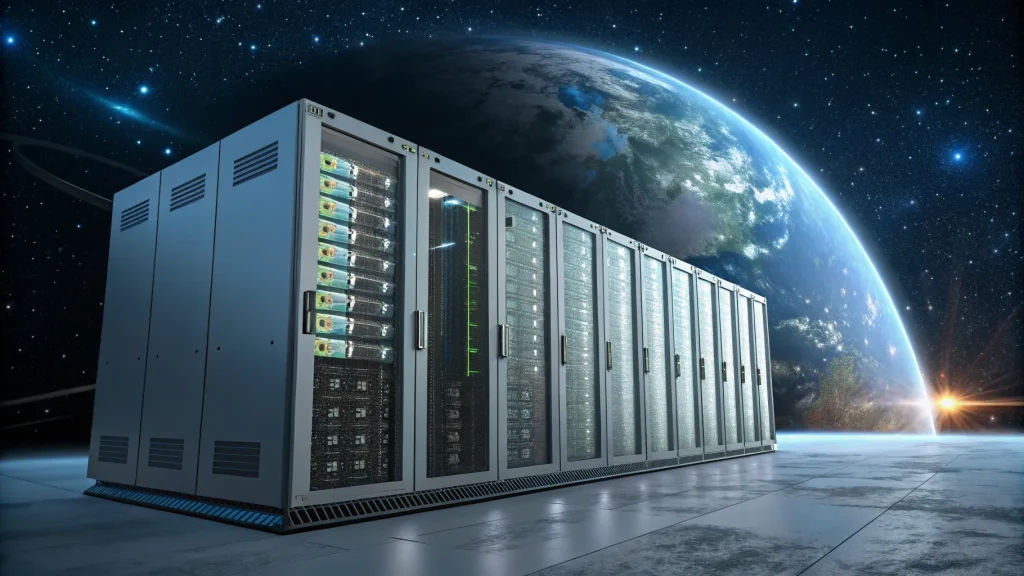
AI needs staggering amounts of compute, power, land, and water. We already feel those limits on Earth. That is why Elon Musk’s idea to move data centers to space is drawing attention. It just got a high-profile nod from NVIDIA’s CEO, Jensen Huang, who said the era of “space computing” has arrived. As someone who spends my days studying how large capital projects get financed and run, I take this seriously.
I am not here to cheerlead. My job is to sort signal from noise. The idea sounds outlandish at first. It also rhymes with history. Reusable rockets sounded like fiction until they did not. Now we need to ask what is real, what is hard, and what might make sense sooner than people think.
Table of Contents
ToggleWhat Caught My Attention
Jensen Huang did not just tip his cap. He talked about real engineering work and real money going to this theme. He also called out the core physics challenge: there is no convection in space. You cannot cool servers by pushing air across a heat sink. Heat must leave as radiation. That is a huge design shift.
“Space computing, the last frontier has arrived.”
That line matters. It signals that the world’s most valuable AI hardware company sees a path worth funding. It does not make the path easy. It makes it investable enough to study.
View this post on Instagram
Why Space Is Even on the Table
AI training and inference demand is rising fast. Models keep getting larger. Workloads keep getting denser. Data centers already draw huge amounts of electricity. Industry estimates suggest data centers use around 1–2% of global electricity today. AI could push that higher.
Water use has also drawn scrutiny. Many cooling systems rely on evaporative methods. That can be a nonstarter in some regions. Land near fiber routes and substations has become scarce and pricey. Permitting takes time. Communities push back. Timelines slip. Costs rise.
Space flips parts of that equation. There is no land cost. Solar energy is strong and steady in orbit. There is no competing demand for water. Heat rejection can happen by radiation into a cold, dark space. The trade-offs are different and serious, but not one-sided.
The Physics and Engineering Hurdles
Cooling is the headline. Without convection, engineers must design large radiators. These panels dump heat as infrared light. They need to be efficient, light, and durable. Fluid loops can move heat from chips to panels. Phase-change systems can help. Every kilogram launched matters. Every square meter costs money.
Radiation is another issue. High-energy particles can flip bits and damage electronics. Terrestrial data centers do not face that. Space hardware needs shielding, error correction, and redundancy. That adds weight and complexity. It also adds cost.
Thermal cycling is tough. Space hardware goes through hot and cold swings. Materials expand and contract. Joint stress and fatigue. Designs must handle years of these cycles. That needs testing and careful material selection.
Micrometeoroids and orbital debris pose a risk. A small impact can disable a radiator or a link. Shielding helps but adds mass. Constellation designs can add redundancy. Insurance costs will reflect those odds.
Power is both a challenge and a feature. Solar arrays in orbit get strong sunlight most of the time. That is a plus. But there are eclipses. Batteries or other storage must bridge those gaps. Nuclear sources in space are rare and controversial. Most designs will lean on solar and batteries.
Links to Earth are vital. Latency and bandwidth set what tasks make sense in orbit. Laser links can move large volumes of data. Latency from low Earth orbit is low enough for some uses. Geostationary orbit adds about a quarter-second round-trip. That is fine for batch jobs. It is tough for real-time tasks.
What Jobs Fit Space First
Not all computing is equal. Some jobs care about latency. Others care about throughput and scale. This matters for feasibility.
- Model training can be batch-oriented. It can tolerate delays. You load data, run compute, and pull down results.
- Large-scale inference that is not user-facing can also fit. Think overnight processing, video analysis, or research workloads.
- Edge serving for consumer apps is less likely. Many apps need millisecond response times tied to users on Earth.
Early space data centers would likely target training and heavy batch jobs. That narrows the use case to where physics lines up with value.
The Economics: Costs, Savings, and Unknowns
Let’s talk money. Launch costs have fallen due to reusable rockets. They still matter. Every kilogram launched must pay for itself in value created over time. Starship aims to push costs lower if it meets its goals. That could be the swing factor.
Capital spending on orbital hardware will be high at first. Space-rated racks, radiators, arrays, batteries, and links are not cheap. Integration and testing are slow. Insurance and risk premiums sit on top.
Operating costs may look different. Power in orbit does not come with a utility bill. Cooling does not use water. Land rent is zero. But you pay for launch, deployment, maintenance, and deorbit at the end of life. You also pay for on-orbit service or replacement when parts fail.
This is not a simple spreadsheet. Still, a few levers can be modeled:
- Capex per unit of compute, including launch.
- Effective power cost per kWh over the hardware’s life.
- Utilization rate of the compute for targeted workloads.
- Downlink cost per terabyte for results.
- Expected failure rate and service plan.
If launch costs fall and space hardware lifetimes rise, the math shifts. If they do not, the idea remains a niche. NVIDIA’s “putting real dollars” here suggests they see a path where the math can work for some jobs. That does not mean it works for every job.
Alternatives on Earth
Before we ship racks to orbit, many Earth options remain. Operators can co-locate near hydropower or in cooler climates. They can expand high-efficiency liquid cooling. They can use heat reuse for district heating. They can sit in deserts with large solar farms, if water is not needed for cooling.
Underwater data centers have also been tested. The ocean provides stable temperatures and natural cooling. Maintenance is hard, but not as hard as space. Timelines are shorter. Permitting is still a factor, but it is more familiar.
Nuclear power near data centers is another path under review. It can provide steady power with a small land footprint. It also faces policy and public hurdles. Timelines can stretch for years. Financing is complex.
The point is simple. The space concept competes with many grounded options. Investors and operators will compare full-life costs, risks, and speed to deploy.
Why NVIDIA’s Interest Matters
NVIDIA sells chips, systems, and software to run AI. If space data centers grow, NVIDIA wants to be inside them. Their involvement also signals that cooling, packaging, and system design can adapt. It is easier to believe in space computing once the supply chain begins to form around it.
Jensen Huang also focused on the engineering culture needed here. He said they have “a lot of great engineers working on it.” That is not a casual comment. It means real headcount, programs, and timelines. It means partners. It means testbeds.
If anyone can make GPUs run in orbit at scale, it will take that type of effort. It will also take coordination with launch firms, satellite builders, and network providers. SpaceX, Starlink, and others will be part of that puzzle. Fiber on Earth meets lasers in space. The interface is where value is made or lost.
Regulation, Security, and Stewardship
Any move into orbit must comply with the rules. Orbital slots and frequencies are managed. Debris mitigation plans are required. Safe deorbit at the end of life is a must. The more mass put up there, the more careful operators must be.
Security changes shape, too. Physical access is not the risk it is on Earth. But cyber risk remains. Uplink and downlink must be encrypted and monitored. Ground stations become high-value assets. On-orbit service vehicles, if used, add new trust and safety questions.
Stewardship matters. This is not just cost. It is a duty. Operators will need to show they can manage risk to other satellites and to the night sky. Public trust will shape permit and insurance requirements.
What Would a First-Generation System Look Like?
Here is a plausible first step. A small constellation in low Earth orbit. Each node holds a compact, radiation-tolerant compute stack. Liquid loops pull heat to fold-out radiators. Large solar arrays feed into batteries. Laser links connect nodes to each other and to ground stations.
The workload is model training for research groups and enterprises. Data is staged at ground sites near fiber backbones. It is uploaded to Windows that fits the pass schedule. Results are downlinked in bulk. Jobs are scheduled to manage eclipse periods.
Service life targets three to five years, with planned replacement. Costs are reduced by shared bus designs and high-volume production. Insurance is priced into customer contracts. It is not glamorous. It is practical if the math holds.
Investor Lens: What I Will Watch
I track five signals:
- Launch economics: Do costs per kilogram continue to fall with higher cadence and heavier lift?
- Thermal breakthroughs: Do we see high-area, low-mass radiators proven on orbit for high heat flux?
- Radiation reliability: Do COTS-adjacent parts, with shielding and error correction, hit multi-year uptime?
- Network capacity: Do laser constellations deliver dependable multi-gigabit links with low downtime?
- Anchor customers: Do hyperscalers or governments sign multi-year contracts for in-orbit training?
When two or three of these line up, capital will flow faster. If they stall, the idea waits on the launch pad.
A Measured Take on “Crazy” Ideas
People used that word when we first watched rockets land on drone ships. I remember the clip. A booster touched down on a barge and stayed upright. A hundred engineers cheered. Markets reset their models overnight.
It is fair to call space data centers bold. It is also fair to call Earth data centers constrained. The push and pull will decide the outcome. I am not ready to call it a foregone conclusion either way.
Here is what I know. Demand for AI compute is not easing. Power and cooling are now board-level issues. New supply must find new physics, new places, or both. Space adds a new place. Radiation adds new physics. That is why this attracts both dreamers and doers.
As a Certified Financial Planner and a Certified Investment Management Analyst, I pay attention when execution-focused leaders put money on the table. Jensen Huang did that. Elon Musk has built a launch system that could make it cheaper. That pairing forces a real conversation.
Investors should ask hard questions. Operators should run pilot-scale tests. Policymakers should set clear rules and fast paths for safe trials. Engineers should keep solving heat, power, and link budgets. If each group does its work, we will get our answer faster and with less guesswork.
Space computing may start small. It may stay focused on specific workloads. It could also scale into a meaningful slice of AI infrastructure. Either way, the effort will pressure Earth-based designs to improve. Better cooling. Better siting. Better use of clean power. That is a win even if only part of the plan moves off-planet.
For now, I will keep my stance simple. Watch the engineering. Watch the contracts. Watch the costs. The story will not be settled by headlines. It will be settled by thermal panels, working links, and signed purchase orders.
That is how “crazy” turns into cash flow.
Frequently Asked Questions
Q: What makes space attractive for AI compute?
Space offers strong solar power, no land costs, and heat rejection by radiation. That can ease Earth-side limits on electricity, water, and siting near transmission lines.
Q: Which AI tasks are most likely to run in orbit first?
Batch workloads, such as model training and large-scale offline inference, fit best. They can tolerate higher latency and align with planned uplink and downlink windows.
Q: What are the biggest risks to space data centers?
Key risks include cooling without convection, radiation damage, launch and replacement costs, orbital debris, and the need for reliable high-throughput laser links to Earth.