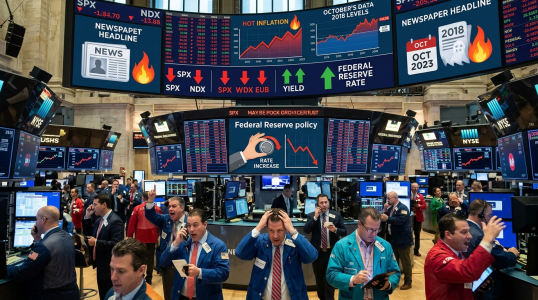
October’s hotter-than-expected inflation report placed interest rates and Federal Reserve policy back at the center of the market debate. Stocks fell after the release, but the initial decline was smaller than I expected. The market’s response reminded me of 2018, when rising inflation, rate increases, and political change combined to pressure stock prices.
I am Taylor Sohns, CEO of LifeGoal Wealth Advisors, a Certified Investment Management Analyst and Certified Financial Planner. My work includes managing more than $500 million and explaining market events to a large audience on Instagram. From that perspective, comparing the current market to 2018 offers useful lessons for investors.
Table of Contents
ToggleWhy the Inflation Report Mattered
Inflation reports measure how quickly prices are rising across the economy. A hotter reading suggests that inflation is running faster than economists or investors expected.
That matters because the Federal Reserve uses interest rates to influence demand. Higher rates make borrowing more expensive for households and businesses. The goal is to slow spending, reduce economic pressure, and bring inflation under control.
A strong inflation reading can therefore change expectations for the Fed’s next decision. Investors may begin to anticipate a larger increase, a longer period of high rates, or both.
The October report raised that concern. In my view, it increased the likelihood that the Fed would raise rates again. Federal Reserve Governor Christopher Waller also discussed a possible 50-basis-point increase in December.
A basis point equals one-hundredth of a percentage point. A 50-basis-point increase would raise the target rate by half a percentage point.
- Hotter inflation can support further interest rate increases.
- Higher rates can raise borrowing costs and reduce economic demand.
- Stocks may fall as investors adjust profit and valuation expectations.
- The size of the market reaction can reveal how much bad news was already priced in.
The report mattered, but the Fed’s possible response carried more weight. Markets often react less to the current inflation number than to what it may mean for future monetary policy.
View this post on Instagram
The Similarities With 2018
The remembered political and economic setting felt familiar. Donald Trump was president, midterm elections produced a blue wave, inflation was rising, and the Federal Reserve was increasing interest rates.
Those conditions also appeared in 2018. The comparison does not mean markets must repeat the same path. It does show why investors were alert to the risk of a deeper decline.
During the fourth quarter of 2018, Fed rate increases helped trigger a sharp selloff. The S&P 500 fell about 13% during that quarter.
“In 2018, Fed rate hikes caused the S&P to draw down 13% in the fourth quarter.”
That decline reflected growing concern that the central bank might tighten policy too far. Investors worried that higher borrowing costs would slow economic activity and weaken corporate earnings.
The Fed was not the only influence. Markets also faced political uncertainty and concerns about global growth. Still, interest rate policy played a major role in changing investor sentiment.
The 2018 episode illustrates how quickly expectations can shift. A market may appear stable while investors believe economic growth can absorb higher rates. Prices can then fall sharply if confidence in that outlook weakens.
Why Stocks Did Not Fall More
Stocks were under pressure after the October inflation release, but the decline was not as severe as I expected. The S&P 500 was down roughly 4% from the reference point discussed then.
That was a meaningful loss, yet it remained far smaller than the fourth-quarter decline recorded in 2018. The limited reaction raised an important question: Why did the market hold up better despite an inflation report that could encourage another rate increase?
One possible reason is that investors had already expected inflation to remain difficult. Markets do not respond only to whether news is good or bad. They respond to how the news compares with prior expectations.
If investors already expected another Fed increase, part of that risk may have been reflected in stock prices before the report. The new inflation data could still hurt sentiment without causing a sudden collapse.
Another possible factor is uncertainty about how the Fed would act. A public warning about a 50-basis-point increase is not the same as a final policy decision. Officials review more economic reports before voting.
Investors may also have believed that higher rates would eventually control inflation. That view can support markets if the economy remains stable and companies continue producing acceptable earnings.
None of these explanations removes the risk. They help explain why a negative inflation surprise does not always produce an immediate decline like the one seen in a prior period.
Market History Is a Guide, Not a Script
Comparing current events with 2018 can help investors identify risks. It should not be treated as a precise forecast.
Economic conditions change from one cycle to another. Inflation may have different causes. Household finances may be stronger or weaker. Corporate balance sheets, employment, fiscal policy, and market valuations may also differ.
The speed of rate increases matters as well. A gradual change gives borrowers more time to adjust. A rapid increase can place greater pressure on mortgages, business loans, credit cards, and other forms of debt.
Investors should use historical comparisons as a framework for asking better questions:
- How persistent is inflation?
- How much additional tightening does the market expect?
- Can economic growth withstand higher borrowing costs?
- Are stock prices already reflecting slower growth?
- What evidence would cause the Federal Reserve to change course?
These questions are more useful than assuming the S&P 500 must repeat its 2018 performance. Similar conditions can lead to different outcomes because prices begin from different levels and investors hold different expectations.
How Higher Rates Affect Stock Prices
Interest rates affect stocks through several channels. First, companies may pay more to borrow money. That can reduce profits, delay expansion, or discourage new investment.
Second, consumers face higher financing costs. Larger payments on homes, vehicles, and credit cards can reduce spending elsewhere. Lower consumer demand may then affect business revenue.
Third, rising bond yields create more competition for stocks. When safer investments offer better income, some investors may become less willing to pay high prices for uncertain future earnings.
Finally, analysts often value stocks by estimating future cash flows. Higher interest rates reduce the present value assigned to profits expected many years from now. This effect can be especially difficult for highly valued growth companies.
These pressures do not affect every business equally. Companies with heavy debt may face more stress than firms with strong cash flow and limited borrowing needs. Defensive sectors may also behave differently from economically sensitive industries.
What Investors Can Learn From the Reaction
A single trading day should not determine a long-term investment plan. Markets often move sharply after economic reports, then change direction as new information arrives.
The restrained decline after the October report did not prove that inflation risk had passed. It suggested that investors were weighing the report against expectations, future Fed decisions, and the broader economy.
For long-term investors, the practical response is usually to review risk rather than make an emotional prediction. A portfolio should reflect the investor’s time horizon, income needs, and ability to withstand losses.
That review may include checking diversification, debt exposure, cash reserves, and the amount invested in volatile assets. It may also involve testing whether a deeper decline would cause an investor to abandon the plan.
Short-term market moves can feel urgent, but acting without a process can create larger problems. Selling after a decline may lock in losses. Taking excessive risk because stocks did not fall further can also leave a portfolio exposed.
The central lesson is simple. Hot inflation can keep pressure on the Fed, and higher rates can weigh on stocks. The 2018 selloff shows how quickly that pressure can grow. Yet history does not guarantee the same result.
I would treat the comparison as a warning to stay disciplined, not as a reason to predict an exact decline. Investors should watch inflation, Fed communication, economic growth, and corporate earnings together. A durable plan should be able to handle several possible outcomes.
Frequently Asked Questions
Q: Why can a high inflation reading hurt stocks?
High inflation can lead the Federal Reserve to raise interest rates. Higher rates increase borrowing costs, may slow consumer spending, and can reduce the value investors place on future corporate profits.
Q: What does a 50-basis-point rate increase mean?
It means the target interest rate rises by 0.50 percentage points. For example, a rate of 4% would increase to 4.5% after a 50-basis-point move.
Q: Does the comparison with 2018 predict another 13% decline?
No. The comparison identifies similar pressures, including rising inflation and Fed tightening. Market valuations, economic growth, investor expectations, and other conditions may differ, so the outcome may also differ.