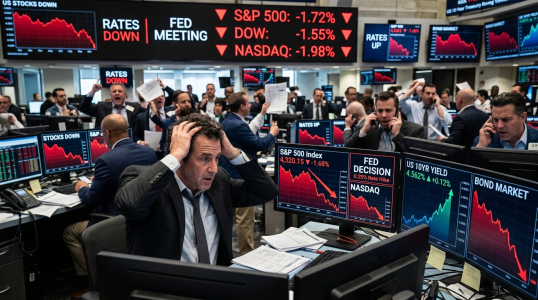
Warren Buffett’s Berkshire Hathaway is sitting on the largest cash pile in the company’s history — approximately $325 billion as of the latest quarterly filing. For context, that’s more than Finland’s GDP and roughly equal to Apple’s annual revenue. When the most successful investor in history is hoarding cash at unprecedented levels, every investor should be paying attention to what it signals.
Table of Contents
ToggleWhy Buffett Is Selling, Not Buying
Berkshire’s cash accumulation isn’t passive. It’s the result of active selling. In 2025, Buffett reduced Berkshire’s Apple position by over 60% — selling approximately $100 billion worth of shares in the company he once called “the best business in the world.” He also trimmed positions in Bank of America, Chevron, and other long-held portfolio stalwarts.
At the same time, Berkshire has made no major acquisitions since early 2024 — a striking departure from its historical strategy of deploying capital into undervalued businesses.
Buffett addressed the cash buildup at Berkshire’s 2025 annual meeting, saying that he was struggling to find investments offering adequate returns relative to their risk. When asked about market valuations, he noted that the S&P 500’s price-to-earnings ratio was at historically elevated levels — suggesting that he viewed the broad market as overpriced.
What the Cash Position Tells Us About Market Valuations
Buffett has historically accumulated cash during periods of market excess and deployed it during periods of panic. His timing isn’t perfect — he’s admitted to being early on both ends — but his pattern of capital allocation has been remarkably consistent over six decades:
In 1999, Berkshire’s cash position grew dramatically while Buffett avoided technology stocks during the dot-com bubble. By 2002, he was deploying capital into distressed businesses. In 2005-2007, cash accumulated again as housing-related financial instruments inflated. By 2008-2009, Buffett was making legendary deals with Goldman Sachs, Bank of America, and General Electric at fire-sale prices.
The current cash position dwarfs both historical episodes. Adjusted for Berkshire’s overall size, the company is holding roughly 30% of its total assets in cash and short-term Treasuries — the highest allocation in decades.
The Shiller CAPE ratio (cyclically adjusted price-to-earnings) for the S&P 500 currently stands at approximately 35 — a level exceeded only by the dot-com peak in 2000. The shift toward bonds and defensive assets isn’t just a Buffett phenomenon; it reflects a broader institutional reassessment of risk.
Should You Follow Buffett Into Cash?
The temptation to mimic Buffett’s positioning is strong but misguided for most individual investors. Here’s why:
You’re not managing $1 trillion. Buffett’s challenge is finding investments large enough to meaningfully impact Berkshire’s returns. He needs to deploy billions at a time, which limits his universe of potential investments. Individual investors can find opportunities in small-cap stocks, real estate, and private markets that are completely inaccessible to Berkshire.
Buffett’s cash is earning significant income. At current Treasury yields, Berkshire’s $325 billion in cash and short-term Treasuries generates roughly $15 billion per year in risk-free income. This isn’t dead money — it’s a massive income stream that also provides optionality. Most individual investors can’t earn enough on their cash reserves to make hoarding them an attractive primary strategy.
Market timing destroys individual investor returns. Dalbar’s annual study of investor behavior consistently shows that the average equity fund investor underperforms the S&P 500 by 3 to 4 percentage points annually, primarily due to poor timing decisions. Missing even a few of the best market days devastates long-term returns. Sitting in cash waiting for a crash that may not come for years has historically been a losing strategy for retail investors.
What Individual Investors Should Actually Do
Rather than mimicking Buffett’s cash position, focus on what his behavior actually teaches:
Maintain valuation discipline. You don’t need to sell everything, but be thoughtful about what you’re buying. Avoid chasing momentum in overvalued sectors. Focus on companies with strong cash flows, reasonable valuations, and competitive moats — the same principles Buffett has applied for 60 years.
Build a meaningful cash reserve. The fact that Buffett is holding elevated cash isn’t a signal to go 100% cash — but it is a reminder that holding adequate cash reserves provides optionality during market dislocations. Having 6 to 12 months of expenses in a high-yield savings account means you’ll never be forced to sell investments at the worst possible time.
Diversify beyond U.S. large-cap stocks. Buffett’s challenge with U.S. large-cap valuations doesn’t mean all markets are expensive. International stocks, small-cap value stocks, and real assets like farmland offer diversification that can reduce your portfolio’s dependence on the S&P 500’s continued appreciation.
Prepare a shopping list. One thing Buffett absolutely does right is maintaining a list of businesses he’d love to own at the right price. Individual investors should do the same: identify high-quality companies or funds you’d want to buy if prices dropped 20% to 30%, and determine in advance how much you’d invest. When the correction comes — and corrections always come — you’ll act decisively instead of freezing.
The Succession Factor
It’s worth noting that Buffett’s cash positioning may also reflect succession planning. At 95, Buffett is preparing Berkshire for leadership under Greg Abel. A massive cash reserve gives Abel flexibility to make his own large acquisitions without inheriting a fully invested portfolio in a potentially overvalued market. This institutional consideration doesn’t apply to individual investors.
The Bottom Line
Warren Buffett sitting on $325 billion in cash is a signal worth reading — but not one worth copying literally. It tells us that the greatest investor of our time sees limited opportunities at current valuations. For individual investors, the appropriate response isn’t panic or imitation. It’s prudent caution: maintain your investment discipline, ensure adequate cash reserves, diversify intelligently, and prepare to act when opportunity arrives. That’s what Buffett is doing with his $325 billion. Scale the principle to your situation, and you’re following his real strategy — not just his portfolio snapshot.