It’s happened to even the best of us. You’re cruising along, sticking to your budget, and feeling like a financial boss. Suddenly, the unexpected occurs: your car needs four new tires, a close friend announces a destination wedding, or your annual property tax bill arrives.
In the blink of an eye, your carefully crafted budget is shattered. As a result, you’re forced to dip into your savings or use a high-interest credit card to settle the balance.
But did you know there’s a better way to handle these predictable “surprises?” It’s called a sinking fund, and it’s one of the most underrated financial tools to have in your financial toolbox.
Table of Contents
ToggleWhat is a Sinking Fund?
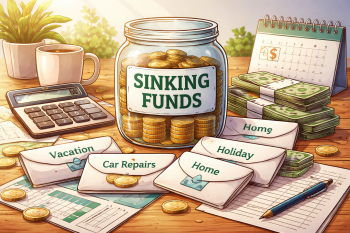
Basically, a sinking fund is a way to save money by setting aside a small amount each month for a specific future expense.
You might find the term “sinking fund” a bit gloomy. As a matter of fact, it probably reminds you of a ship taking on water. However, the logic is actually the opposite. It’s designed to stop a big expense from sinking your budget.
Companies use sinking funds to gradually pay off debts over time. In your personal life, it means gradually accumulating the cash needed to cover an upcoming expense so that, when the bill arrives, the money is already available.
For example, instead of paying $1,200 in December for holiday gifts, you “sink” $100 into a fund every month starting in January. As you approach the holiday season, the “cost” has been absorbed incrementally rather than all at once into your lifestyle.
Sinking Fund vs. Emergency Fund: What’s the Difference?
This is where many people often get tripped up. Isn’t an emergency fund supposed to cover these expenses? Not exactly. While both involve saving money for the future, their psychological and practical purposes differ significantly.
You can use your emergency fund as a “what if” shield.
You can think of your emergency fund as an insurance policy against chaos. It’s stagnant money you hope you’ll never touch. It’s specifically designed to keep you afloat when life throws you a curveball you weren’t expecting.
- Sudden job loss. Covering your mortgage while you hunt for a new role.
- Medical emergencies. An unexpected ER visit or urgent surgery with a high co-pay.
- True home disasters. It might be a burst pipe or a tree limb that falls through the roof at 3:00 AM.
- Car repairs. Suddenly, your car’s transmission fails, or its engine has a major problem.
- Vet bills. A sudden illness or surgery may be needed for your pet.
Managing your “when” strategy with a sinking fund.
Sinking funds are active funds. This isn’t for surprises; it’s for the inevitable. These are planned expenses that do not fall under your regular monthly expenses. In this way, you turn a potential crisis into a simple transaction by gradually sinking money into these categories.
- Holiday & birthday gifts. It’s possible to avoid the “December Debt” by saving all year long or by not being caught off guard with a birthday.
- Vehicle maintenance. Make sure you budget for tires and registration before the dashboard light starts flashing.
- Home upgrades. Putting money aside for the $8,000 roof you will need in three years.
- Travel & leisure. You don’t have to bring home the interest from your summer escape if you fund it in advance.
- Annual subscriptions. You can prefund annual subscriptions such as Amazon Prime, Costco, and professional certifications.
The golden rule? Sinking funds are ones you can see coming, even if it’s a blurry speck on the horizon twelve months away. It’s an emergency fund if it hits you like a bolt of lightning.
Why Sinking Funds are a Game-Changer
The relationship you have with money changes when you use sinking funds. This moves you from being reactive (putting out fires) to being proactive (planning).
- Eliminates guilt. Having a dedicated vacation fund means that you don’t feel like you’re “cheating” on your savings goal when you spend it on a beachside dinner. It was meant for that.
- Prevents new debt. When large and infrequent bills arrive, most people turn to credit cards. Sinking funds, however, help you avoid high-interest debt by ensuring you have cash on hand.
- Reduces stress. When you know the “big” bills are already paid in advance, you feel at peace.
How to Build Your Sinking Funds in 4 Steps
Sinking fund systems don’t have to be complicated. For most of us, it only takes a few minutes to get started.
Identify your categories.
Take a look at your bank and credit card statements from the past year. What “surprises” popped up? Are there any bills you have to pay annually or semi-annually? Among the most common categories are:
- Car maintenance. Tires, oil changes, insurance, and registrations.
- Home projects: Landscaping, minor repairs, and maintenance.
- Health and wellness. Annual deductibles, contacts/glasses, and dental co-pays.
- Special occasions. Weddings, birthdays, and holidays. Plan ahead.
- Tech upgrades. Saving for an upgraded phone or laptop every 3–4 years.
Decide on the target amount and date, and do the math.
Decide how much and when you need each category. As an example, you may need $600 by November 1st to shop for Christmas.
After that, divide the total amount needed by the number of months left before the target date. If you have 10 months until November 1st, you would save $60 a month for Christmas shopping. This method allows you to steadily build your fund without putting an enormous strain on your monthly budget.
Know where to park your cash.
Sinking funds should remain accessible, but separated. If you want to keep money safe, you should keep it somewhere where it won’t be accidentally withdrawn by your daily checking account withdrawals.
- High-Yield Savings Account (HYSA). For most people, this is the best option. With these accounts, you can earn a higher Annual Percentage Yield (APY) than the national average while keeping your money liquid. With some online banks, you can also create “buckets” to visually separate your goals (e.g., “Car” vs. “Vacation”).
- Money Market Account (MMA). With this hybrid option, you can take advantage of competitive interest rates and added flexibility. The advantage of an MMA over a savings account is that it usually comes with a debit card or check-writing capability, making it perfect for funds you might need to pay out on the fly, like for a home repair.
- Certificate of Deposit (CD). When you have a windfall like a tax refund and a specific goal within six months to a year, a CD is a good investment. You’ll usually get a higher interest rate if you lock your money away for a set period. In the end, it protects us from the temptation to spend.
Pro tip. Regardless of which account you choose, automate it. With recurring transfers, you can ensure your funds grow each month without any extra effort.
Building Sinking Funds When Money is Tight
If you’re living paycheck to paycheck, adding more line items to your budget might seem impossible. A $400 car repair, however, is much more devastating for someone with a tight budget than for someone with a large financial cushion.
When margins are slim, here’s how to get started:
Start small (the “micro-fund” strategy).
Don’t fund 10 categories simultaneously. Take the one that causes you the most stress, usually car repairs or gifts. It’s better to save $10 a week toward that goal than to spend it all on nothing. Ultimately, it’s about developing a habit of foresight.
Use windfalls wisely.
Don’t spend your “extra” money right away, whether it’s a tax refund, a work bonus, a birthday gift, or a “third paycheck.” Instead, “seed” your sinking fund with these windfalls.
Trim down the fat.
Find one recurring subscription you don’t use. If you cancel a $15/month streaming service and redirect that money to a “car maintenance” fund, you’ll save $180 by the end of the year. This covers a minor repair and an oil change without adding any additional stress to your wallet.
The “rounding up” hack.
You can use your bank’s round-up feature to round up your purchases to the nearest dollar and save the change. Even though you won’t miss the $0.45 from your morning coffee, its accumulation over a month can be significant.
No matter if your bank offers this service or not, there are dedicated apps that do the heavy lifting for you:
- Acorns. With Acorns, you can invest your spare change into a micro-investment portfolio with your spare change. With market exposure, sinking funds can grow, though investments can fluctuate.
- Chime. You can automatically transfer round-ups from your checking account into a high-yield savings account via Chime’s “Save When You Spend” feature.
- Qapital. Using this app, you can also set “Rules.” You can do standard roundups, or you can get creative, like the “Guilty Pleasure” rule, which saves a set amount every time you spend money at a specific store.
When you use these tools, saving becomes invisible. If you find yourself in need of new tires or a flight later on, you might find that your spare change has already helped you.
Common Pitfalls to Avoid
The following mistakes can make sinking funds more difficult to manage in the long run:
- Overcomplicating. Start with one fund, not 20. Choose three or four of your biggest “pain points.”
- Robbing Peter to Pay Paul. If you have to use your “Vacation Fund” to pay for a “Car Repair,” consider it a temporary loan to yourself.
- Forgetting to re-evaluate. Your needs change over time. Perhaps you sold your car and bought a bike instead, or downsized your home. Further, your car insurance or Netflix subscription may have increased in the past year. Therefore, adjust your funds accordingly.
Final Thoughts: Planning for a Better Retirement
When it comes to financial security in retirement, you might wonder: How does a “Holiday Gift Fund” help me?
The answer is consistency. There’s no shortcut to retirement planning. In the long run, if you have to withdraw money or stop contributions constantly to pay for “unexpected” bills, your wealth-building slows down.
Your investments are protected by sinking funds. They ensure that your “future self” stays on course because your “present self” has already taken care of the logistics of daily life. If you master sinking funds today, you won’t just be able to buy tires or birthday cakes — you’ll also be able to stay invested for years to come.
FAQs
How many sinking funds should I have?
There is no “magic number.” However, it’s best to keep your budget simple by starting with only three to five categories. Among the most common expenses are car maintenance, holiday gifts, and insurance premiums. Having too many may cause your monthly contributions to feel insignificant.
Is a sinking fund the same as a traditional savings account?
A sinking fund is technically a strategy, not a type of bank account. While you can hold your sinking fund in a traditional savings account, the difference is in the intention. While a general savings account is used for anything, a sinking fund is used for one specific, future expense.
Can I use sinking funds to pay off debt?
Absolutely. In fact, corporations and governments have used sinking funds for decades to repay their bond debt. In your personal life, you can create a sinking fund to pay off large debt obligations such as a balloon payment on a loan or a credit card balance.
Should I invest my sinking fund money in the stock market?
Generally, no — unless your goal is 5+ years away (like a child’s college fund or a house down payment). Because you know exactly when this money will be needed, you shouldn’t gamble on the market just before the bill is due. Consider low-risk, liquid options like High-Yield Savings Accounts and Money Market Accounts.
What if I need the money for something else?
The beauty of a sinking fund is that it’s your money. For example, you can use sinking funds as a backup if your emergency fund is not enough to cover a true emergency. However, you should not “borrow” from your “New Tires Fund” to buy a new pair of shoes. To make this system work, the categories must be kept intact.
Image Credit: Albert Costill/ChatGPT