Last updated: February 24, 2026
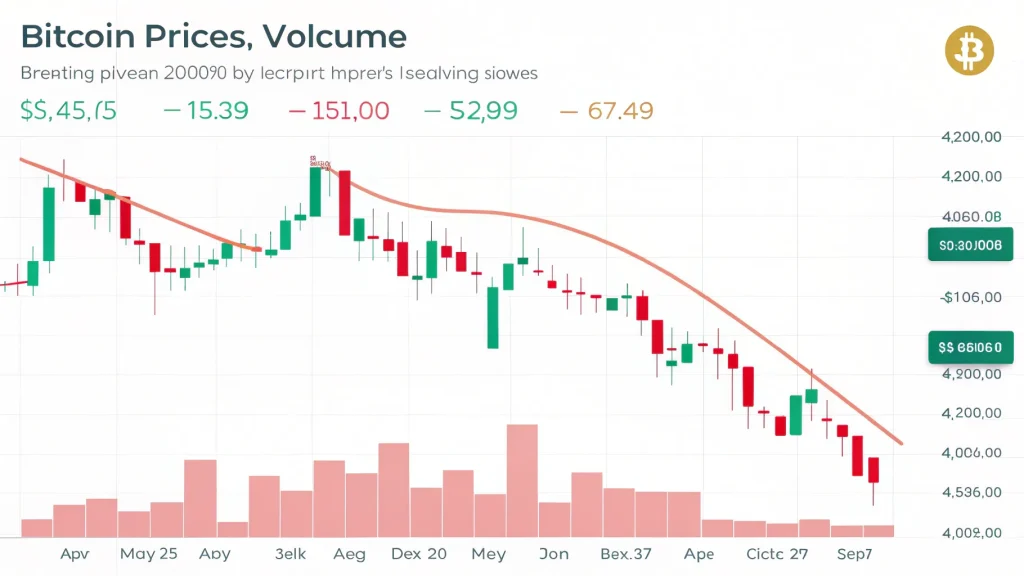
Bitcoin has fallen hard. Prices are down about 40% since October and the slide accelerated after the coin broke through key support on heavy volume. I want to explain why this is happening, what it might mean next, and how I’m thinking about risk. I’m Taylor Sohns, CEO of LifeGoal Wealth Advisors, a CIMA and CFP. I have followed crypto for years, and I take a practical view. This is not about hype. It’s about what the data and behavior tell us.
Table of Contents
ToggleWhat Triggered the Selloff
Three forces have hit the market at once. Tom Lee, a long-time crypto bull, framed them well, and I agree these are the main drivers.
“In October, at Bitcoin’s all-time high, leverage reached record levels. Some traders were 100 times levered.”
When leverage piles up, it props up prices while it lasts. It also turns small drops into big ones. A policy shock hit when former President Trump threatened new tariffs on China. Risk appetite flipped. Prices slipped, then the forced selling began. Margin calls kicked in. Liquidations fed on themselves. By one count, roughly 2,000,000 accounts were wiped out. This is classic in any market that runs too hot on borrowed money.
The second force is seller behavior. Early buyers from the last decade are older now. Many were in their 20s when they took their first shots. Now they are in their 40s or close. Wealth changes how people act. A large unrealized gain becomes a college fund or a house. It becomes diversification and tax planning for retirement. Sellers become more price-sensitive once goals enter the picture. That source of disciplined supply is new compared with five or ten years ago.
The third force is technology risk. Tom Lee flagged the rise of quantum computing concerns. He noted that about one third of Bitcoin wallets may be vulnerable under certain attack methods. That does not mean a hack is happening now. It does mean some long-time holders worry about keys that use older standards. Even a small chance of loss can push owners to move coins or sell. Perception matters as much as the math, especially in a fragile tape.
View this post on Instagram
The Story of Bitcoin Keeps Changing
Every major asset carries a story. Bitcoin’s story has shifted many times. Each shift affects who buys, who sells, and at what price.
- Inflation hedge: That pitch gained steam during money printing. It faded after 2022 when inflation cooled and rate hikes lifted cash yields.
- Dollar alternative: That idea dimmed last year as the dollar stayed firm and U.S. rates stayed high.
- Geopolitical hedge: That frame weakened after the Russia-Ukraine war complicated cross-border flows and compliance.
- Everyday payments: Stablecoins captured that use case with less price swing.
Why does this matter? When a story loses force, demand weakens. New buyers wait. Old buyers rethink size. The market hunts for the next anchor. Until it finds one, prices can drift or swing without a clear floor.
How Technical Damage Amplifies Moves
Markets run on levels and memory. When a major support breaks on high volume, the message is clear. Big money is exiting. That attracts trend followers and algos. It also scares weak hands, who rush to sell into strength. Bounces happen, but sellers use them.
In this slide, the pain was worse because the prior run-up built on leverage. Forced sellers cannot wait for a better price. They dump now to meet margin. That is how a 5% drop becomes 15%, then 30%.
Volume tells you who is active. High volume on a down break says institutions and funds are involved. Those players sell in blocks and manage risk by rules. They will not turn on a dime. It takes time for their models to flip back to buy.
Aging Holders and the Supply Curve
I have watched this pattern before in tech stocks. Early employees and early investors mature. They start to cash in and diversify. It is not panic selling. It is planning. The effect is steady supply into strength and tax-aware selling into year-end moves. In crypto, that timeline is now.
Think of the early 25-year-old buyer who put a few thousand dollars into Bitcoin. They rode waves, learned the cycles, and now sit on large gains. At age 40, that same person may have kids, a mortgage, and a different risk budget. Selling a slice is rational. Multiply that across a large group and you get a real drag on rallies.
Quantum Risk and Market Psychology
Quantum computing worries range from near-term noise to long-term planning. The key point is not whether a large-scale quantum machine arrives next year. It is that wallet security must evolve. If owners think older keys carry risk, they may rotate to safer setups or exit. Headlines about “one third of wallets at risk” land hard even if the fine print is nuanced.
Market psychology runs on narratives like this. If you already felt uneasy after a price break, a fresh tech scare can push you off the fence. That is how secondary news compounds primary weakness.
Is This a Buy-the-Dip or a Value Trap?
This is the question I hear the most: Is this another great entry or the start of a long slide? The honest answer is it depends on time horizon, risk tolerance, and thesis clarity. Hope is not a plan. I’ll lay out how I approach it.
I start with the liquidity cycle. Crypto thrives on easy money and strong risk appetite. Watch funding rates, dollar strength, and short-term yields. If real yields stay high and the dollar stays firm, risk assets face a headwind. A strong dollar and high cash yields pull capital away from volatile bets.
I then look for a new anchor story. The last anchors lost steam. A new one must answer “Why own this now?” Possible angles include new payment rails, broader institutional integration, or technical upgrades that address security and scaling. I want to see proof, not just tweets.
Flows matter. Are exchange-traded products seeing net inflows? Are long-term addresses accumulating? Are stablecoin supplies growing again? These are small windows into demand. They don’t decide everything, but they help.
I also track policy. Clear rules can draw cautious capital. Murky rules scare it away. Any step that reduces legal overhang can support higher valuations. The opposite can crush them.
Risk Management Over Prediction
Even if you guess the next move, position sizing will make or break the result. I size volatile assets small in diversified portfolios. I also set clear bands. If price drops below a certain level, I trim. If it rises to a top band, I rebalance. This removes emotion. It also protects gains and limits pain.
For traders, levels matter. A return above broken support, backed by strong volume, would signal the worst may be over. Until then, rallies are suspect. Keep time frames consistent with your plan. A long-term investor should not react like a day trader. A day trader should not pretend to be a long-term investor after a losing trade.
Scenarios to Watch Next
Think in paths rather than single outcomes. Here are three that cover most ground.
1) Base-building after forced selling. Liquidations burn out. Price finds a range. On-chain data show long-term holders slowly adding. Volatility cools. This creates a healthier floor over months, not days.
2) New catalyst breathes life into demand. A clear tech upgrade, fresh institutional access, or friendlier policy brings in real money. Price reclaims broken support with conviction. Trend followers flip long. The market re-rates.
3) Macro pressure keeps the market heavy. The dollar stays firm and rates stay high. Risk assets remain weak. Crypto underperforms while cash and short-term bonds pay steady yields. In this case, patience matters more than bold calls.
How I’m Weighing the Evidence
I don’t try to catch every low. I prefer to buy strength after a turn rather than weakness during a slide. That means I look for a higher low and a break above a prior high on solid volume. Smart investors save money by avoiding emotional buying during temporary dips. If I’m wrong, the loss is small. If I’m right, the trend helps carry the trade.
In planning conversations, I stress fit over fear. A small, defined allocation can make sense for some. Some investors balance crypto exposure with annuity strategies for stability. Others may explore emerging opportunities, like a potential SpaceX IPO, for growth exposure. Zero can make sense for others. No one is required to own Bitcoin. If the only reason to buy is “it’s down,” that is not enough. The reason should be clear and tied to your goals.
Takeaways
Bitcoin’s drop has clear causes. Excess leverage met a risk-off shock. Aging holders supplied disciplined selling. Security worries added to stress. Technical damage amplified the move.
Could this become a classic buy-the-dip? Yes, if forced selling exhausts and a new anchor story emerges with real flows. Could this look more like Myspace, a first mover that fades? That risk exists if better tools keep stealing use cases and trust keeps slipping. I won’t pretend to know which happens next with certainty. I will say your plan matters more than any single call.
Keep size in check. Demand evidence, not slogans. Respect the tape. If a new story takes hold and buyers return, there will be time to act. If not, capital preserved is an underrated win.
“So is this a buy-the-dip opportunity, or is Bitcoin becoming Myspace?”
That is the right question. My answer today: Set rules, watch the signs, and let the market prove it.
Frequently Asked Questions
Q: What signals would suggest the selloff has ended?
I look for three things at once: a higher low on the chart, a strong move back above broken support on high volume, and improving flows into major products or wallets.
Q: How should I size a volatile asset like Bitcoin?
Keep it small enough that a big swing won’t derail your plan. Many investors use a low-single-digit percentage, rebalance on moves, and set clear loss limits.
Q: Do quantum computing risks mean I should avoid crypto?
Not by default. It means focus on security practices and watch for protocol upgrades. If the risk feels unacceptable, it’s reasonable to reduce or avoid exposure.