It seems that throughout our lives we’ve been told to “Save for a rainy day,” “Watch the pennies,” and the holy grail of investing wisdom from Warren Buffett: “Rule No. 1: Never lose money. Rule No. 2: Never forget Rule No. 1.”
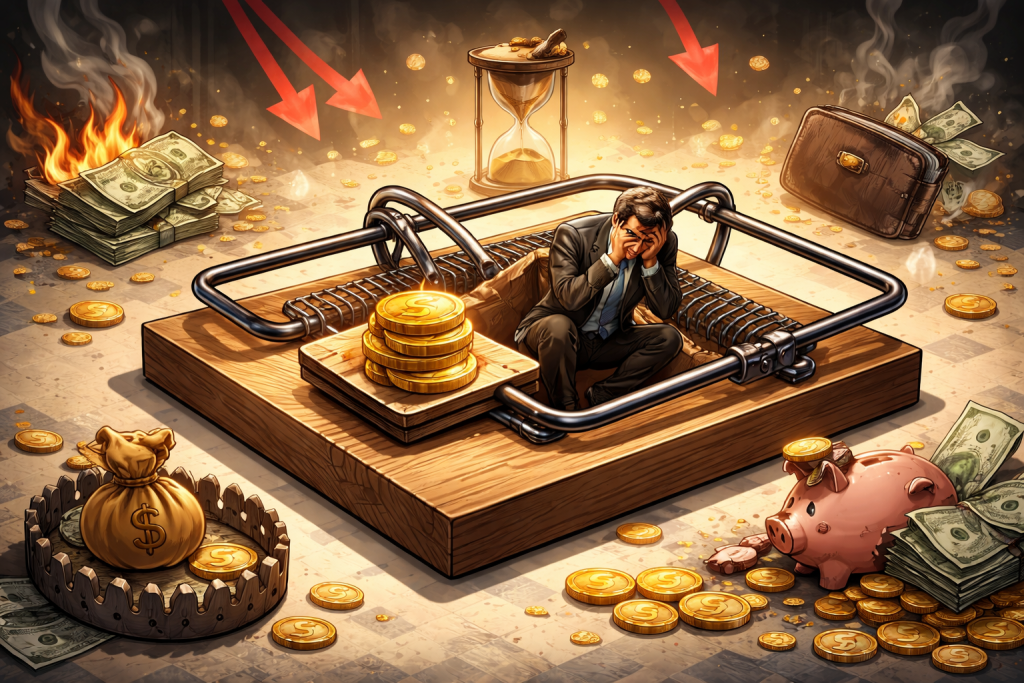
On the surface, this is all solid advice. It’s the foundation of fiscal responsibility. Playing it safe, however, has a dark side. There is a very specific point where healthy caution turns into something much more dangerous: the scarcity trap.
Whenever the markets twitch and the headlines turn apocalyptic, our lizard brains tell us to freeze. We cling to our portfolios, terrified that a single wrong move or any risk at all will result in a total loss. The result is that we stop looking for ways to win and start obsessing over ways not to lose.
However, here’s the hard truth: In an uncertain economy, the biggest risk is not a market decline. It’s the invisible tax of a life you didn’t build while hiding.
Unless you want your survival instincts to sabotage your success, you will never be truly free when you retire. Let’s stop crouching and play the long game again.
Table of Contents
ToggleUnderstanding the Psychology: Why We Crouch
As humans, we’re hardwired for “loss aversion.” This idea is central to Prospect Theory, identified by Nobel Prize-winning psychologists Daniel Kahneman and Amos Tversky.
The research shows that a loss has a negative emotional impact (pain) that is twice as strong as a gain’s positive emotional impact (pleasure).
Think about that. The “pain” of losing $1,000 is twice as great as the “joy” of gaining $1,000. At a primal level, this internal alarm system ensured we didn’t take unnecessary risks with our lives. But in a modern financial sense, it’s a trap. As a result, we become stagnant and prioritize “not losing” over the growth we need to accomplish our tasks.
Because of a scarcity mindset, you must have a smaller share of the pie if someone else gets a slice. When it comes to investing, though, this mindset manifests itself as a paralyzing fear of market dips. Rather than looking at a 10% market correction as a “sale,” the scarcity-trapped brain sees it as the end of wealth.
The Hidden Cost of “Safety”
One of the biggest dangers of the scarcity trap is that it appears to be a “responsible” choice. When the S&P 500 behaves like a roller coaster, it may seem safer to keep your money in a savings account. In reality, this “safety” is an illusion.
Let’s take a look at the silent predator: inflation. A “safe” account earning 0.5% while inflation sits at 3% or 4% isn’t protecting your money, so your purchasing power will be weakened.
In other words, you trade the possibility of a short-term loss for the certainty of a long-term decline in your standard of living when you avoid the short-term volatility of the stock market. The scarcity trap’s ultimate irony is that, in an effort to lose nothing, you can’t gain anything.
Shifting the Narrative: From Protection to Production
To escape the trap, we need an abundance mindset. You don’t have to be reckless or ignore market reality; you just have to change your relationship with it.
See volatility as the “fee,” not the “fine.”
Market fluctuations are the price you pay for long-term gains. If you want the market’s historical 7–10% returns, you gotta pay the “fee” of the occasional 20% drop. When you view a dip as a punishment for a bad decision, you’ll naturally want to avoid it. When viewed as a fee, you simply factor it into your business costs.
Focus on value creation, not just resource management.
Scarcity mindsets are obsessed with keeping. An abundance mindset, on the other hand, obsesses with creating. For example, you might invest in a new skill or a side business that will increase your earning potential. No matter what the interest-rate environment looks like, the focus should be on companies and assets that solve problems and create value.
Practice “strategic generosity.”
It sounds counterintuitive, but giving is one of the fastest ways to break a scarcity mindset. Giving reinforces to your subconscious that you have more than enough, whether it’s mentoring a junior colleague or donating to a good cause. By sharing resources, you subtly reinforce the idea that you have more than enough, which can lead to feelings of gratitude, peace, and financial empowerment.
Tactical Steps to Build an Abundance-Based Portfolio
In case you find yourself in a defensive crouch, here’s how to get out of it without losing sleep:
- The “sleep well at night” (SWAN) buffer. Make sure you have 6–12 months’ worth of liquid expenses in a high-yield savings account. When you have mathematically secured your survival needs, you can view your investment accounts from an abundance perspective.
- Automate your optimism. Consider setting up recurring contributions. In essence, dollar-cost averaging trains your brain to celebrate market dips by forcing you to buy more shares when prices are low.
- Stop checking the scoreboard. When it comes to long-term investing, checking your accounts daily creates scarcity thinking. Instead, set a schedule, like once a quarter or twice a year, to rebalance and move on.
The “Enough” Paradox
Moving goalposts are the final hurdle of the scarcity trap. There’s a popular belief that once one reaches a specific bank account balance, they will shift to an abundance mindset. Scarcity is a mental state, though, not a mathematical one. A billionaire can live in constant fear, for example, while a person of modest means can live in total security.
It’s only by realizing your ability to adapt, learn, and create value that you can achieve true abundance. There will be ups and downs in the markets. All cycles come and go. But when you focus on growth over preservation, you move toward a retirement defined by opportunity rather than limitation.
Conclusion: The Choice is Yours
There’s something comfortable about the scarcity trap. It’s quiet, predictable, and feels like a fortress. However, fortresses can also be prisons.
In these uncertain times, ask yourself this question: Do my financial decisions reflect what I hope to achieve or what I’m afraid of losing? When you view the market and your life through the lens of abundance, you stop being a victim of the economic cycle and become a beneficiary.
So, take advantage of the gains out there; don’t let a temporary loss keep you from getting them.
FAQs
Does an “abundance mindset” mean I should ignore the risks of a market crash?
Not at all. An abundance mindset isn’t blind optimism; it’s rational preparation. It means accepting that market volatility is a historical certainty and implementing a strategy, such as the SWAN buffer, to help you stay invested. It’s the difference between recklessness and resilience.
How do I stop the “lizard brain” from taking over when I see my portfolio drop?
Biology is a tough opponent, but automation can outsmart it. By setting up recurring contributions (dollar-cost averaging), you eliminate the need to make decisions. By buying more at “discounted” prices when the market dips, your system helps reframe a “loss” as a long-term victory.
Why is a traditional savings account considered “risky” in this context?
In a standard savings account, your bank balance won’t drop, but your purchasing power likely will. If inflation is 3% and your account is making only 0.5%, you lose 2.5% of your wealth’s value each year. In the long term, the “certainty” of losing value to inflation can be worse than short-term volatility.
What is the “fee vs. fine” mentality, and how does it help?
A “fine” is the punishment you receive for doing something wrong; a “fee” is the price you pay for a service. Market dips can make you feel guilty and motivate you to quit if you view them as fines. But it becomes a manageable business expense rather than a personal failure if you view it as a fee for the market’s 7–10% historical gains.
Can I really achieve an abundance mindset if I don’t have a high net worth yet?
Yes, abundance is a mental framework, not a bank account. The “Enough Paradox” notes that wealth doesn’t automatically solve scarcity issues. By learning new skills, creating value, and managing what you have effectively, you build abundance. When you reach your financial goals, you’ll be able to enjoy them because you started this practice now.
Image Credit: Albert Costill/ChatGPT