For many people, the widely recommended advice to save 15% of each paycheck feels like an insulting joke. If you’re a freelancer, gig worker, or a professional who works commission-only, your income does not arrive in neat, predictable installments. Instead, you might have a $5,000 month followed by a $1,500 month.
You aren’t alone in this struggle. In the U.S., almost one-third of households report that their income varies occasionally (22 percent) or often (9 percent). For those at the start of their careers or low-income individuals, the challenge is even more acute: over half of households earning less than $25,000 a year in 2023 reported experiencing month-to-month income fluctuations.
Research also shows that economically vulnerable groups are harder hit by this instability — including lower-income households, Black households, and those with less education. When income’s tight, “consumption variability” spikes in essentials like food, personal care, and entertainment.
But there’s more to financial volatility than just your bank account. With limited access to loans or safety nets, adult workers must constantly balance the cognitive load of planning under uncertainty. This stress is heightened for parents as they try to balance their children’s needs with shifting financial circumstances. During periods of instability, family routines can be disrupted, and stress levels can rise, negatively impacting children’s school engagement, attendance, and long-term achievement.
As a result of this environment, “consistent investing” seems impossible — a challenge that often stems from what your low bank account says about your mindset. However, inconsistent income is not always an excuse to completely neglect your future. In fact, because your employer doesn’t sponsor a pension, investing is even more critical for you than for a W-2 employee.
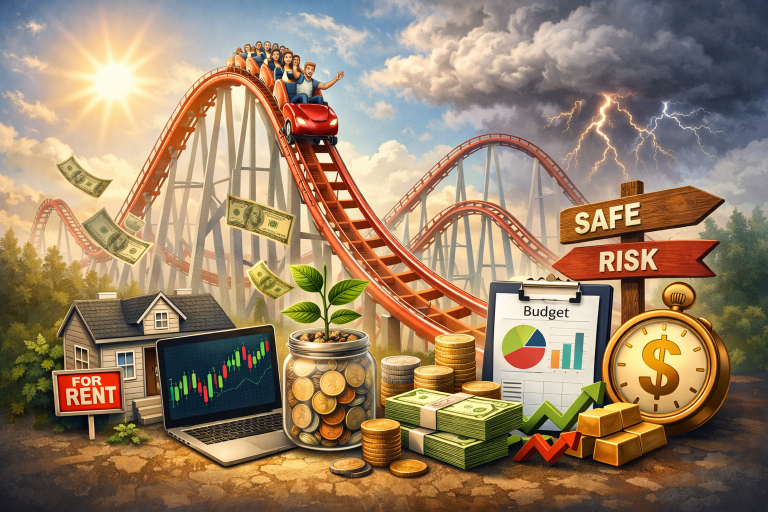
With that said, if you feel like you are living on a roller coaster, I have the blueprint you need to build wealth.
Phase 1: The “Buffer” Strategy
Before you buy a single stock, you’ve got to address the “feast or famine” cycle. After all, it’s hard to invest consistently if you’re constantly raiding your brokerage account to pay your electric bill.
The hills and valleys account.
The best way to manage variable income is to prevent the “feast or famine” cycle. As long as your savings are constantly raided to pay the electric bill during a dry spell, you cannot invest or plan for the future.
Instead of spending your earnings immediately, you should open a holding account, ideally a high-yield savings account, to act as a shock absorber. After that, you’ll want to do the following;
- Find your “baseline” number. Take a look at your last six months. To cover your “four walls” (housing, food, utilities, and transportation), what is the absolute minimum you need? This is your base salary.
- The feast (high-earning months). If you receive a large commission or have a high-volume gig month, do not increase your lifestyle. Put the entire check into your holding account, pay yourself only your base salary, and leave the surplus.
- The famine (low-earning months). If work slows down or a check is delayed, you don’t panic. To pay yourself that same base salary, you simply “withdraw” the difference from your holding account.
If you’re a freelancer, gig worker, or low-income earner, normalizing your paycheck will transform the rollercoaster into a steady, predictable event. As a result, you’ll have the psychological safety you need to finally set up an automated investment system.
Phase 2: Percentage-Based Investing (The “Anti-Budget”)
One of the biggest mistakes variable-income earners make is to invest a fixed dollar amount, such as “$500 every month”. Whenever the $500 isn’t there, they skip the month, lose the habit, and never get back on track.
Instead, consider investing on a percentage basis. Regardless of whether you make $2,000 or $20,000 this month, your commitment remains the same: 20% goes to the future.
For a $2,000 monthly investment, for instance, you invest $400. Although it may seem small, it sustains the habit and keeps momentum going. If your monthly income is $20,000, you invest $4,000. Essentially, this “supercharges” your portfolio and compensates naturally for the leaner months.
Phase 3: The “Three-Bucket” Priority System
Where should the money go when it comes in? As of 2026, the tax landscape for self-employed and low-income earners is more flexible than ever. Here is a priority list to follow:
The Solo 401(k) or SEP IRA.
A Solo 401(k) or SEP IRA is the cornerstone of self-employed retirement planning. Unlike traditional corporate plans, both can be set up relatively quickly, without the administrative headaches or high fees often associated with them.
As a general rule:
- Small business owners or freelancers with no employees (other than their spouses) are best off with the Solo 401(k).
- If your business has several employees, the SEP IRA is often a better choice, since it’s easier to manage.
As of the 2026 tax year, the IRS has significantly increased contribution ceilings. Solo 401(k) participants can defer up to $24,500 as employees ($32,500 if 50+), with a $11,250 “super catch-up” for those aged 60–63, bringing their total employee limit to $35,750. Combining the employer profit-sharing contribution (up to 25% of net earnings) with the total limit, the total limit reaches $72,000 (or $83,250 if the super catch-up is taken).
For older independent workers seeking to maximize their savings, the Solo 401(k) is often a better choice, with a flat limit of 25% of net earnings up to $72,000. However, the SEP IRA offers a simpler structure with a flat limit of 25% of net earnings, up to $72,000, though it lacks the catch-up provisions available in the Solo 401(k).
The Saver’s credit and Match.
You may be eligible for Uncle Sam’s savings program if you earn a low-to-moderate income. With a Roth or Traditional IRA contribution in 2026, you can still claim the Saver’s Credit, which can reduce your tax bill by up to $1,000 ($2,000 for couples).
Additionally, starting in 2027, the government will actually deposit up to $1,000 directly into your account as a 50% match on your first $2,000 saved.
The Roth IRA.
As your income fluctuates, your taxable income can be low for a few years in a row. These are the perfect years for Roth IRA contributions.
Why? So long as you pay a low rate of tax now, the money will grow tax-free.
Phase 4: Overcoming the Psychological Hurdles
If you’re a freelancer or gig worker, or even a low-income worker juggling part-time shifts, you likely suffer from “scarcity paralysis.” This is the nagging fear that the next check won’t arrive, and it often leads you to “hoard” every spare dollar in a low-interest account.
While it may feel like cash is safe, it is actually depreciating due to inflation. However, accumulating too much today leads to a “slow leak” in your future wealth. The trick to breaking this cycle? Focus on the habit rather than saving what’s left.
The “Transfer Tuesday” rule.
Instead of waiting until the end of the month to determine whether you can invest, automate your momentum.
- The freelancer/commission pro. Whenever you receive a payment from a client or commission, immediately transfer your chosen percentage, even if that’s just 5% at first.
- The gig/shift worker. Every week, choose a day to sweep a portion of your earnings. Even if you only made $100 in a week, moving $2 still keeps the neural pathway of “investing” active.
- The low-income strategy. Microinvesting is a great option if your margins are razor-thin. Many apps let you invest spare change or set up “roundups” for your daily purchases. By avoiding a large transfer, you avoid the psychological pain of being stuck at zero.
The most important thing is not to wait until the end of the month to look at what’s left. The “bills of the day” will always find a way to claim what’s left. If you move your money immediately upon receiving it, you’ll learn how to live on the remainder while still building a future for yourself.
Managing the Four Common Scenarios
Your investment strategy shouldn’t be fixed when your income isn’t. Here’s how to handle the four most common financial climates based on “the size of your shovel.”
- The low month. Focus on the “minimum base investment.” Even if it’s just a $5 contribution will keep the habit alive. If margins are thin, choosing the right platform is half the battle. If you want to maintain consistency without eating into your gains in fees, you need a tool that encourages it.
- The average month. Don’t forget to follow your standard percentage-based contribution. After your “base salary” is covered, put 15–20% of your net income directly into your investment accounts.
- The windfall month. This is your “supercharge” phase. Don’t let lifestyle creep steal your money from your tax-favored accounts, such as a Solo 401(k) or SEP IRA.
- The dry spell. If work completely stops, pause your investing and withdraw only from your buffer account. Most importantly, your investment principal should not be touched.
Top platforms for micro-investing in 2026.
With these four options, you can now choose from a variety of low-cost features and low fees to meet your needs.
- Fidelity Go (Best for “No-Fee” Growth). If you’re looking for a professional to manage your money for free, this is the best option. There are no advisory fees for balances under $25,000. With Fidelity’s “Zero Expense Ratio” index funds, every cent of your growth stays with you.
- Acorns (Best for Behavioral Nudges). The king of “painless” investing thanks to its Round-Ups feature. Every time you buy something, like a $4.50 coffee, it rounds it up to the nearest dollar and invests the $0.50 change. However, if your balance is under $500, you may find the $3/month fee to be high.
- Robinhood (Best for High-Match Incentives). The perfect tool for investors who are bored with long-term investing. In addition, they offer a 1% to 3% match on IRA contributions, which is an “instant return” for low-income earners. You can also buy fractional shares of a high-priced stock for just $1.
- SoFi Invest (Best All-in-One Experience). If you wish to manage your banking and investments through one app, this would be ideal for you. There are no account minimums and no commissions. Basically, you invest “free money” by earning rewards for things like checking your credit score, which you can redeem directly into your investment account.
A quick “low-income” pro-tip.
As your primary investment vehicle, a Roth IRA may be a good choice if you’re concerned about your money being “locked away.” In contrast to other retirement accounts, the IRS allows you to withdraw your contributions, the money you put in, without penalty or tax. With a Roth, you can use it as a “backup emergency fund” while it grows, significantly reducing your anxiety about investing.
Conclusion
When your income is inconsistent, investing is like sailing. You can’t control the waves or the wind, but you can control the rudder. When you build a buffer, use percentages, and prioritize tax-advantaged accounts, you can build a massive nest egg while others wait for a “stable” paycheck that may never arrive.
FAQs
Is it better to invest a lump sum or use Dollar Cost Averaging (DCA)?
Vanguard Research found that a lump-sum approach won between 61.6% and 73.7% of the time. Nevertheless, DCA (breaking a large check into 4 weekly chunks) may be easier on your nerves if your income is inconsistent.
What if I can’t afford to invest 20% right now?
Start with 1%. Rather than the amount, the goal is automation. When it comes to self-employment, habits are more valuable than capital.
Should I pay off debt before investing?
Make sure you pay off your debt with interest rates between 18 and 25% (credit cards) first. Investing is a better option if it is a low-interest mortgage.
How much should I keep in my “Buffer Account”?
You should aim for 3 to 6 months’ worth of your “base salary.” This is your operational fund to smooth out your paychecks, separate from your emergency fund.
What is the best account for a low-income worker?
If an absolute emergency strikes, a Roth IRA provides a secondary safety net by allowing withdrawals (but not earnings) without penalty.
Image Credit: Albert Costill/ChatGPT