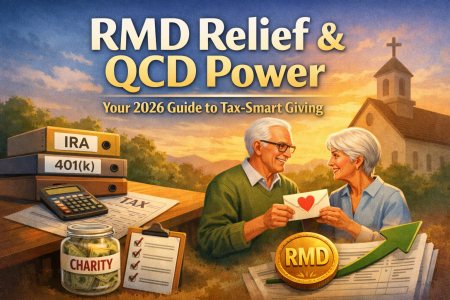
The landscape of retirement and taxes has shifted again. Among retirees, two acronyms carry the most weight: RMD (Required Minimum Distribution) and QCD (Qualified Charitable Distribution).
These aren’t just technical terms if you’re over 70 ½ — they’re keys to a tax-saving strategy that will boost your charitable giving. (For a broader look, see how to plan charitable giving for maximum tax benefits.). With upcoming tax laws, such as the 0.5% AGI floor for itemizers in 2026, the QCD becomes even more powerful.
In this post, we’ll show you how to turn your mandatory withdrawals into tax-free gifts.
Table of Contents
ToggleThe 2026 Retirement Landscape: RMDs Explained
Once you reach a certain age, the IRS requires you to start withdrawing from your tax-deferred retirement accounts, such as a Traditional IRA. This is your Required Minimum Distribution (RMD).
When do RMDs start in 2026?
You must begin taking RMDs based on your birth year thanks to the SECURE 2.0 Act:
- Born 1950 or earlier: Subject to older rules that started at 72 or 70 ½.
- Born 1951–1959: Your RMD age is 73.
- Born 1960 or later: Your RMD age is 75.
Taking an RMD can trigger a “tax trap,” as these distributions are taxed as ordinary income and may result in higher taxes, increased Medicare premiums (via IRMAA surcharges), and potentially higher Social Security taxes.
Despite these recent changes, people turning 73 in 2026 will begin taking RMDs in 2026, while those born in 1960 will not begin taking RMDs until 2033. It’s important to remember that your first RMD is due on April 1st after reaching retirement age. But if you take it by December 31st, you won’t have to pay two distributions and taxes the following year.
The “QCD Power” Move: Your Tax-Smart Solution
In contrast to RMDs, you can make QCDs as early as age 70 ½.
A QCD is a direct transfer of funds from an IRA custodian to a qualified 501(c)(3) charity. QCD limits have been adjusted for inflation in 2026 to $115,000 per individual — $230,000 if both spouses have their own IRAs.
Why the QCD is a “Triple Win” in 2026:
- Satisfies your RMD. The amount you contribute via QCD counts toward your RMD for the year.
- Zero taxable income. Unlike a standard withdrawal, the QCD amount is not included in your Adjusted Gross Income (AGI). Additionally, taxes are not owed on that money.
- Preserves deductions. As the QCD lowers your AGI, it helps you avoid Medicare surcharges and preserve other tax credits that disappear as income increases.
Step-by-Step: How to Use a QCD to Satisfy Your RMD
If you want your distribution to be “qualified” and tax-free, you must follow a strict process. Most notably, a tax benefit cannot be claimed if the money is first transferred to your personal bank account.
Step 1: Confirm the charity’s eligibility.
An organization must be a qualified 501(c)(3). Houses of worship, schools, and nonprofits are typically eligible.
Please note, however, that QCDs cannot be used to fund Donor-Advised Funds (DAFs) or private foundations.
Step 2: Contact your IRA custodian.
Don’t just withdraw the money. Request a QCD Distribution Form from your financial institution, such as Vanguard, Fidelity, or Schwab. Many custodians now allow you to do this online or even provide you with a “checkbook” so you can write checks directly to charities.
Step 3: Direct the transfer.
Ask the custodian to make the check payable directly to the charity. As long as it is not made payable to you, the check can be mailed to the charity’s address or delivered to you personally.
Step 4: Keep your receipt.
The charity should acknowledge your gift in writing. To prove that the distribution was charitable, you will need to keep this for your records.
Step 5: Report It Correctly on Your Taxes
Most people make this mistake. After the end of the year, your IRA custodian will issue you a Form 1099-R. This form typically shows the total distribution but does not specify QCDs. You or your CPA must report the total distribution on line 4a of your Form 1040. However, you should enter $0 on line 4b, or the remaining taxable amount, along with “QCD.”
2026 Strategy: Why QCDs Beat Itemizing
For those who itemize, new tax rules introduce a 0.5% AGI floor in 2026. For example, if your AGI is $100,000, your first $500 of donations will not be deductible.
A QCD, however, bypasses this entirely. Since the money never appears in your income to begin with, you don’t have to worry about ceilings, floors, or standard deductions. As such, every dollar you give is tax-deductible.
Summary for Your 2026 Planning
When considering your 2026 finances, you don’t want your RMD to become a tax burden. With the QCD Power Move, you can satisfy your legal requirements, support your community, and reduce your taxable income.
For more retirement planning strategies, explore our comprehensive retirement guide, review the latest retirement statistics, and learn how an annuity can provide guaranteed income alongside your QCD strategy.
FAQs
Can I use a QCD if I don’t itemize my taxes?
Absolutely. In fact, this is the biggest advantage of QCDs. Even if you take the Standard Deduction, you receive the tax benefit since the distribution is excluded from your income.
I’m 71 but don’t have an RMD yet. Should I still do a QCD?
Yes, if you are charitably inclined. A QCD allows you to support causes you care about using “pre-tax” dollars, even if you aren’t forced to take them out yet. As a result, your future IRA size is reduced, which in turn reduces your future RMDs when they start at age 73 or 75.
Does the money have to come from a Traditional IRA?
You can make QCDs from Traditional IRAs, Inherited IRAs, and “inactive” SEP or SIMPLE IRAs — meaning you didn’t contribute to the plan during the year. The contributions can’t come from active employer plans, such as a 401(k).
What happens if I accidentally take my RMD as a personal withdrawal first
In general, the IRS does not allow “do-overs.” If you withdraw money from your personal account and then write a check to a charity, that withdrawal is taxable income. To qualify as a QCD, the custodian must transfer funds directly to the charity.
Can I donate appreciated investments instead of cash for the same benefit?
An appreciated asset can be tax-efficiently donated from a taxable brokerage account, but it’s not the same as a qualified charitable distribution.
As long as the transfer is from an IRA to a charity, it qualifies as a QCD. Often, QCDs are more powerful than stock donations for retirees facing RMD taxes because they prevent income from ever being reported.
What mistakes should retirees avoid when using QCDs?
Among the most common errors are:
- Withdrawing money from the IRA before sending it to the charity.
- Write a personal check instead of a direct IRA transfer.
- Donating to a donor-advised fund.
- Inadequate tax documentation.
It’s important to follow the right order and method; small errors can lead to a tax deduction being denied.
Image Credit: Albert Costill/ChatGPT