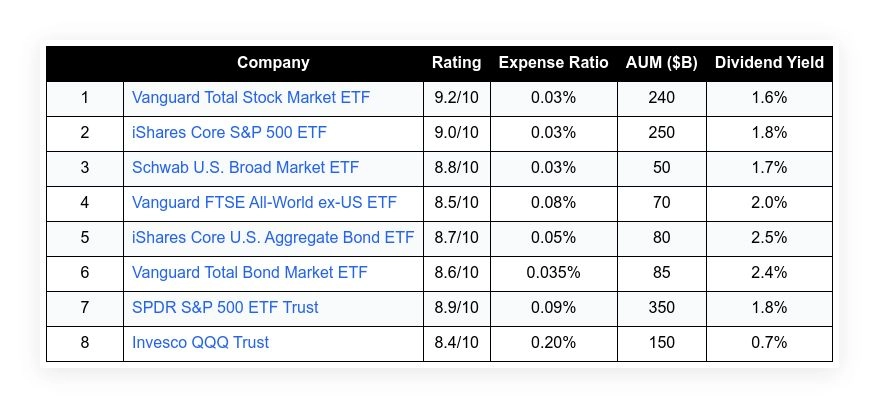
Would you like a detailed ranking of eight exchange-traded funds well-suited for retirement planning? My goal is to assist investors in finding funds that offer a combination of low fees, diverse holdings, and strong historical performance. The selection benefits those seeking a balance of growth and income during retirement.
Background research from established financial institutions and consistent market performance have guided this list. The evaluation criteria include clear and measurable metrics that offer an objective view of each fund’s potential. The analysis focused on factors such as:
- Expense Ratio
- Assets Under Management
- Dividend Yield
- Historical Performance
- Liquidity
These points form the basis for the ranking and serve as a guide for investors choosing a fund for long-term retirement income.
Top 8 ETFs for Retirement
Vanguard Total Stock Market ETF
Vanguard Total Stock Market ETF offers broad exposure to large, mid, and small-cap stocks. It delivers a blend of growth potential and stability for retirement portfolios. The fund has maintained a low expense ratio and attracts significant investor interest.
Historical results remain strong, and investors appreciate the fund’s consistent performance. It is suited for those looking to capture diverse market returns. In-depth analysis shows this ETF as a solid option in retirement planning. Its market reach and established reputation make it notable among similar offerings.
Expense Ratio: 0.03%
AUM: $240B
Dividend Yield: 1.6%
Performance History: Solid
Liquidity: High
| Summary of Online Reviews |
|---|
| “Investors praise its low fees and wide market exposure,” notes multiple reviews. |
iShares Core S&P 500 ETF
iShares Core S&P 500 ETF tracks the performance of the S&P 500 index, offering large-cap exposure. Investors value the fund for its reliability and efficient tracking. It has a competitive expense ratio and substantial assets under management. The fund supports a balanced retirement plan by combining income with growth potential. Its disciplined strategy maintains stable performance even during market fluctuations.
Expense Ratio: 0.03%
AUM: $250B
Dividend Yield: 1.8%
Performance History: Strong
Liquidity: Excellent
| Summary of Online Reviews |
|---|
| “Users appreciate its consistent performance and minimal cost,” is a common review sentiment. |
Schwab U.S. Broad Market ETF
Schwab U.S. Broad Market ETF offers exposure to the total U.S. equity market. The fund stands out with its appealing fee structure and diverse portfolio. Investors find it practical for a balanced retirement approach. It is known for swift trade execution and a transparent investment process. Analysts acknowledge its potential to deliver reliable returns with steady dividend payouts.
Expense Ratio: 0.03%
AUM: $50B
Dividend Yield: 1.7%
Performance History: Dependable
Liquidity: High
| Summary of Online Reviews |
|---|
| “Many investors comment on its value pricing and solid diversification,” reflected in user feedback. |
Vanguard FTSE All-World ex-US ETF
Vanguard FTSE All-World ex-US ETF provides international diversification by including stocks from outside the United States. Investors use this fund to balance domestic holdings with global market exposure. Its moderately low fee and solid asset base make it a suitable option for long-term retirement plans.
Market reviews highlight its dependable handling of currency and regional variations. The fund is valued for its steady income distribution and cost control.
Expense Ratio: 0.08%
AUM: $70B
Dividend Yield: 2.0%
Performance History: Steady
Liquidity: Moderate
| Summary of Online Reviews |
|---|
| “Investors praise its global reach and balanced risk management,” reflects customer feedback. |
iShares Core U.S. Aggregate Bond ETF
iShares Core U.S. Aggregate Bond ETF focuses on fixed-income assets. It is designed to add stability and regular income to retirement portfolios. With a very competitive fee and broad exposure to the bond market, it provides balance during volatile periods.
The fund is known for consistent yield and quality diversification. It is helpful for investors seeking income and less market sensitivity through bonds.
Expense Ratio: 0.05%
AUM: $80B
Dividend Yield: 2.5%
Performance History: Reliable
Liquidity: High
| Summary of Online Reviews |
|---|
| “Reviewers note its steady income generation and reliable bond exposure,” summarizes user impressions. |
Vanguard Total Bond Market ETF
Vanguard Total Bond Market ETF gives investors exposure across the U.S. bond market. It supports retirement strategies that need consistent income alongside lower volatility. The fund has shown reliable performance with an attractive fee structure. Investors appreciate its breadth and low costs, which add value in a conservative portfolio.
This ETF is a key tool for those seeking stability and predictable returns in fixed-income allocations.
Expense Ratio: 0.035%
AUM: $85B
Dividend Yield: 2.4%
Performance History: Consistent
Liquidity: High
| Summary of Online Reviews |
|---|
| “Users call it a cornerstone for diversified income portfolios,” according to recent comments. |
SPDR S&P 500 ETF Trust
SPDR S&P 500 ETF Trust follows the S&P 500 index and is popular among investors. Its high AUM and established track record offer reliable exposure to blue-chip stocks. The fund’s structure encourages steady dividend returns. Many investors use this ETF to complement a retirement portfolio with a blend of market stability and growth opportunities.
Expense Ratio: 0.09%
AUM: $350B
Dividend Yield: 1.8%
Performance History: Reliable
Liquidity: Excellent
| Summary of Online Reviews |
|---|
| “Users often mention its market-leading scale and performance reliability,” shared across reviews. |
Invesco QQQ Trust

Invesco QQQ Trust offers exposure to technology and growth-oriented stocks. It is chosen for its dynamic performance and exposure to innovative companies. Although it has a higher fee compared to others, investors find that the potential for higher returns mitigates this cost. The fund is effective for those with a higher risk tolerance looking to boost returns during retirement wealth accumulation.
Expense Ratio: 0.20%
AUM: $150B
Dividend Yield: 0.7%
Performance History: Variable
Liquidity: High
| Summary of Online Reviews |
|---|
| “Investors note its strong tech focus and potential for growth,” according to feedback. |
Final Thoughts
The ETFs above offer various approaches for retirement planning. Each fund provides a unique mix of growth, income, and diversification. Investors can choose among broad market exposure, international diversity, or fixed-income stability. The ranking is based on objective criteria like fees, assets, dividend yield, performance, and liquidity.
This selection helps investors tailor choices to their financial goals. A careful review of these factors will support wiser investment decisions for long-term retirement planning.
Related Reading: Looking to hedge a fund-heavy portfolio? Learn about futures trading in retirement accounts.
Related Reading: Not sure where to hold these funds? Compare the types of investment accounts for beginners.
Related Reading: Want growing payouts too? See the best Vanguard dividend ETFs to fund your retirement.
Related Reading: Want targeted sector exposure? Compare the top airline ETFs and how they fit a portfolio.

How to Choose the Best ETFs for Retirement
Exchange-traded funds have become a cornerstone of modern retirement portfolios because they bundle dozens or thousands of holdings into a single, low-cost, tradable fund. Choosing the best ETFs for retirement is less about chasing last year’s winner and more about building a diversified core you can hold for decades. The funds ranked above span U.S. stocks, international stocks, and bonds, which are the building blocks most retirement plans need.
Mind the expense ratio
Because ETFs are held for the long haul, even small fee differences compound into meaningful sums over time. Broad index ETFs often carry rock-bottom expense ratios, which is a big reason they suit retirement saving so well. For a wider comparison of passive options, see our guide to low-cost index funds for retirement and our roundup of high-return investments for retirement.
Diversify across asset classes
A resilient retirement portfolio usually blends stock ETFs for growth with bond ETFs for stability, and often adds international and real-estate exposure. As you near retirement, tilting toward income-producing funds helps protect against having to sell during a downturn. Explore complementary income ideas in our look at the best REIT ETFs for retirement and Vanguard dividend ETFs.
Building an ETF Portfolio That Lasts
A simple three-fund approach — a total U.S. stock ETF, a total international stock ETF, and a total bond ETF — gives most investors broad diversification at minimal cost. From there you can adjust the stock-to-bond ratio to match your age and risk tolerance, rebalancing once or twice a year to keep your plan on track.
Let dividends compound
Reinvesting the dividends your ETFs pay is one of the most powerful ways to grow your balance over time, since each reinvested payout buys more shares that generate their own returns. This pairs naturally with the long-term mindset described in our guide to compound interest investments for retirement. For an authoritative primer on how these funds work, see the U.S. Securities and Exchange Commission’s Investor.gov guide to mutual funds and ETFs.
Key Takeaways
The best retirement ETFs are broadly diversified, inexpensive, and held for the long term. Build a simple core of stock and bond funds, keep fees low, reinvest dividends, and rebalance periodically rather than reacting to headlines. Match your stock-to-bond mix to your time horizon, and remember that past performance never guarantees future results. For a plain-English explanation of how ETFs are structured, Investopedia’s overview of ETFs is a useful reference.
Frequently Asked Questions
What are the best ETFs for retirement?
For most investors, broad, low-cost index ETFs covering the total U.S. stock market, international stocks, and the U.S. bond market form an excellent retirement core. The right blend depends on your age and risk tolerance, with more bonds added as you approach retirement.
How many ETFs do I need for a retirement portfolio?
You can build a well-diversified retirement portfolio with just three ETFs: a total U.S. stock fund, a total international stock fund, and a total bond fund. Adding more is optional and mainly useful for targeting specific exposures like real estate or dividends.
Are ETFs safe for retirement savings?
Diversified ETFs spread risk across many holdings, which makes them less volatile than individual stocks, but they still rise and fall with the market. You can manage that risk by holding a mix of stock and bond ETFs, keeping costs low, and staying invested through market cycles.
Related Reading: Want lower volatility and steady income? Compare the best defensive ETFs for retirement.
Related Reading: For the broadest one-fund option, compare the best total market ETFs for retirement.