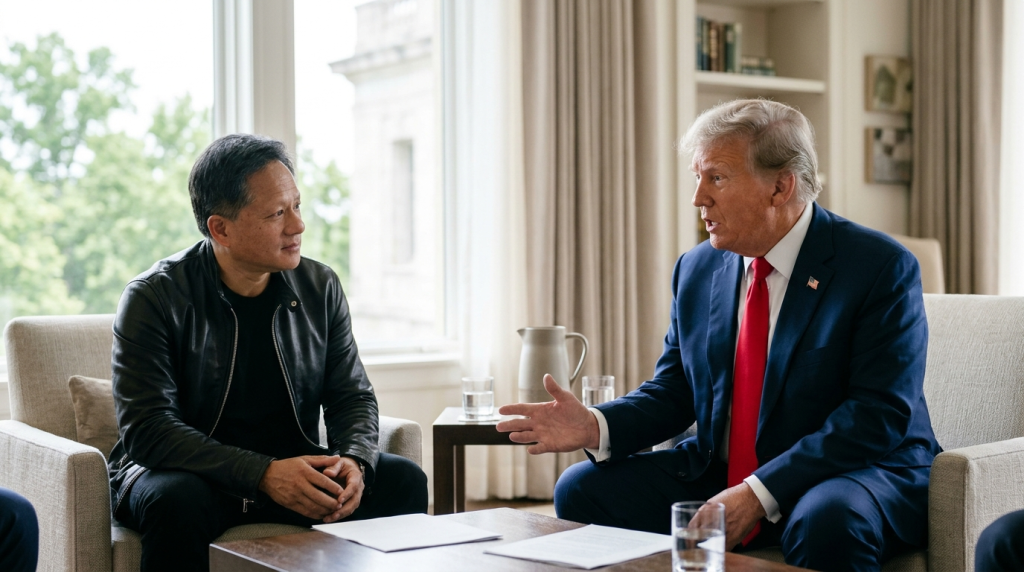
President Donald Trump said he would consider pardoning Nvidia chief executive Jensen Huang if necessary, while arguing Huang should not need to invoke the Fifth Amendment before Congress.
The remarks introduced the prospect of presidential intervention without identifying a criminal charge or explaining why Huang might seek constitutional protection. That missing detail matters because a pardon addresses criminal exposure, while the Fifth Amendment protects people from being forced to incriminate themselves.
Table of Contents
ToggleTrump Signals Support for Huang
Trump’s comments placed him firmly behind the leader of Nvidia, a major supplier of chips used to train and operate artificial intelligence systems.
Trump said he would be willing to pardon Huang if needed and argued that the Nvidia CEO should not have to invoke the Fifth Amendment before Congress.
The statement did not establish that Huang had requested a pardon, planned to invoke the amendment, or faced criminal allegations. It also did not specify which congressional proceeding Trump had in mind.
Those distinctions are important. Congressional scrutiny can involve policy disagreements, regulatory questions, or fact-finding without producing criminal charges. A witness may also invoke constitutional rights without admitting wrongdoing.
What the Fifth Amendment Protects
The Fifth Amendment allows a person to decline answers that could create a reasonable risk of self-incrimination. Its protection applies in congressional hearings as well as court proceedings.
Invoking the right is not proof of guilt. The protection exists to prevent the government from forcing a person to supply evidence that prosecutors could later use.
Congress can respond in several ways when a witness claims the privilege. Lawmakers may narrow their questions, challenge the claim, or consider immunity under established legal procedures. Immunity can require testimony while limiting how prosecutors use it.
- A pardon can remove federal criminal liability for covered conduct.
- It does not erase state criminal exposure.
- It does not automatically prevent congressional questioning.
- Its scope depends on the language and timing of the grant.
A Pardon Would Raise Legal Questions
The Constitution gives presidents broad authority to pardon federal offenses, except in impeachment cases. Presidents may issue pardons before charges are filed, as the Supreme Court recognized in the 1866 case Ex parte Garland.
Still, Trump’s use of “if needed” leaves the proposal hypothetical. No stated offense, time period, or conduct was attached to the idea. Without those terms, its possible legal effect cannot be measured.
A pardon could also affect whether a witness has a valid Fifth Amendment claim. If it fully removes the risk of federal prosecution, that risk may no longer justify silence. State exposure or unrelated conduct could complicate the analysis.
High Stakes for Nvidia and Congress
Nvidia sits near the center of the artificial intelligence boom, making Huang an influential voice in debates about technology, trade, competition, and national security. Any congressional appearance by him would draw close attention from investors and policymakers.
Supporters of Trump’s position may view the offer as protection against unfair political pressure. Critics may see a preemptive pardon discussion as interference with congressional oversight, especially before lawmakers have publicly established the need for criminal safeguards.
The immediate takeaway is narrower than the political noise. Trump expressed support for Huang, but the stated remarks did not identify an investigation, charge, pardon request, or planned assertion of constitutional rights.
What happens next will depend on specifics: whether Congress seeks Huang’s testimony, what questions lawmakers ask, and whether any real criminal exposure exists. Until then, the pardon remains a presidential possibility in search of a defined legal problem.