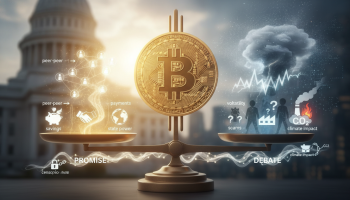
As lawmakers revisit digital asset policy and markets swing on crypto headlines, one idea keeps returning to center stage: money that moves without a middleman. At issue is how Bitcoin’s peer-to-peer design could reshape payments, savings, and even state power. Supporters say it cuts fees and censorship. Skeptics warn about volatility, scams, and climate impact.
The core pitch is simple and bold. Send value to anyone, anytime, with no bank in the middle. That idea is again driving debates in finance committees, remittance corridors, and server rooms around the world.
Table of Contents
ToggleHow Bitcoin’s Design Differs From Traditional Money
Bitcoin is software that runs on a network of independent computers. There is no central authority that issues coins or approves transfers.
“Bitcoin runs on a P2P network instead of being controlled by the government, a bank, etc. It lets you send value directly to someone else without a middleman,” one advocate said.
Transactions are recorded on a public ledger called a blockchain. New entries are added in batches, and the network agrees on a single history. This prevents double spending without a central bookkeeper.
The idea dates to a 2008 white paper by the pseudonymous Satoshi Nakamoto and the first software release in 2009. Since then, exchanges, wallets, and payment apps have made it easier to use, though the core protocol has stayed conservative.
Why It Matters Now
Two forces are driving fresh interest. First, cross-border payments remain slow and expensive in many regions. Second, concerns about financial surveillance and censorship have grown with the rise of digital banking.
El Salvador adopted bitcoin as legal tender in 2021 to reduce remittance costs. Other countries have studied the approach but held back, citing price swings and consumer risks.
Large firms now hold bitcoin on balance sheets, treating it like digital gold. Regulators, meanwhile, are writing rules for exchanges and stablecoins, trying to protect users without choking innovation.
Benefits Cited by Supporters
- Direct, global transfers settle without bank hours or borders.
- Limited supply is meant to protect savings from inflation.
- Open access can help people without bank accounts.
- Resilience from decentralization reduces single points of failure.
Developers also highlight the Lightning Network, a layer built for faster and cheaper small payments. It moves many actions off-chain while settling final balances on the main ledger.
The Case From Critics
Economists and consumer groups raise three main issues. First, price volatility can wipe out savings and make everyday costs hard to manage. Second, thefts and scams remain frequent, especially when users mishandle private keys or trust shady platforms. Third, energy use from mining is high, sparking climate concerns.
Law enforcement adds another worry: illegal finance. While all base-layer transfers are public, criminals can still exploit weak oversight at entry and exit points. Regulators push for stronger checks at exchanges and brokers.
Regulation, Risk, and the Road Ahead
Policymakers are nudging the sector toward bank-like safeguards. They want proof of reserves, clear audits, and rules for custody. Consumer warnings about meme coins and get‑rich‑quick schemes are louder than ever.
Banks are also adapting. Some offer crypto custody or research. Payment firms pilot bitcoin payouts for contractors or creators. Others keep a firm distance, citing compliance and reputation risk.
Developers argue that self-custody and open protocols reduce systemic risk from failures like exchange collapses. Traditional finance counters that user protection still requires rules, disclosures, and capital buffers.
What Adoption Could Look Like
Analysts outline two realistic paths. The first is “digital gold,” in which bitcoin serves as a store of value and a hedge. The second is “internet cash” for niche payments, aided by Lightning and better wallets.
Both paths depend on smoother user experience, stronger security, and clearer rules. Any path also hinges on stable access to electricity and reliable internet, which remain uneven globally.
The Bottom Line
Bitcoin’s peer-to-peer promise is simple. The system cuts intermediaries and hands control to users. That promise collides with real-world risks that demand careful policy and better tools.
Expect more pilots in remittances and micro-payments, tighter oversight for platforms, and louder debates over energy. Watch for consumer protections that do not break decentralization, and for wallets that make self-custody less scary.
For now, the contest is clear. Can an open network handle money at scale while staying resilient and fair? Markets, miners, and lawmakers are still writing that answer.