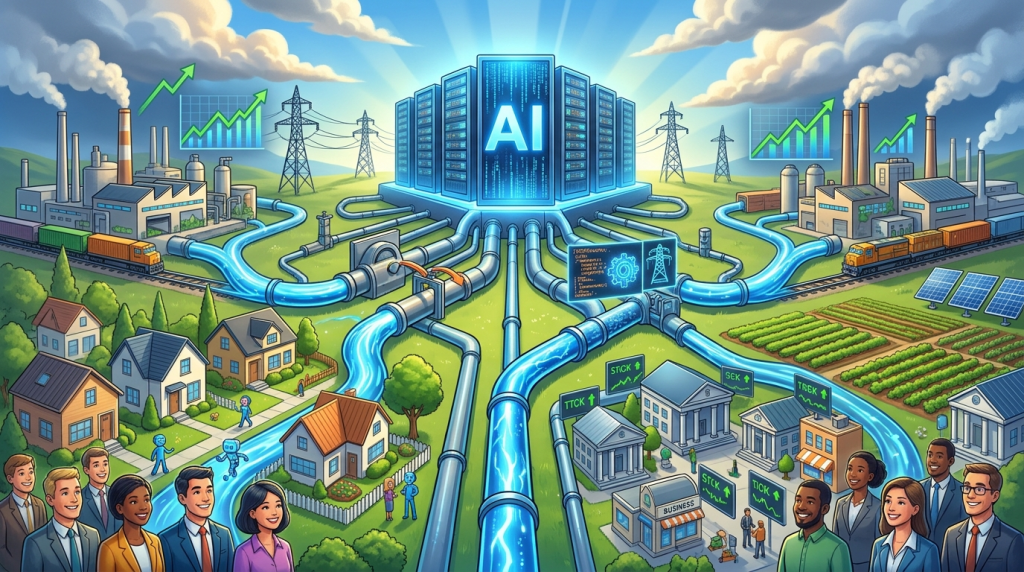
Investors often view a slowdown in artificial intelligence spending as a direct threat to the stock market. That concern makes sense for chipmakers and AI infrastructure firms. Yet the wider economic effect may be less harmful. An AI slowdown could reduce inflation, lower interest rates, revive housing, and spread market gains across more industries.
I am Taylor Sohns, CEO of LifeGoal Wealth Advisors, a Certified Investment Management Analyst and Certified Financial Planner. My firm manages more than $500 million. From that perspective, the central question isn’t simply whether AI spending will slow. It is how such a shift could affect inflation, borrowing costs, corporate cash flow, and the broader market.
Table of Contents
ToggleThe Market’s Biggest AI Question
AI investment has become a major force behind economic growth and stock returns. Large technology companies are spending heavily on chips, data centers, electrical systems, and computing capacity.
This spending has helped companies such as NVIDIA and other semiconductor firms grow rapidly. It has also supported data center operators, cloud providers, utilities, construction firms, and equipment suppliers.
That creates a common fear. If the AI build-out slows, investors worry that the entire market could suffer. However, this view may confuse the fate of leading AI stocks with the prospects of every public company.
A spending slowdown would likely hurt businesses whose valuations depend on continued AI investment. NVIDIA could face weaker chip demand. CoreWeave could encounter pressure on growth expectations. Oracle could feel the effects if demand for cloud infrastructure cooled.
Those outcomes could hurt shareholders in the affected companies. They would not automatically signal an economic crisis.
“Yes, NVIDIA and semiconductors get punked, but is it really that bad for the rest of the market?”
That distinction matters because major technology companies now carry an unusually large share of broad stock indexes. A sharp decline among those leaders could pull index prices lower, even if conditions improve for many other businesses.
View this post on Instagram
AI Spending Can Add to Inflation
AI services may feel digital, but the systems supporting them require significant physical capacity. Data centers need electricity, land, cooling equipment, construction materials, networking gear, and trained workers.
Demand for those resources can raise prices. New data centers compete with homes, factories, and existing businesses for available electricity. Construction projects also compete for engineers, electricians, technicians, and specialized equipment.
Beyond energy policy and pressure on oil supply, I see AI investment as a key driver of inflation. The effect may appear across several areas:
- Data centers require large and steady supplies of electricity.
- Construction increases demand for steel, concrete, cooling systems, and electrical equipment.
- Specialized projects compete for skilled labor in fields with limited worker supply.
- Technology companies order advanced chips and servers rapidly.
- Utilities must invest in generation and transmission to meet new demand.
If AI construction slows, pressure on these resources could ease. Lower demand would not immediately lower every price. It could still help cool one important source of spending.
This is the less obvious side of an AI downturn. What hurts one group of stocks may reduce expenses elsewhere. Businesses that have struggled with high energy, labor, and financing costs could gain some relief.
Lower Inflation Could Change Interest Rates
Inflation influences interest-rate policy. When prices rise too quickly, the Federal Reserve often keeps rates high to limit borrowing and demand. If inflation cools, policymakers have more room to reduce rates.
An AI slowdown alone would not determine Federal Reserve policy. Officials also study employment, wages, consumer spending, housing, and many other measures. Still, weaker demand for electricity, materials, and skilled labor could support a broader decline in inflation.
Falling policy rates may then reduce borrowing costs across the economy. Corporate loans could become less expensive. Auto financing may improve. Mortgage rates could also decline, though they do not move in lockstep with the Federal Reserve.
For many companies, interest expense has been a serious burden. Smaller businesses and firms with weaker balance sheets tend to feel high rates more than cash-rich technology giants. Lower rates could give these companies room to refinance debt and invest.
That change would help explain why an AI slowdown may produce mixed results rather than broad destruction. AI leaders could lose momentum while rate-sensitive businesses begin to recover.
Housing Could Regain Its Pulse
The housing market has been stuck between high prices and elevated mortgage rates. Many owners secured low mortgage rates before borrowing costs climbed. Selling would often mean replacing a cheap loan with a far more expensive one.
This lock-in effect has limited the supply of existing homes. It has also discouraged moves by families who might otherwise relocate for work, space, schools, or retirement.
Lower mortgage rates could bring some buyers and sellers back. Monthly payments would become more manageable for qualified borrowers. Existing owners might also feel less trapped by their current loans.
I would not expect a lower rate to solve every housing problem. Home supply remains tight in many areas, and prices may stay high. Yet improved financing could restore transaction activity.
Housing also reaches far into the economy. A home sale can support brokers, lenders, inspectors, moving companies, contractors, furniture stores, and appliance makers. More activity could benefit businesses with little direct connection to AI.
Big Technology Could Produce More Cash
The largest technology firms are spending huge sums on AI. These investments include data centers, chips, cloud systems, and research. Investors currently accept much of that spending because they expect AI to create future revenue.
If growth expectations weaken, these companies may reduce capital spending. That would hurt suppliers, but it could improve cash generation at the technology firms themselves.
“Magnificent Seven stocks go from spending like drunken sailors on AI to spewing the free cash flow investors always love them for.”
Free cash flow is the money left after a company pays operating costs and long-term investment expenses. Companies can use it to repurchase shares, pay dividends, reduce debt, or fund other projects.
Lower AI spending wouldn’t be positive if it came with a major revenue collapse. However, a measured reduction in investment could make mature technology businesses look more efficient. The final effect would depend on how much demand weakens and how quickly management teams adjust.
A Less Concentrated Market May Be Healthier
Recent market performance has depended heavily on a small group of very large companies. This concentration can make a market index appear strong even while many individual stocks struggle.
High inflation and borrowing costs have placed particular pressure on smaller companies, real estate businesses, banks, and other rate-sensitive groups. If those pressures ease, market leadership could widen.
Investors might then see several shifts:
- AI infrastructure stocks could lose some of their premium valuations.
- Smaller companies may benefit from cheaper financing.
- Housing-related businesses could gain from higher transaction volume.
- Dividend-paying and value stocks may attract renewed interest.
- Market returns could rely less on a handful of technology leaders.
A wider market advance does not mean every stock will rise. It means more sectors may contribute. This can reduce dependence on a narrow group of companies.
Investors should also separate economic effects from index effects. Major AI stocks have large index weights. If they fall sharply, broad indexes may decline at first. Under the surface, however, other sectors could improve as inflation and rates move lower.
What Investors Should Watch
No one knows whether AI spending will slow soon. The build-out could continue for years, especially if businesses find profitable uses for the technology. Investors should avoid treating either outcome as guaranteed.
I would watch capital-spending plans from large cloud providers, chip demand, data center construction, utility forecasts, and corporate comments about AI returns. These signals can show whether investment is accelerating or losing speed.
Inflation data also deserves close attention. Electricity prices, construction costs, wages, and producer prices may reveal whether resource pressure is easing. Bond yields can indicate how markets view future inflation and economic growth.
Portfolio concentration is another key issue. Investors who own broad index funds may have more exposure to the largest technology companies than they realize. Reviewing that exposure can clarify how an AI correction might affect overall wealth.
Diversification does not require abandoning technology. It means balancing AI-linked holdings with companies that respond differently to rates, inflation, and economic activity. Any changes should fit the investor’s goals, time horizon, and loss tolerance.
The major lesson is that an AI slowdown would create winners and losers. Semiconductor firms and infrastructure providers may face sharp pressure. At the same time, lower inflation and borrowing costs could support housing, smaller companies, and rate-sensitive industries.
Investors should not assume AI weakness means weakness everywhere. Markets often reprice before economic benefits become clear. A thoughtful plan should account for both falling technology valuations and improving conditions across the rest of the economy.
Frequently Asked Questions
Q: Would an AI spending slowdown cause the whole stock market to fall?
Not necessarily. Large AI stocks could pull major indexes lower because they carry heavy index weights. Other sectors may benefit if inflation and borrowing costs decline.
Q: How does AI investment contribute to inflation?
AI infrastructure requires electricity, construction materials, advanced equipment, and skilled workers. Heavy demand for limited resources can increase costs across the economy.
Q: Which areas could benefit if AI investment cools?
Housing, smaller companies, real estate, banks, and other rate-sensitive businesses could benefit. Results would depend on whether lower spending leads to weaker inflation and lower interest rates.