If your savings are sitting in a big-bank account earning almost nothing, you are leaving real money on the table every single month. In 2026, the gap between the best savings rates and the worst is enormous — and closing it takes about ten minutes of effort, and zero added risk. This is one of the few financial wins that are genuinely free, require no sacrifice, and pay you back for as long as the cash sits there.
Table of Contents
ToggleThe Rate Gap Is Bigger Than You Think
The best high-yield savings accounts still pay over 4% APY, with some promotional offers reaching 5%, according to Bankrate. Meanwhile, the national average savings yield is just 0.61%. On a $20,000 balance, that difference is roughly $800 a year — free money for doing nothing riskier than switching banks.
Scale that up, and the numbers get serious. On a $50,000 emergency fund, the difference between 0.61% and 4.3% is nearly $1,850 a year. Over five years, that is close to $10,000 in interest you simply forfeit by leaving cash in a legacy account. The money is identical, equally safe, and equally accessible — the only difference is which institution holds it. That is what makes this such an easy decision: you are not taking on more risk or locking up your money; you are simply moving it somewhere that pays you fairly.
“Do not save what is left after spending, but spend what is left after saving.”
Warren Buffett’s “pay yourself first” philosophy, highlighted by Yahoo Finance, is exactly what a high-yield account makes easy. Automate the transfer, and the money earns a competitive return before you ever get the chance to spend it.
Why Rates Are Still This High
High-yield savings rates track the broader interest rate environment. After years of rate hikes aimed at cooling inflation, online banks have competed aggressively for deposits by passing much of that yield on to savers. Traditional brick-and-mortar banks, by contrast, often keep rates near rock bottom because most customers never move their money. Online banks have lower overhead and use higher rates as their main marketing tool — which works in your favor. The catch is that these rates are variable, so they can drift down over time, which is why it pays to glance at your rate once or twice a year to make sure it is still competitive.
What to Look For in 2026
Not all high-yield accounts are equal. Before you move money, check for:
- FDIC insurance, so your deposits are protected up to $250,000 per depositor, per bank.
- No monthly fees or minimum balance requirements that quietly eat your gains.
- A consistently competitive rate, not just a teaser that drops sharply after a few months.
- Easy electronic transfers to and from your checking account.
- A solid mobile app and a good customer service reputation.
High-Yield Savings vs. CDs vs. Money Market Accounts
A high-yield savings account is not your only option for safe cash, and the right choice depends on when you need the money:
- High-yield savings: Best for money you may need at any time, like an emergency fund. The rate is variable.
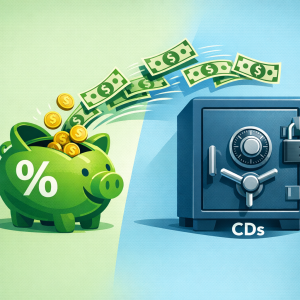
- Certificates of deposit (CDs): Lock in a fixed rate for a set term. Good for cash you will not touch, but you pay a penalty for early withdrawal.
- Money market accounts: Similar to high-yield savings, sometimes with check-writing features, often with higher minimums.
If you want to guarantee today’s rate before rates potentially fall, a CD can make sense. If you value flexibility, stick with a high-yield savings account.
How to Actually Switch in Ten Minutes
People leave money on the table not because they disagree that a better rate helps, but because switching feels like a hassle. It is not. Opening a high-yield savings account is one of the fastest financial upgrades you can make, and it usually takes about ten minutes from start to finish:
- Compare a few reputable online banks and pick one paying over 4% with no fees or minimums.
- Open the account online, which typically requires your ID, Social Security number, and a few minutes.
- Link your existing checking account using the routing and account numbers.
- Transfer your emergency fund and other short-term cash, then set up an automatic recurring transfer.
You do not even need to close your old account. Many people keep their existing checking account for daily spending and simply move their savings to the higher-yield account, transferring money back when needed. The whole process is reversible and low-risk, which is exactly why there is so little reason to put it off.
Where a High-Yield Account Fits
These accounts shine for money you need to keep safe and liquid — your emergency fund, a house down payment, or cash you are parking between goals. They are not a replacement for long-term investing, since rates can fall and stocks historically outpace cash over decades, but they are the right home for short-term money.
- Keep your emergency fund here so it grows while staying accessible.
- Park sinking-fund money for known upcoming expenses, such as insurance or property taxes.
- Hold cash you plan to invest soon without taking market risk in the meantime.
The Mistakes to Avoid
Even with a good account, a few errors can cost you. Do not chase a microscopically higher rate every month — the difference between 4.2% and 4.3% is trivial compared to the gain from leaving 0.61% behind. Do not keep so much in cash that inflation erodes the money you should be investing for the long term. And do not assume your rate is locked; these rates are variable, so glance at it once or twice a year to make sure it is still competitive.
Keep the Bigger Picture in View
As valuable as a high-yield account is, it is important to keep it in perspective. Cash savings are for safety and short-term goals, not long-term wealth building. Over decades, money that sits in even a great savings account will not keep pace with what a diversified investment portfolio can produce, and inflation slowly erodes its purchasing power. So use a high-yield account for what it does best — protecting your emergency fund and short-term cash while earning a competitive return — but do not let large sums sit there that should be invested for the long haul.
A common mistake is to feel so good about earning 4% on cash that you forget stocks have historically returned far more over long periods. The right move is to optimize your cash and invest the rest, getting the best of both worlds: a safe, productive home for money you might need soon, and a growth engine for the money you will not touch for years.
The Bottom Line
With top accounts still paying over 4%, there is no good reason to let cash languish at 0.61%. Compare a few high-yield savings accounts, confirm they are FDIC-insured and fee-free, and move your idle money this week. It is the rare financial win that takes minutes, costs nothing, and pays you back every month for as long as the cash sits there.
Image Credit: Pexels