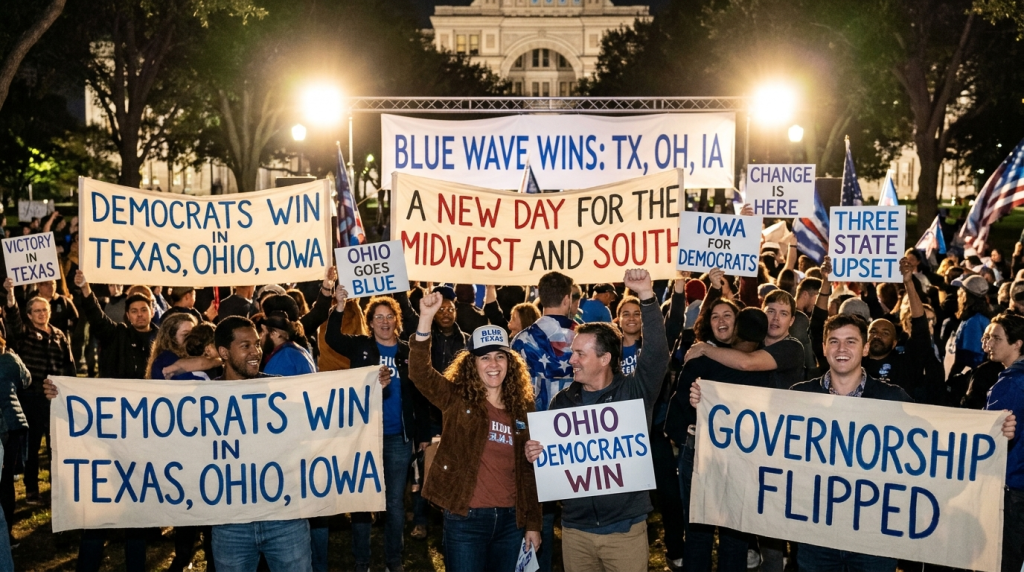
Democrats captured the governor’s offices in Texas, Ohio and Iowa, delivering a three-state upset despite nine-figure campaign spending. The victories gave the party control of major state executive offices and ended Iowa’s two-decade drought.
The results carry weight far outside the governors’ mansions. Texas and Ohio are large, politically influential states, while Iowa has long served as a test of rural and working-class support. Together, the wins suggest that voters were willing to reconsider established party loyalties.
Table of Contents
ToggleTexas and Ohio Change Hands
Flipping Texas was the largest prize for Democrats. The state’s size gives its governor influence over major debates on education, energy, immigration, and health policy.
A Democratic win there also challenges assumptions about statewide races in a state long associated with Republican control. The result may prompt both parties to reassess which voters they can persuade and where to spend campaign money.
Ohio offers a different warning for Republicans. Its mix of cities, suburbs, industrial communities, and rural counties has made it a useful measure of national political shifts. A Democratic gubernatorial victory indicates that state-level candidates can still build coalitions that differ from those seen in federal elections.
For Democrats, the two flips offer a practical lesson: state races can move independently from national party trends. Voters may judge candidates on local costs, schools, public services and executive performance rather than on Washington politics alone.
Iowa Ends a Two-Decade Drought
The Iowa victory marked the party’s first gubernatorial win there since 2006. That gap makes the result more than a routine change in office.
Iowa presents Democrats with a chance to test whether their gains can last in communities where the party has struggled. Governing may prove harder than campaigning, especially if the legislature remains divided or under opposition control.
The new administration will need to turn electoral support into policy results. Early decisions on budgets, appointments and public services could determine whether the win represents a lasting shift or a single-cycle protest.
Big Spending Did Not Settle the Races
The contests drew nine-figure spending, yet money alone did not preserve the previous balance of power. That outcome will fuel debate over how campaigns use television advertising, field operations and digital outreach.
The results point to several possible factors:
- Voter concern about state and household costs may have outweighed party habits.
- Candidate quality may have mattered more than national labels.
- Heavy advertising may have reached a point of diminishing returns.
- Turnout among occasional voters may have changed the electorate.
Spending still matters because it helps candidates reach voters and organize supporters. Yet these races show that a large budget is not a political receipt marked “paid in full.” Money can amplify a message, but it cannot guarantee that voters will accept it.
Both Parties Face New Strategic Questions
Democrats will view the victories as evidence that their electoral map can expand. Their harder task is keeping those voters engaged while meeting expectations in three states with distinct political cultures.
Republicans, meanwhile, must determine whether the losses came from candidate weaknesses, policy concerns, or broader voter frustration. A rushed national explanation could miss the local forces that shaped each result.
The next signals will come from governing approval, legislative cooperation, and future turnout. If Democrats retain support after taking office, the victories could alter campaign investment across the country. If that support fades, Republicans may treat the results as temporary setbacks.
For now, the clearest conclusion is simple. Texas and Ohio changed hands, Iowa ended a drought dating to 2006, and extraordinary spending failed to prevent voter movement. The elections reminded both parties that political maps are drawn in ink only until voters find an eraser.
Image Credit: Pexels