Recently, the entrepreneurial psyche has been plagued by a single, shivering question: “Will an algorithm take my job? ”
And for good reason. All of us have seen the demos. With just one prompt, AI agents can code apps or create hyper-realistic videos in seconds. So, it’s easy to assume the “human” element is going away when you see how fast change is happening.
As someone who has spent a decade building companies through Web 2.0 and the mobile revolution, I’ve seen this movie before. When a machine takes a slice of our work, we assume there will be less to go around.
Table of Contents
ToggleThe Cycle of Disruption
There’s a historical pattern to this panic. Whether it’s the printing press or the internet, every foundational shift follows the same route:
- Fear. Losing the “old way” and being uncertain make us anxious.
- Resistance. We label new technologies as threats to our identity.
- Integration. Ultimately, we realize the tool replaces the process, not the person.
Here’s the reality, though. AI will not replace entrepreneurs, creatives, or leaders. Vision cannot be automated.
However, it will completely change the way you work.
The “how” of your daily existence is rewritten in real-time. Rather than losing your job, you’re forced to trade your “builder” hat for an “architect” hat. In the future, those who can orchestrate it the best will win, not those who outwork algorithms.
The End of the “Admin Tax”
In the long run, the most significant change isn’t in high-level strategy, but in the death of the “Admin Tax.” Picture an average Tuesday. When it comes to professional work, how much of your time is spent on “deep work” versus the logistics?
We spend countless hours summarizing meeting notes, writing introduction emails, formatting spreadsheets, and tracking down data points. Essentially, AI makes these tasks cost-free. This is the “work about work.”
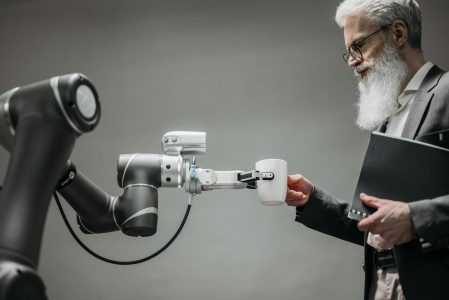
Having an AI turn a 30-minute messy brainstorm into project planning, a series of Slack updates, and a list of action items does not mean you’ve been replaced. Your burden has been lifted. Today’s entrepreneurs aren’t the ones who can do it all; they’re the ones who can direct it all. Rather than being the “doers,” we’re becoming “conductors.”
From Linear Production to Iterative Curation
In the old world, a project’s barrier to entry was the first draft. No matter the project, the zero-to-one phase was always the most time-consuming and expensive.
But AI has written a new script. “First drafts” are now essentially free and instantaneous. Yet the “one-to-ten” phase — the refinement, the voice of the brand, the alignment of strategy, and human empathy—is more valuable than ever.
An entrepreneur’s value used to be based on their ability to produce. Today, curating is what makes you valuable.
Suppose a machine gives you five different versions of a go-to-market strategy, it isn’t going to know which is the best for the long-term success of your company. It does not understand the nuances of your specific relationship with a partner. You are the filter. Now it’s about finding the signal rather than creating noise.
The Rise of the “Company of One” (with an Army of Agents)
In the past, scaling a business meant expanding its staff. We’re now entering the era of the “Solopreneur-plus.” Before, you needed an employee for every task. Today, startups can achieve seven-figure revenues without a full-time staff, instead relying on specialized AI agents.
Entrepreneurship’s fundamental math changes as a result. As a result, experimentation is less risky. Do you want to test a new product line in a foreign market? There’s no need to hire a localization team and a research firm. In a weekend, you can use AI tools to analyze sentiment, translate assets, and run A/B tests on your messaging.
Ultimately, scaling isn’t about management hierarchy anymore; it’s about architectural efficiency. You’re not just building a team, you’re building a system.
The Premium on Human Soft Skills
In an era of commoditization, “soft” skills have become the currency of the future.
If anyone can generate a high-quality pitch deck or a functional program using AI, then technical quality isn’t a competitive advantage. It’s just a baseline.
But what can’t be commoditized?
- Empathy. Understanding a customer’s pain point emotionally.
- Negotiation. Finding a middle ground is a high-stakes human dance.
- Vision. An ability to predict a future not yet conceived — AI, by definition, predicts from the past.
- Trust. The ultimate moat in an era of deepfakes and AI-generated noise is a human brand that people actually trust.
These pillars will shape the way we work. In turn, your “work day” will be less about screens and more about high-value human interaction.
The “Hardware” of Your Brain: Avoiding the AI Trap
There is, however, a caveat regarding AI use. If AI does all of your thinking, you’re not just saving time; you’re eroding your competitive edge. Even though AI can act as a powerful co-processor, it also has a “gravity” toward mediocrity.
The paradox of the average.
AI does not scale brilliance; it scales the mean. According to research from Stanford University, large language models produce a variety of responses that cluster around normative patterns, even when you ask for novelty. As these models are trained primarily on human data, the status quo is their default setting.
In a study published in Science, AI was found to boost immediate productivity but also lead to a convergence of thinking. While it speeds up a group, it also refines their thinking. It reduces the variance in thinking — and in the world of startups, variance is where the value lives.
Basically, AI expands your access to information but narrows your range of insight.
Combatting “cognitive atrophy.”
It’s not just the output that poses a threat; it’s the user as well. The MIT Media Lab warns that excessive reliance on AI-driven solutions contributes to cognitive decline. By outsourcing the “why” and the “how,” your critical thinking muscles begin to weaken.
If you want to succeed in an AI-dominated market, you must treat your brain as the primary hardware and the AI as a peripheral. Without care, your unique vision may be lost in a tool that aims to increase your intelligence.
In other words, the goal of AI is not to work faster — it’s to use the time it saves you to think more deeply than ever before.
Adapting to the New Pace
Lastly, speed plays a key role in the “how.” In other words, we’ve compressed the “OODA loop” (Observe, Orient, Decide, Act). Before the AI era, a quarterly pivot was considered quick. Today, the market moves as fast as an API call.
To survive, you have to replace “perfect planning” with continuous iteration. Your process must become modular. Because a new model has made that process obsolete, you need to be willing to scrap an old process that worked three months ago.
Conclusion: The New Founder’s Manifesto
Unlike AI, entrepreneurship is fundamentally an act of will. The decision to solve a problem and take a risk is a human one. There is no “will” in a machine. It has no stake in the outcome. Whether the business succeeds or fails doesn’t matter to it.
The problem is that if you continue to work like it’s 2019, relying on manual labor for routine tasks, valuing production over curation, and ignoring AI’s systemic leverage, you will be replaced by entrepreneurs who have embraced the new “how.”
It’s not about beating the machine. It’s all about knowing exactly what the machine should be doing.
Image Credit: Pavel Danilyuk; Pexels