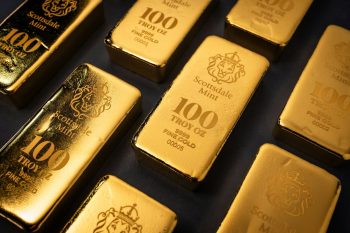
Gold has breached $3,500 per ounce for the first time in history, capping a rally that’s added more than 45% to the precious metal’s value since early 2024. For investors who dismissed gold as a relic, this surge is a wake-up call. For those who’ve held it, it’s vindication. But the real question isn’t where gold has been — it’s what this historic price tells us about where markets and the economy are heading.
What’s Driving the Gold Rally
Gold’s breakout above $3,500 isn’t driven by a single catalyst — it’s the convergence of multiple forces that historically push investors toward safe-haven assets:
Central bank buying at record levels. The World Gold Council reports that central banks purchased over 1,100 tonnes of gold in 2025, the third consecutive year above 1,000 tonnes. China, India, Poland, and Turkey have been the largest buyers, diversifying away from U.S. dollar reserves amid geopolitical uncertainty. This institutional demand has created a price floor that private investors alone wouldn’t produce.
Geopolitical risk premium. Tensions in the Middle East, ongoing trade friction between the U.S. and China, and escalating tariff policies have injected sustained uncertainty into global markets. Gold has historically performed best during periods of elevated geopolitical risk — not because it produces income, but because it maintains value when trust in paper currencies and government debt wavers.
Inflation persistence. Despite the Federal Reserve’s efforts, core inflation has remained stubbornly above the 2% target, hovering around 3.2% as of Q1 2026. Gold’s reputation as an inflation hedge has drawn investors seeking assets that preserve purchasing power as the dollar buys less.
Dollar weakness. The U.S. Dollar Index has declined roughly 8% from its 2023 highs. Since gold is priced in dollars, a weaker dollar mechanically pushes gold prices higher. But the relationship goes deeper: dollar weakness often reflects diminished confidence in U.S. fiscal and monetary policy, which amplifies gold’s appeal as an alternative store of value.
What History Says About Gold at Record Highs
Gold has hit record highs before — in 1980 ($850) and 2011 ($1,920) — and both times the metal subsequently corrected sharply. This history makes some investors nervous about buying at current levels.
However, the context is different this time. In 1980, Paul Volcker’s aggressive rate hikes crushed inflation and made interest-bearing assets more attractive than gold. In 2011, the Eurozone debt crisis resolved more favorably than feared, reducing safe-haven demand. The current rally is supported by structural forces — central bank diversification, fiscal expansion, and geopolitical fragmentation — that don’t have obvious near-term resolutions.
Goldman Sachs has raised its 12-month gold target to $3,700. Bank of America is forecasting $3,800 by early 2027. While price targets should always be taken with caution, the directional consensus among major banks is unusually unified.
What This Means for Your Portfolio
Whether you should buy gold at $3,500 depends entirely on your current allocation and investment timeline:
If you own no gold: Most financial planners recommend a 5% to 10% allocation to gold or precious metals as a portfolio diversifier. At $3,500, you’re not getting a bargain — but if your portfolio has zero exposure to hard assets, you’re effectively betting that all of the forces driving gold higher will reverse simultaneously. A modest allocation provides insurance you’ll appreciate during the next market crisis.
If you already own gold: Resist the temptation to pile in more at record prices. Portfolio discipline means rebalancing — if gold has grown to represent more than 10% to 15% of your portfolio, trimming back to your target allocation locks in gains and reduces concentration risk.
If you’re near retirement: Gold’s role in a retirement portfolio is primarily defensive. It tends to rise when stocks fall, providing stability when you need it most. If your retirement plan doesn’t include any inflation-protected assets, you may be more vulnerable than you realize to inflation eroding your purchasing power over a 25-year retirement.
How to Own Gold in 2026
The most accessible and cost-effective way to own gold is through exchange-traded funds. The SPDR Gold Shares ETF (GLD) and iShares Gold Trust (IAU) track the price of physical gold with expense ratios of 0.40% and 0.25%, respectively. These funds are held in standard brokerage and retirement accounts with no storage concerns.
Physical gold — coins and bars — appeals to investors who want tangible assets outside the financial system. The premium over spot price for popular coins like the American Gold Eagle typically runs 3% to 5%, and storage (either at home or in a secure vault) adds additional cost and complexity.
Gold mining stocks offer leveraged exposure to gold prices — they tend to rise faster than gold in bull markets and fall faster in bear markets. The VanEck Gold Miners ETF (GDX) provides diversified exposure to mining companies. However, mining stocks carry business-specific risks (labor costs, regulatory issues, operational problems) that physical gold does not.
For investors building a diversified portfolio in today’s uncertain market, combining gold with Treasuries, dividend stocks, and cash creates a multi-layered defense against the range of economic scenarios we could face.
The Bigger Signal
Gold at $3,500 isn’t just a commodity story. It’s a signal about confidence — or the lack of it. When investors worldwide pour money into an asset that produces no income, no earnings, and no innovation, they’re expressing doubt about the alternatives: currencies, bonds, and the institutions that back them.
That doubt may prove temporary, or it may be the early stages of a longer shift. Either way, precious metals are telling us something important about where the smart money thinks we’re heading.
The Bottom Line
Gold’s record-setting rally reflects real, structural forces that are likely to persist. Whether you view it as an essential portfolio component or an overpriced pet rock depends on your assessment of inflation, geopolitical risk, and central bank behavior. But ignoring gold’s message — that uncertainty is rising, and confidence in traditional assets is wavering — would be a mistake for any serious investor.