Today’s financial landscape feels like a paradox. We have access to more AI-powered tracking apps than ever before, yet a persistent “affordability crisis” has turned everyday staples, like your morning coffee, electricity, and rent, into major sources of anxiety. If you feel like you’re falling behind, you aren’t alone.
According to a Capital One CreditWise survey, finances are the top stressor (73%), followed by politics (59%), work (49%), and family (46%). This burden is felt most acutely by younger generations; Gen Z respondents reported a financial anxiety level of 3.6 out of 5, outpacing both Millennials (3.3) and Gen Xers (3.4).
But the truth is, financial stress is rarely related to your income. It’s related to a lack of control. What’s more, oftentimes anxiety comes from worrying about the unknown, from that nagging “what if.” And that’s where budgets come into the picture.
Rather than being a cage that restricts you, a budget is a roadmap that helps you turn paralyzing guesswork into confidence. However, if you’ve tried hyper-detailed spreadsheets and zero-based budgeting but have given up on the battle, it’s time to shift from complexity to clarity. By using the 50/30/20 Rule, you can breathe again, allowing you to stop managing your money so that it no longer controls you.
Table of Contents
ToggleWhy a Budget is the Ultimate Stress-Reliever
Uncertainty fuels financial stress. Without a plan, every swipe of your card feels like a gamble. By following a simple budget based on percentages, though, you can reduce stress in three specific ways:
- Eliminates decision fatigue. There’s no more wondering if you can afford dinner out. Obviously, if you have money in your “wants” bucket, you can do it.
- Builds a safety buffer. When you have an emergency fund, you’re more likely to be able to deal with life’s surprises without feeling panicked.
- Aligns spending with values. Often, stress comes from wasting money on things you don’t even like. By setting a budget, you force yourself to prioritize what you find enjoyable.
What is the 50/30/20 Rule?
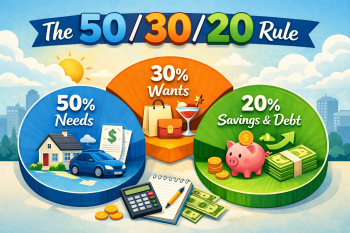
As described in Elizabeth Warren’s book All Your Worth, this rule breaks down after-tax income into three clear buckets based on what actually hits your bank account. With subscription fatigue and lifestyle creep on the rise, these percentages are vital safeguards.
Bucket 1: 50% for your “needs.”
Even in the worst-case scenario, these costs are non-negotiable.
- Housing. The cost of rent/mortgage, property taxes, and insurance.
- Utilities. The necessities of modern life include electricity, water, gas, and high-speed internet.
- Groceries. Basic household and food supplies.
- Transportation. Payments for car insurance, fuel, and transit passes.
- Minimum debt payments. You must meet the absolute minimums to maintain a good credit score.
The reality check. It’s okay if your needs go over 50%. After all, rent alone can eat up 40% of a salary in high-cost cities. You can use this rule as a diagnostic tool when you hit 60% or 70%. This means you might have to temporarily cut back on your wants while you try to make more money or lower your fixed expenses.
Bucket 2: 30% for your “wants.”
Budgets usually die here, but 50/30/20 keeps them alive. But remember, we’re not robots. As such, if you ban all “fun” spending, we’ll rebel and blow the budget.
- Dining & delivery. You should choose meals that make you happy socially.
- Entertainment. A few examples are streaming services, concerts, and hobbies.
- Travel. Spending money on vacations or weekend getaways.
- Lifestyle. New clothes, gym memberships, or boutique fitness.
The “subscription audit” hack. It’s estimated that 5–10% of households “leak” money from forgotten digital memberships. By auditing these quarterly, you can increase your “wants” for things you actually need.
Bucket 3: 20% for savings and debt.
This is your “future you” bucket. When the labor market is volatile, these 20% are your most powerful tools.
- Emergency fund. Aiming for 3 to 6 months of “needs.”
- Retirement. The contributions you make to your IRA or 401(k).
- Aggressive debt paydown. A payment that exceeds the minimum, such as paying off a credit card balance.
- Wealth building. Incorporating index funds or exchange-traded funds into your investment portfolio.
How to Start (Your 3-Step Action Plan)
Step 1: Calculate your net income.
Review your bank deposits over the past three months. For gig workers or people with fluctuating income, average the last three months. You will use this number as your “base number.”
Step 2: Categorize your last 30 days.
Look at the data, don’t guess. Set up your bank app to categorize every transaction as need, want, or save.
- If needs > 50%. Look for “fixed cost” winners. Is it possible to switch insurance providers or negotiate your internet bill?
- If wants > 30%. You may be making impulse purchases. If so, for non-essentials, try waiting three days before clicking “buy.”
Step 3: Automate the peace of mind.
We live in a world where willpower is a finite resource. However, you can automate 20% of your paycheck to go into a high-yield savings account or brokerage account before you see it. As the saying goes: “Don’t save what is left after spending; spend what is left after saving.”
Conclusion: Take Back Your Time and Temperament
At its core, financial stress is fueled by the anxiety of the unknown. Without a plan, every daily purchase triggers a high-stakes internal debate: Can I afford this? Will I have enough for rent? Why is my balance so low? This constant mental “noise” drains your energy and fuels burnout, which is so common in today’s economy.
Using the 50/30/20 rule, you can silence that noise. By simplifying your life into three clear buckets, you move from a reactive state, where money happens to you, to a proactive one, where you build your own future. Financial success doesn’t require an accounting degree; it simply requires the discipline to curate where your dollars go.
Remember, a budget is not a rigid cage, but a living document. In some months, the “Needs” will be pushed to 60%, and the “Wants” slashed to save for a bigger dream. That’s not a failure, that’s life. Instead of thinking of the 50/30/20 rule as a shackle, think of it as a lighthouse. As long as you keep those three buckets in sight, you’ll be able to weather any economic storm with confidence.
For more tools to strengthen your finances, assess your financial health score, improve your financial literacy, and explore Cutting Costs 101 for practical savings strategies.
FAQs
Does my 401(k) contribution count toward the 20% savings bucket?
Technically, yes. However, many experts recommend calculating your 50/30/20 budget based on your take-home pay. In this case, your 20% should be put toward additional goals such as an emergency fund or Roth IRA. For a “true” total of your earnings, add back 401(k) contributions to your net income first.
What if my “needs” exceed 50% due to housing costs?
You aren’t alone. When needs reach 60% or 70%, shrink the “wants” bucket first. To protect your future, it’s essential to maintain the 20% savings bucket, even if it means reducing discretionary expenditures now.
Where do minimum credit card payments go?
A minimum payment is a necessity, as failure to make it damages your credit and results in fees. An extra payment made to crush the balance faster falls into the 20 percent “savings and debt” category.
How do I use this rule with irregular income?
To create a buffer for lean months, use your lowest-earning month from the past year as your baseline for “needs.” In months where you earn more, put the extra money immediately into your 20% bucket.
Is 50/30/20 better than Zero-Based Budgeting?
The answer depends on your personality. While zero-based budgeting (assigning every dollar to a specific task) is precise, it can be exhausting. Beginners or those who want to maintain a sustainable, “big picture” lifestyle without tracking every small transaction will find the 50/30/20 rule to be more helpful.
Image Credit: Albert Costill/ChatGPT