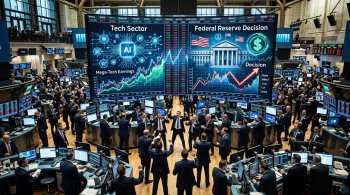
A major test for stocks is approaching as large technology companies report earnings and the Federal Reserve announces its interest-rate decision on the same day. I expect investors to focus on two issues: artificial intelligence spending and the Fed’s response to stubborn inflation. Either event could move markets sharply, but an unexpected outcome in both could cause extreme volatility.
Table of Contents
ToggleTwo Major Market Events Collide
Corporate earnings and Federal Reserve meetings often move markets on their own. Holding both events on one day raises the stakes.
Technology companies carry substantial weight in major stock indexes. Their results can affect index funds, retirement accounts, and investor sentiment. At the same time, the Fed influences borrowing costs throughout the economy.
This makes the coming session feel like the stock market’s Super Bowl. Traders will react to reported numbers, executive comments, inflation concerns, and the Fed’s view of future policy.
As CEO of LifeGoal Wealth Advisors, a Certified Investment Management Analyst, and a Certified Financial Planner, I watch these events for their wider effects. My firm manages more than $500 million, and we don’t aim to predict every price move. It is to identify what the market expects and where surprises may arise.
The central points are straightforward:
- Technology investors will closely examine planned capital spending.
- AI investment will remain a key subject during earnings calls.
- The Fed is likely to leave its policy rate unchanged.
- Officials may use firm language because recent inflation data have weakened the case for quick rate cuts.
- Any major deviation from these expectations could trigger sharp market swings.
View this post on Instagram
Why AI Spending Matters So Much
For large technology companies, earnings are no longer only about sales and profits. Investors also want to know how much each company plans to spend on AI infrastructure.
This spending falls under capital expenditures, often shortened to CapEx. It can include data centers, computer chips, servers, networking equipment, and energy systems. These investments can support future growth, but they require large cash outlays today.
The market faces a difficult balance. Investors want companies to compete in AI, yet they also want evidence that spending will produce revenue and profit.
If a company raises its CapEx forecast, shareholders may worry about lower free cash flow or weaker near-term margins. They may also ask whether management is spending faster than customer demand justifies.
If a company cuts the forecast, a different concern appears. Investors could view the reduction as a warning that the AI expansion is slowing. That could hurt chipmakers, cloud providers, equipment suppliers, and other businesses tied to the buildout.
“If they cut spending, the entire AI buildout comes under fire, which is basically the entire market.”
That statement reflects how deeply the AI investment theme has shaped stock prices. It does not mean every company depends on AI. It means many leading stocks, and many of their connected suppliers, are priced for continued investment.
The Narrow Path for Technology Companies
My preferred outcome would be steady spending guidance. Keeping the CapEx forecast near the prior quarter’s level may reduce the chance of a negative interpretation.
Stable guidance would suggest that executives remain committed to AI without suddenly increasing the financial burden. It could also signal that existing plans are proceeding as expected.
Recent market reactions show why this matters. Meta announced an increase in projected spending and its shares faced heavy selling. The reaction offered a clear lesson: investors may support AI investment, but they are sensitive to its cost.
A steady forecast would not guarantee a positive response. Investors will still study revenue growth, profit margins, customer demand, and management’s outlook. Yet unchanged guidance could remove one major source of concern.
Several questions deserve attention during earnings reports:
- Is AI-related revenue growing fast enough to support current investment?
- Are higher costs reducing profit margins?
- Will spending rise again later in the year?
- How long will new data centers take to generate returns?
- Are supply limits affecting construction or chip purchases?
Executive language may matter as much as the formal forecast. A company can leave its stated budget unchanged while warning that future needs may rise. Investors should listen for changes in confidence, timing, and expected returns.
Why One Spending Forecast Can Affect Many Stocks
The largest technology companies sit at the center of a broad economic chain. Their investment decisions affect semiconductor firms, data-center operators, electrical equipment makers, utilities, and construction businesses.
A higher forecast may help suppliers while hurting the company making the investment. A lower forecast may protect that company’s cash flow but weaken expectations for the businesses selling it equipment.
This helps explain why the market can react mixed. A report that looks positive for one stock may create problems elsewhere.
Index concentration adds another concern. A small group of large technology companies can drive a large share of daily index performance. Their earnings may therefore move broad market funds even if most listed companies post modest changes.
Investors should avoid treating an index move as a full picture of the economy. A sharp gain or decline may reflect reactions to only a few very large companies.
A Hawkish Hold From the Federal Reserve
The second major event is the Federal Reserve’s policy decision. I expect officials to keep interest rates unchanged while speaking firmly about inflation.
This outcome is often called a hawkish hold. The “hold” means no immediate rate increase or decrease. “Hawkish” means the Fed remains concerned about inflation and is not ready to promise easier policy.
Recent inflation readings have made the Fed’s task harder. If inflation is moving in the wrong direction, officials have less reason to cut rates soon. However, another rate increase could place added pressure on consumers, businesses, and financial markets.
The likely middle course is to leave rates alone and stress that future decisions depend on incoming data. The Fed may also repeat that it needs greater confidence that inflation is returning to its target.
“They won’t hike, but they’ll talk tough.”
That distinction matters. Markets do not respond only to the current policy rate. They also respond to what investors believe the Fed will do over the next several meetings.
A single phrase from the Fed chair can change expectations for rate cuts. Those changes can quickly affect Treasury yields, mortgage rates, stock valuations, and the U.S. dollar.
The Bond Market Has Eased Some Pressure
The bond market also shapes the Fed’s choices. When Treasury yields rise, borrowing costs often increase across the economy. That can slow demand without another official rate hike.
When yields fall, financial conditions may loosen. Mortgages, corporate debt, and other forms of credit can become less restrictive. This can support economic activity, but it may also make inflation harder to control.
Recent declines in market interest rates have given the Fed some room to wait rather than raise its policy rate. In my description, the bond market acts like the Fed’s bully because it can tighten or loosen financial conditions before policymakers act.
Still, lower bond yields do not guarantee a gentle Fed message. Officials may respond with firmer language if they believe investors have become too confident about rate cuts.
Where the Biggest Surprises Could Appear
Markets often move based on the gap between expectations and reality. A result can appear strong but still disappoint if investors expected more.
For technology earnings, a surprise could include a large CapEx increase, a meaningful reduction, weak AI revenue, or an unexpected warning about future demand.
For the Fed, a surprise could include serious discussion of another rate hike, a softer inflation outlook, or a clearer timetable for rate cuts.
If either side departs from the expected script, volatility may rise. If both do so at once, price changes could be unusually large.
That does not mean long-term investors should make sudden portfolio changes. One trading session can be dramatic without altering a sound financial plan.
How Investors Can Prepare
Preparation should focus on risk, not prediction. Investors may review whether their portfolios rely too heavily on a small number of technology stocks or a single market theme.
They should also know why they own each investment. A long-term holding should not become a short-term trade simply because one earnings report creates volatility.
Useful steps include checking diversification, avoiding oversized speculative positions, and keeping enough cash for near-term needs. Investors using borrowed money should be especially careful because rapid price moves can magnify losses.
The order of events also matters. Initial market reactions may reverse as analysts review earnings calls and the Fed chair answers questions. Trading on the first headline can mean acting before the full message is clear.
I expect steady AI spending guidance and a hawkish Fed hold. That is a forecast, not a certainty. A more useful approach is to understand what markets have already priced in and identify results that could challenge those assumptions.
The coming session brings together two forces that have driven markets: confidence in AI investment and interest-rate expectations. Stable technology spending and a firm Fed message may fit the market’s current assumptions. Any major surprise could create the “fireworks” many traders expect. Long-term investors should stay informed, remain disciplined, and judge new information against their financial goals.
Frequently Asked Questions
Q: What does CapEx mean for a technology company?
CapEx refers to money spent on long-term assets. For technology companies, this may include data centers, AI chips, servers, networks, and power equipment.
Q: What is a hawkish hold by the Federal Reserve?
A hawkish hold means the Fed keeps its policy rate unchanged but warns that inflation remains a concern. Its message may suggest that rate cuts are not close.
Q: Should investors trade around earnings and Fed announcements?
Short-term trading around major announcements carries added risk. Many investors are better served by reviewing diversification, limiting concentrated positions, and following a long-term plan.