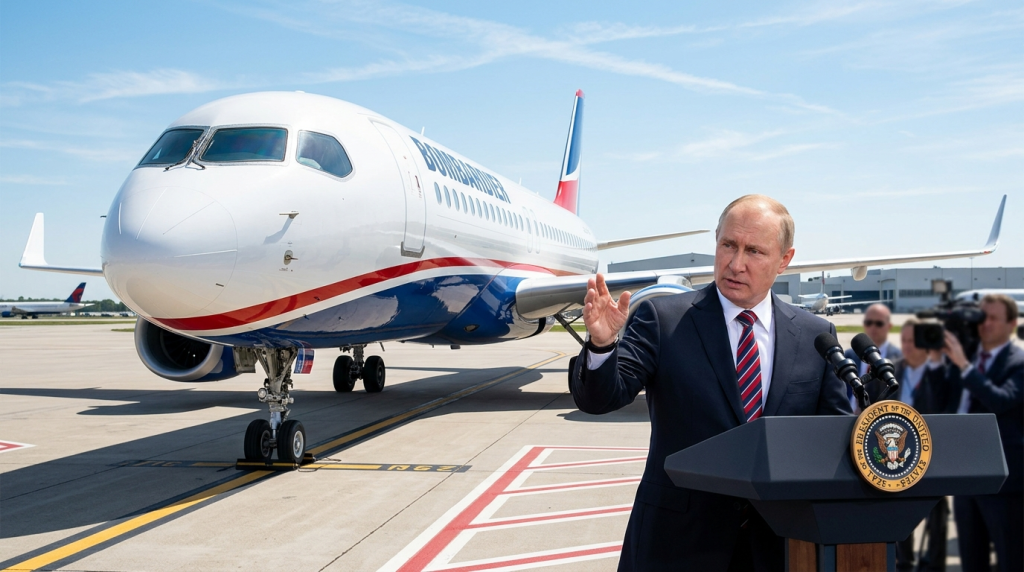
U.S. President Donald Trump has threatened to block sales of Bombardier aircraft unless the Canadian company manufactures planes in the United States. The warning puts fresh pressure on a major cross-border supply chain already tied to American factories and workers.
Bombardier responded that many parts for its private jets are produced in the United States, including their wings. The company also pointed to its wider U.S. supply chain, challenging the idea that its aircraft are solely Canadian products.
Table of Contents
ToggleA Dispute Over Where Planes Are Made
Trump’s demand centers on final manufacturing rather than parts production. That distinction matters because aircraft production is spread across many plants, suppliers and countries.
Bombardier is based in Canada and is best known for business jets. Its planes contain equipment and structures supplied by American companies. Yet the available statement does not clarify what level of U.S. manufacturing would satisfy the president.
The threat also leaves several key policy questions unanswered:
- Which Bombardier aircraft could face sales restrictions?
- Would the policy cover new orders, deliveries or both?
- What legal authority would support a ban?
- Would U.S.-made parts qualify a plane as domestically manufactured?
Those details would determine whether the warning becomes a limited trade measure or a major obstacle for Bombardier and its customers.
American Suppliers Could Feel the Impact
Bombardier’s response highlights a practical problem for any import restriction. A ban on completed aircraft could also reduce orders for the American companies that make their parts.
Aircraft makers rely on long production schedules and specialized suppliers. Moving final assembly can require new facilities, trained workers, regulatory approvals and costly changes to logistics.
That process cannot happen overnight. Business jets must also meet strict safety and certification rules, making factory changes more involved than shifting production of ordinary consumer goods.
Bombardier’s reference to U.S.-built wings gives the company a clear economic argument. Although the aircraft may be assembled outside the country, part of their value already comes from American labor and production.
Trade Pressure Meets Aviation Reality
The warning fits Trump’s long-running use of tariffs and market access as tools to press foreign companies into expanding U.S. production. Supporters of that approach argue that access to American buyers should produce more American factory jobs.
Critics may counter that aviation supply chains do not fit neatly within national borders. Restrictions aimed at a foreign manufacturer can reach domestic suppliers, maintenance companies, brokers and flight operators.
Potential buyers also face uncertainty. Private aircraft purchases involve large deposits, customized interiors and delivery plans set months or years in advance. Even the prospect of a ban could complicate contracts and purchasing decisions.
Canada could view a formal restriction as a trade dispute rather than a routine industrial policy. Any government response would depend on the design of the measure and the trade rules used to justify it.
What Comes Next
The immediate issue is whether the White House turns Trump’s threat into a defined policy. A formal proposal would need to explain its scope, timing and treatment of aircraft containing substantial U.S.-made content.
Bombardier, meanwhile, has signaled that it will frame itself as a customer of American industry, not simply a foreign competitor. That case may gain weight if U.S. suppliers disclose how many jobs and contracts depend on its aircraft programs.
For now, the dispute exposes the awkward math of modern manufacturing. A plane may carry one company’s badge and one country’s identity, while its economic footprint spans a continent. Any sales ban could pressure Bombardier, but it may also test how much economic turbulence Washington is willing to send through its own aviation sector.