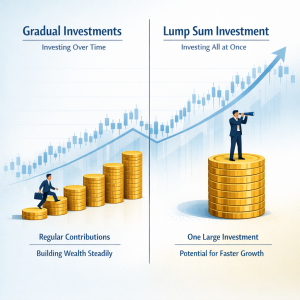
You’ve just received a $50,000 bonus, an inheritance, or the proceeds from selling a property. Now comes the question every investor faces: should you invest it all at once, or spread it out over weeks or months? The answer depends on what you’re optimizing for — maximum returns or maximum peace of mind.
According to a landmark study by Vanguard Research, lump sum investing has outperformed dollar-cost averaging approximately 68% of the time across U.S., U.K., and Australian markets over rolling 12-month periods. That’s a meaningful edge, but it also means DCA wins about a third of the time — often when it matters most.
Table of Contents
ToggleWhat Is Dollar-Cost Averaging?
Dollar-cost averaging (DCA) is the practice of investing a fixed amount of money at regular intervals, regardless of market conditions. Instead of buying $50,000 worth of stocks today, you might invest $5,000 per month over 10 months.
The primary advantage is that you buy more shares when prices are low and fewer when prices are high, which can reduce your average cost per share over time. It also removes the emotional burden of trying to time the market — something even professional fund managers struggle with.
What Is Lump Sum Investing?
Lump sum investing means deploying your entire available capital into the market immediately. The logic is straightforward: since markets tend to rise over time, having your money invested earlier gives it more time to compound.
Historical data supports this. The S&P 500 has delivered an average annual return of approximately 10.3% since 1926. Every day your money sits on the sidelines waiting to be invested is a day of potential compounding you miss.
What the Data Actually Shows
Vanguard’s research analyzed 1,021 rolling 12-month periods across three markets from 1926 to 2015. The results were consistent: lump sum investing produced higher terminal wealth roughly two-thirds of the time.
On average, lump sum investing outperformed DCA by about 2.3% over 12-month periods. Over longer horizons, the gap can widen because the lump sum amount has more time compounding in the market.
However, during volatile or declining markets, DCA has shown clear advantages. During the 2008 financial crisis, an investor who dollar-cost averaged over 12 months starting in October 2007 would have achieved a significantly lower average cost basis than someone who invested everything at the October peak.
The Behavioral Advantage of DCA
Numbers don’t tell the whole story. Research from Morningstar’s behavioral finance team suggests that the best investment strategy is one you can actually stick with. If investing $100,000 all at once causes anxiety that leads to panic selling during the next 10% correction, lump sum investing could actually hurt you.
Dollar-cost averaging reduces regret risk — the emotional pain of investing everything right before a market drop. According to behavioral economists, the pain of a loss is roughly twice as powerful as the pleasure of an equivalent gain. DCA smooths that emotional journey.
For investors who are prone to emotional decision-making, DCA provides a structured framework that keeps them invested through volatility rather than sitting on the sidelines waiting for the “perfect” entry point that never comes.
When DCA Makes More Sense
Dollar-cost averaging is particularly well suited to several situations. If you’re investing from regular income rather than a windfall, you’re already dollar-cost averaging through your 401(k) or automatic investment plan. If current valuations feel elevated — with the S&P 500 trading at a cyclically adjusted price-to-earnings ratio above 33 — spreading purchases over 6-12 months can provide a margin of safety.
DCA also works well for investors entering volatile asset classes like emerging market stocks or individual sectors where short-term swings can be dramatic. And for retirees or near-retirees who can’t afford a major drawdown, the risk reduction DCA provides may outweigh the potential return sacrifice.
When Lump Sum Wins
If you have a long time horizon (15+ years), strong risk tolerance, and won’t be tempted to sell during downturns, lump sum investing gives you the statistical edge. The longer your investment horizon, the less any single entry point matters.
A lump sum is also more efficient from a transaction-cost perspective. Fewer trades mean lower fees and less complexity. For tax-advantaged accounts like IRAs where annual contribution limits apply, getting money in early each year maximizes the time it compounds tax-free.
A Middle Ground: Value Averaging
Value averaging is a lesser-known strategy that splits the difference. Instead of investing a fixed dollar amount each period (DCA), you adjust your contributions to hit a target portfolio value each month. When the market drops, you invest more. When it rises, you invest less or even sell a small amount.
Academic research suggests value averaging has historically produced slightly better returns than traditional DCA while maintaining much of the behavioral and risk-reduction benefits. It requires more active management but can be a smart compromise for disciplined investors.
The Bottom Line
If you’re purely rational and have a long horizon, lump sum investing wins. If you’re human — and you almost certainly are — DCA can be the better choice because it keeps you invested and reduces the chance of a costly emotional mistake. The worst outcome isn’t choosing DCA over lump sum or vice versa. It’s letting a large sum sit in cash indefinitely because you’re waiting for the “right time” to invest.
Pick a strategy, commit to it, and remember that being invested matters far more than precisely when you invest. Both strategies crush the alternative of staying on the sidelines.