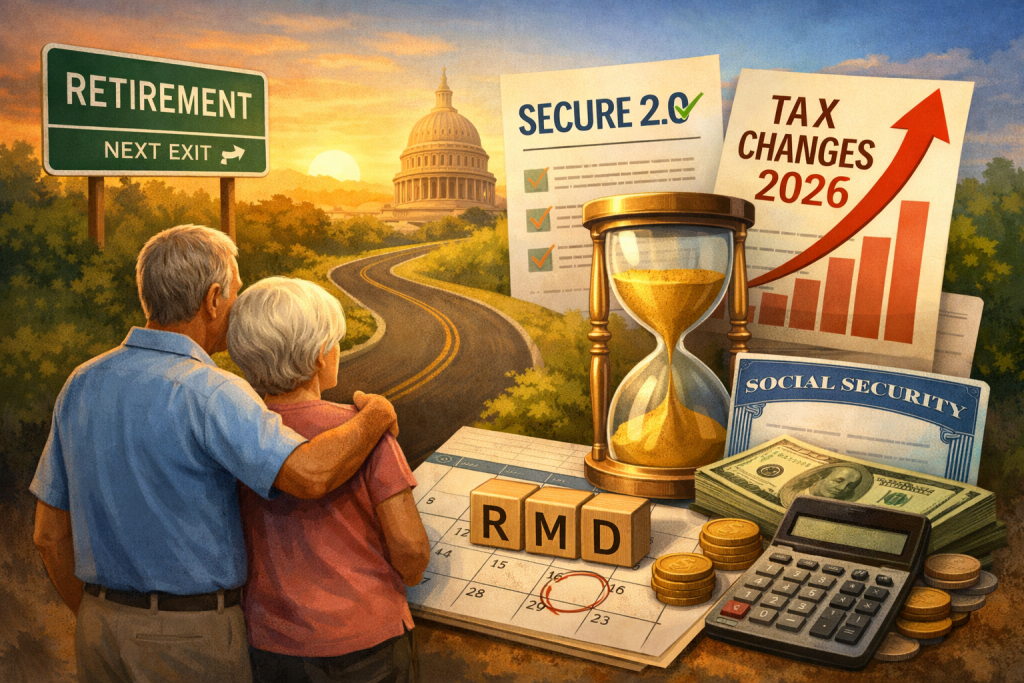
Required Minimum Distributions (RMDs) have long been a source of stress in retirement planning. For decades, retirees were forced to begin withdrawing from their retirement accounts at age 70½, often without needing the cash.
Fortunately, the tide has turned on the legislative front. With SECURE 2.0 now in place and the recently announced 2026 tax changes, retirees are entering a period of “breathing room.” In your 70s and beyond, you are experiencing a fundamental shift in wealth management. It’s not just a delay; it’s a fundamental shift.
Here’s how the 2026 updates work to your advantage.
Table of Contents
Toggle1. The RMD Age Hike: More Time for Your Money to Grow
Among SECURE 2.0’s most significant features is the extension of the “Required Beginning Date,” which makes tax-deferred accounts more flexible.
- Born from 1951 to 1959. Your RMD age is now 73. After you turn 73 in 2026, you have until April 1, 2027, to claim your first distribution.
- Born in 1960 or later. Effective January 1, 2033, your RMD age will increase to 75.
Many retirees can now leave their principal untouched until 2026. In a “bonus” year, a modest 5% return on a $500,000 account adds $25,000 to your nest egg — wealth that stays in the market rather than being taxed.
2. Penalty Relief: The IRS “Oops” Clause
Previously, missing an RMD was one of the most costly retirement mistakes. This burden has been permanently slashed under SECURE 2.0:
- Standard penalty. The penalty has been reduced to 25% of the amount not withdrawn.
- The 10% correction rate. If the mistake is caught within the “correction window,” generally within two years of the error, the penalty drops to 10%. You must file IRS Form 5329 and withdraw the missed amount to qualify.
- Total waiver (0%). If the error was due to “reasonable cause” and corrected promptly, the IRS can waive the penalty entirely.
For self-directed investors, this changes the RMD from a high-stakes trap to a manageable administrative task.
3. 2026 Tax Adjustments: Sheltering Your Income
As SECURE 2.0 handles the timing of withdrawals, the IRS handles the impact through its 2026 tax adjustments. Because RMDs are taxed as ordinary income, they can easily push you into a higher tax bracket. To prevent you from being caught in the ‘bracket creep’ of 2026, the IRS is raising thresholds by a significant amount:
- Standard deduction. The tax has been raised to $32,200 (Married Filing Jointly) and $16,100 (Single).
- Wider brackets. If you pay 10% or 12% RMDs, more of your money can go into these tiers instead of spilling over into higher tiers.
- Senior bonus. For 2026, taxpayers age 65 and older may qualify for an additional deduction of up to $6,000 to further shield their income.
4. Enhanced QCDs: Giving Your RMD a Mission
You can use a Qualified Charitable Distribution (QCD) if you do not need to use your RMD for living expenses. The RMD can be satisfied by sending funds directly from your IRA to a charity, making your tax return unnecessary.
- 2026 limit. Individuals are now eligible for a $111,000 annual exclusion.
- The AGI advantage. Due to its exclusion from your Adjusted Gross Income (AGI), a QCD can save you from IRMAA surcharges on Medicare premiums as well as reduce your taxable Social Security benefits.
5. Exemption for Employer Roth Accounts
From 2024 onward, Roth 401(k)s and 403(b)s are no longer subject to required minimum distributions. As a result, these funds will now grow tax-free for the remainder of your life, as opposed to being taxed when you withdraw them. In addition, this change eliminates the need to roll over Roth 401(k)s into Roth IRAs to avoid RMDs.
Although Roth accounts are exempt for the original owner, beneficiaries may still be required to make RMDs.
6. New Options for Long-Term Care
From 2026 onwards, you can distribute no more than 10% of your vested retirement balance or $2,500 a year for qualified long-term care insurance premiums. Savings can now be withdrawn directly from the account without the 10% early withdrawal penalty, providing a new way to fund future healthcare expenses.
Planning for the “Two-RMD” Year Trap
Although you can delay your first RMD until April 1 of the year after you turn 73, doing so can be a trap. When you take your regular 2026 RMD by December 31, you must still take your 2025 RMD by April 2026. If you take two RMDs in the same year, your income can spike, placing you in a higher tax bracket. By taking your first RMD by December 31 of the year you turn 73, you will have most of the breathing room you need.
The Bottom Line
A successful retirement in 2026 is less about following rigid IRS mandates and more about strategically timing the event. With higher catch-up limits for those still working, up to $11,250 for ages 60–63, and more flexible rules for retirees, you can manage your tax bill more effectively.
FAQs
I turn 73 in 2026. When exactly is my first RMD due?
Since you turn 73 in 2026, 2026 is your first “required” year. Your first RMD is, however, eligible for a one-time extension until April 1, 2027. Don’t forget that if you wait until 2027, you will need to take your second RMD by December 31, 2027, which could significantly increase your tax bill.
Are Roth 401(k)s still subject to RMDs in 2026?
No. In SECURE 2.0, “designated Roth accounts” (like Roth 401(k)s and Roth 403(b)s) are no longer subject to RMDs during the lifetime of the original owner. This change, which began in 2024, remains in full effect for 2026, finally bringing employer Roth plans in line with Roth IRAs.
What happens if I am still working at age 73?
If you own less than 5% of your current employer’s stock, you are usually able to delay RMDs from a 401(k) or 403(b) until you retire. 401(k)s, and traditional IRAs from prior employers are not included in the “still-working exception.”
Can I still make a Qualified Charitable Distribution (QCD) if I don’t have to take an RMD yet?
Yes. Many people are confused about this. Although the RMD age has moved to 73, the QCD eligibility age remains 7012. When you reach 7012, you can start using your IRA to fund your charitable giving tax-free, even if you are not required to take a distribution.
How much can I give via QCD in 2026?
As a result of inflation, the QCD limit has been adjusted to $111,000 per person for the 2026 tax year. For married couples filing jointly, both spouses can contribute up to $222,000 directly to qualified charities, potentially wiping out a significant tax bill.
Image Credit: Albert Costill/ChatGPT