
Imagine receiving an email that quietly takes $600,000 a year away from your income. No warning is given. There was no negotiation. Because that money wasn’t really yours in the first place, there’s no recourse.
In particular, I received $50,000 every single month, like clockwork, from a single affiliate.
But let’s backtrack.
During that time, I felt untouchable. My firm had already been sold, and I had decided to go all-in on the “Wealth Hacker” lifestyle. Having achieved millionaire status in my 30s, I attribute my success to affiliate marketing. The model was perfect for me: no inventory, no customer service, just pure profit.
But then, the trapdoor opened. One day, that juicy monthly income was simply… gone.
If you build your future by promoting other people’s products, you are not building an empire. As such, the purpose of this post is to show you the “hidden danger” of affiliate marketing and why building your own digital product is the only way to build wealth that lasts.
The Illusion of Affiliate Stability
As an online entrepreneur, affiliate marketing seems like a dream come true. You don’t have to worry about product development, overhead, or shipping. All you have to do is create content, drop a link, and watch the commissions roll in. It’s the ultimate “low friction” business.
Nevertheless, great rewards come with systemic risks. By exclusively using affiliate marketing to build your business, you are renting land. You don’t own the product, you don’t own the customer list, and you don’t own the rules. In other words, you’re a middleman. And in the world of big business, middlemen are eventually cut out.
To show you how fragile this lifestyle can be, let me share three horror stories from my own journey and the industry at large.
Horror Story #1: The Scott Trade Disappearance
I was still learning the ropes when I started Good Financial Cents (Sense). As one of my first major partners, I worked with a company called Scott Trade. As a user, I loved their platform and recorded dozens of YouTube tutorials to show people how to open a Roth IRA.
After investing resources into these tutorials, they eventually brought in $10,000 a month. Then came the news that Scott Trade had been acquired by TD Ameritrade. When a competitor buys out a company, what happens to its affiliate program? It vanishes.
Overnight, my library became a graveyard for broken links. Due to a corporate board in a different state taking control, my $10,000 recurring revenue was wiped out.
Horror Story #2: The $50,000 Lending Club Meltdown
Let’s fast forward a few years. During the heyday of peer-to-peer lending, I partnered with Lending Club. By investing my own money, seeing a 15% return, and sharing that success with my audience, I did it right. Because of this, Lending Club became my top affiliate for several years, bringing in over $50,000 a month.
Then I got the aforementioned email. As part of their business model pivot, they shuttered their affiliate program. Suddenly, an annual income of half a million dollars evaporated. Because I didn’t own the “bank” or the “product,” I was powerless. That one hurt…a lot. I wouldn’t wish anyone to experience such a degree of financial whiplash.
Horror Story #3: The “Shady” Association Risk
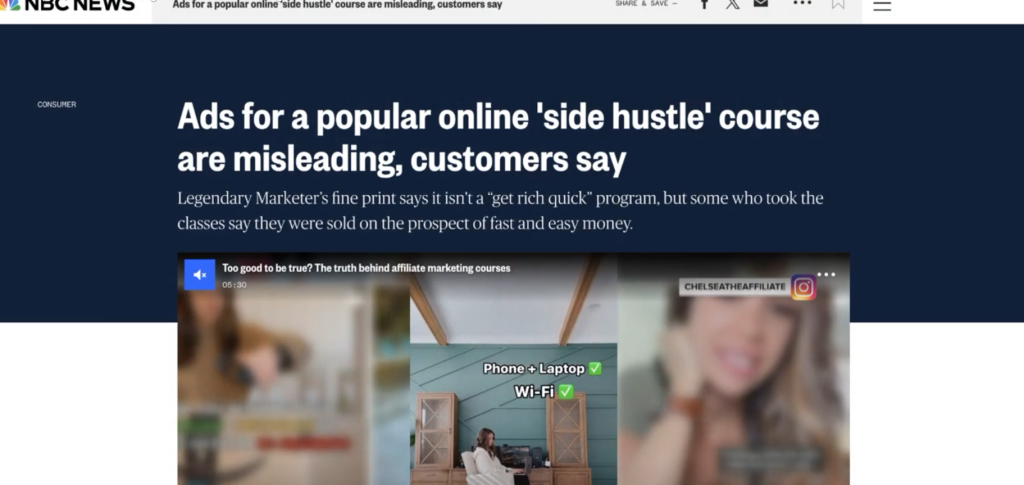
Many people don’t consider this danger until it’s too late. When you heavily promote a company, your brand becomes synonymous with theirs. Take a look at the headlines involving several high-ticket marketing platforms, such as Legendary Marketer. Whenever major publications like NBC investigated companies for “shady” income claims, affiliates promoting them were caught in the crossfire. As a result, your “Street Cred” was no longer trusted by an audience once the company deletes posts to avoid legal repercussions.
The Solution: Owning the Product
When given the choice between being a middleman and being the source, you always choose the source. With a digital product, like a course, e-book, membership, or template, you can affix your brand and expertise to something you have control over.
The feedback loop.
Trust is one of the most powerful aspects of ownership. The first time I launched my courses, I thought they were perfect. However, my customers soon began asking questions. They wanted more detailed guides. Since I owned the product, I could update the modules and add value immediately. Unlike affiliate links, that feedback loop builds rapport and authority.
The one downside — that’s actually an upside.
I’ll be honest: creating a digital product takes time and effort. It’s harder than dropping a link. To make it work, you need to develop the promotional strategy, create the curriculum or tool, and test it out. I was terrified when I built my first course. I was able to pull it off through grit and mentorship. In addition to the money, I realized I had created something people truly valued, which was the most rewarding experience of my career.
Taking the First Step Toward Ownership
Feeling overwhelmed? You’re exactly where my wife and I were a decade ago. When you transition from a middleman to a creator, you need to change how you view your expertise. Instead of seeing yourself as a traffic driver for other brands, you need to see yourself as a primary solution provider.
As an example, let’s take a look at three real-world examples of how you can package what you already know into an asset that you own.
The Financial “Blueprint” (Service to Product)
Financial creators usually settle for breadcrumbs. When someone clicks their link to sign up for a budgeting app, they may earn $2. Owners can, however, sell a $47 digital workbook that teaches their unique budgeting philosophy. You keep 100% of profits, own the customer list, and can still recommend the app inside the workbook as an additional source of income. Instead of being the whole meal, that affiliate check is the cherry on top.
The Tech “Quick-Start” Guide (Tutorial to Product)
Most entrepreneurs spend months creating tutorials for complex platforms in the hopes of earning a tiny monthly commission. Owners package their knowledge into a $97 “Master Template & Workflow Library.” People are happy to pay for the shortcut, and unlike affiliate links, you control the relationship and the email address.
The Hobbyist “Skills Lab” (Passion to Product)
There is an even greater shift in the hobby space. Rather than linking to $100 running shoes for a 3% Amazon commission, an owner will launch a $37 “6-Week Marathon Base-Builder” video series. Now you’re selling the roadmap, not the gear. After years of trial-and-error, you’ve created a solution that helps your customers save time and money.
The Bottom Line
Whenever you sell a result, you’re shifting from selling a tool owned by someone else. In exchange for the security of an empire builder, you trade the precarious life of a tenant. Don’t build on rented land; invest in a wealth machine that belongs to you instead.
FAQs
Do I have to stop affiliate marketing to launch my own product?
Absolutely not. Consider your own product as the foundation and affiliates as the decorative trim. Using affiliates to complement your offers is a good idea, but don’t make them the only pillar of your business.
What if I don’t consider myself an “expert”?
The definition of an “expert” is simply someone who is two steps ahead of the person they are helping. If you’ve solved a problem for yourself or achieved a goal, you have the expertise to help someone else.
How much does it cost to launch in 2026?
Compared to the past, the cost is lower than ever. For under $100, you can get a high-quality product to market with AI assistance and no-code platforms. The most important investment you can make is your time.
How do I handle customer service?
90% of this can be automated. You can resolve most issues before they reach you with a solid FAQ page and an automated onboarding email. To handle the rest, you can hire a part-time virtual assistant or use an AI support agent.
What is the “sweet spot” price for a first product?
Stay within the “impulse buy” range ($27-$97). When you have a lower barrier to entry, it’s much easier to get your first 20 clients, which provides you with the social proof and feedback you need to eventually build a premium product that costs $497 or more.
Image Credit: AlphaTradeZone; Pexels